
Lethe, or Aesop in the Shades
Furnishing Fabric
ca. 1766 (designed)
ca. 1766 (designed)
| Artist/Maker | |
| Place of origin |
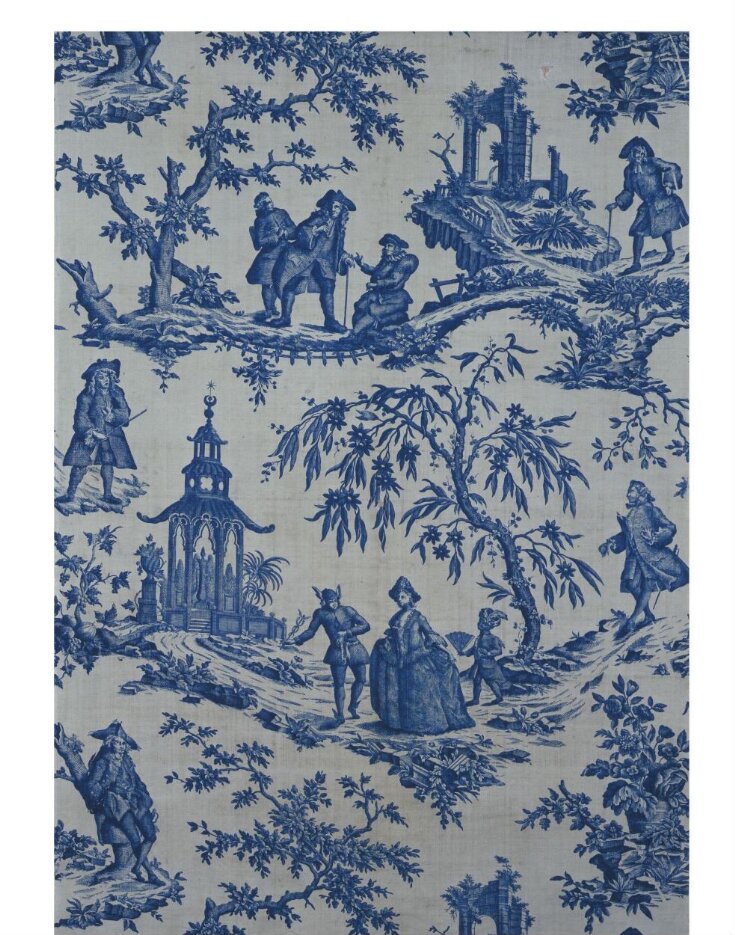
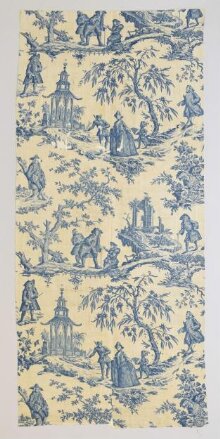
This furnishing fabric is decorated with scenes from David Garrick's play Lethe, first performed at Drury Lane Theatre, London, in 1740. The figures here are taken from prints by Gabriel Smith and A. Moseley from 1750, and the textile was probably designed at about the time of the command performance of 1766.
The lady in this scene is accompanied by a young black page-boy. Images such as this were very common in paintings and prints of the period, though they were slightly more unusual on textiles. Many black boy servants were employed, particularly by women, in white households in 18th-century western Europe. But, when they became adults, they were sometimes turned out of their homes and forced to join the ranks of the urban poor. In the 18th century, images of black people were associated with exoticism and luxury, in sharp contrast to the harsh realities of racism that characterised the experience of many black people in Europe.
The lady in this scene is accompanied by a young black page-boy. Images such as this were very common in paintings and prints of the period, though they were slightly more unusual on textiles. Many black boy servants were employed, particularly by women, in white households in 18th-century western Europe. But, when they became adults, they were sometimes turned out of their homes and forced to join the ranks of the urban poor. In the 18th century, images of black people were associated with exoticism and luxury, in sharp contrast to the harsh realities of racism that characterised the experience of many black people in Europe.
Object details
| Categories | |
| Object type | |
| Parts | This object consists of 3 parts.
|
| Title | Lethe, or Aesop in the Shades |
| Materials and techniques | Linen and cotton, plate-printed in china blue |
| Brief description | Textile with scenes from Lethe, a play by David Garrick, plate-printed cotton, Britain, ca. 1770. |
| Gallery label | Scenes from 'Lethe'
Linen and cotton, plate-printed in blue. Decorated with scenes from Garrick's play 'Lethe', including Kitty Clive as the 'Fair Lady' and Henry Woodward as the 'Fine Gentleman'. The play was first produced at Drury Lane in 1740. Porcelain figures of Kitty Clive and Henry Woodward in this play were made at Bow about 1750. It is probable that the textile was made to commemorate the Command Performance of 23 January 1766.(1992) |
| Credit line | Given by Arthur du Cane |
| Object history | This textile was probably designed about the time of the command performance of 'Lethe' 1766. 'Lethe: or, Esop in the shades'' a comedy, was David Garrick's first play, produced at Drury Lane in April 1740. |
| Historical context | Included in the V&A's 1976 exhibition '1776 : a Londoner's View', a display of domestic decorative arts. |
| Production | . |
| Association | |
| Summary | This furnishing fabric is decorated with scenes from David Garrick's play Lethe, first performed at Drury Lane Theatre, London, in 1740. The figures here are taken from prints by Gabriel Smith and A. Moseley from 1750, and the textile was probably designed at about the time of the command performance of 1766. The lady in this scene is accompanied by a young black page-boy. Images such as this were very common in paintings and prints of the period, though they were slightly more unusual on textiles. Many black boy servants were employed, particularly by women, in white households in 18th-century western Europe. But, when they became adults, they were sometimes turned out of their homes and forced to join the ranks of the urban poor. In the 18th century, images of black people were associated with exoticism and luxury, in sharp contrast to the harsh realities of racism that characterised the experience of many black people in Europe. |
| Bibliographic reference | King, D, ed. British textile design in the Victoria and Albert Museum. Tokyo, 1980. vol.II, p. 165 |
| Collection | |
| Accession number | T.75 to B-1914 |
About this object record
Explore the Collections contains over a million catalogue records, and over half a million images. It is a working database that includes information compiled over the life of the museum. Some of our records may contain offensive and discriminatory language, or reflect outdated ideas, practice and analysis. We are committed to addressing these issues, and to review and update our records accordingly.
You can write to us to suggest improvements to the record.
Suggest feedback
You can write to us to suggest improvements to the record.
Suggest feedback
| Record created | December 15, 1999 |
| Record URL |
Download as: JSONIIIF Manifest
