Ceremonial Cloth
late 19th century (made)
| Artist/Maker | |
| Place of origin |
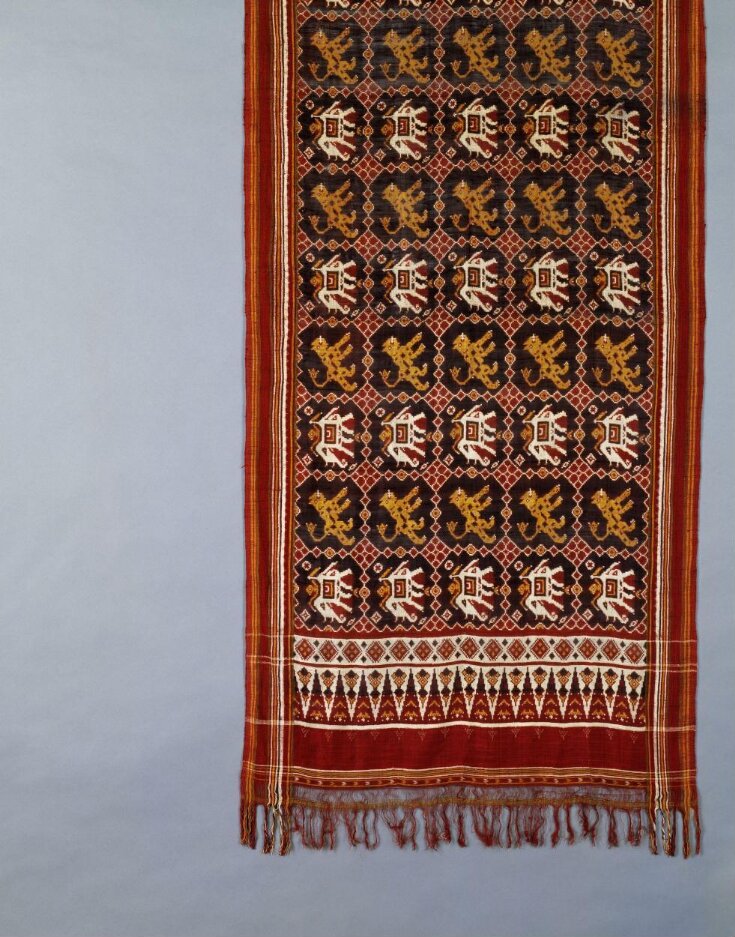
This ceremonial cloth with an elephant-and-tiger design was woven in India for the Indonesian market. Known as a ‘patolu’ (pl. ‘patola’), this type of woven silk was a speciality of Gujarati weavers and involved a highly sophisticated technique. They had to tie and dye the warp and weft threads in patterns and then weave them together to create a pattern on both sides of the cloth.
In Indonesia ‘patola’ were intended for use by the elite. They were worn by members of the nobility, and at times subject to court sumptuary laws prohibiting their use by commoners.
In Indonesia ‘patola’ were intended for use by the elite. They were worn by members of the nobility, and at times subject to court sumptuary laws prohibiting their use by commoners.
Object details
| Categories | |
| Object type | |
| Materials and techniques | Resist-dyed double ikat silk, cotton |
| Brief description | Ceremonial cloth (patola) of resist-dyed double ikat silk with striped cotton borders, Gujarat, late 19th century |
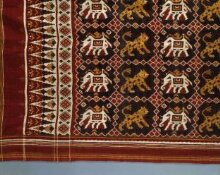
| Physical description | Ceremonial cloth (patola) of resist-dyed double ikat silk with striped cotton borders. With a repeating design of rows alternating with tigers and elephants within a grid. The ends have a row of diamond shapes, and another with triangular tumpals. Loose and open weave. |
| Dimensions |
|
| Gallery label | CEREMONIAL CLOTH
Silk, resist-dyed in the warp and weft (double ikat)
Gujarat, for the Indonesian market
1850-1900
IS.5-1989
These cloths (patola) were, and still are, highly prized in India because of the time-consuming and precise technique of double ikat in which they are made.
Patola with designs of tigers and elephants were made mainly for export to South-East Asia, especially Indonesia. There they were used as hangings and canopies in rituals and ceremonies, and were preserved as precious heirlooms.(27/9/2013) |
| Production | Made for the Indonesian market. |
| Subjects depicted | |
| Summary | This ceremonial cloth with an elephant-and-tiger design was woven in India for the Indonesian market. Known as a ‘patolu’ (pl. ‘patola’), this type of woven silk was a speciality of Gujarati weavers and involved a highly sophisticated technique. They had to tie and dye the warp and weft threads in patterns and then weave them together to create a pattern on both sides of the cloth. In Indonesia ‘patola’ were intended for use by the elite. They were worn by members of the nobility, and at times subject to court sumptuary laws prohibiting their use by commoners. |
| Bibliographic references |
|
| Collection | |
| Accession number | IS.5-1989 |
About this object record
Explore the Collections contains over a million catalogue records, and over half a million images. It is a working database that includes information compiled over the life of the museum. Some of our records may contain offensive and discriminatory language, or reflect outdated ideas, practice and analysis. We are committed to addressing these issues, and to review and update our records accordingly.
You can write to us to suggest improvements to the record.
Suggest feedback
You can write to us to suggest improvements to the record.
Suggest feedback
| Record created | December 15, 1999 |
| Record URL |
Download as: JSONIIIF Manifest
