Figure
1904 (made), 1898 (designed)
| Artist/Maker | |
| Place of origin |
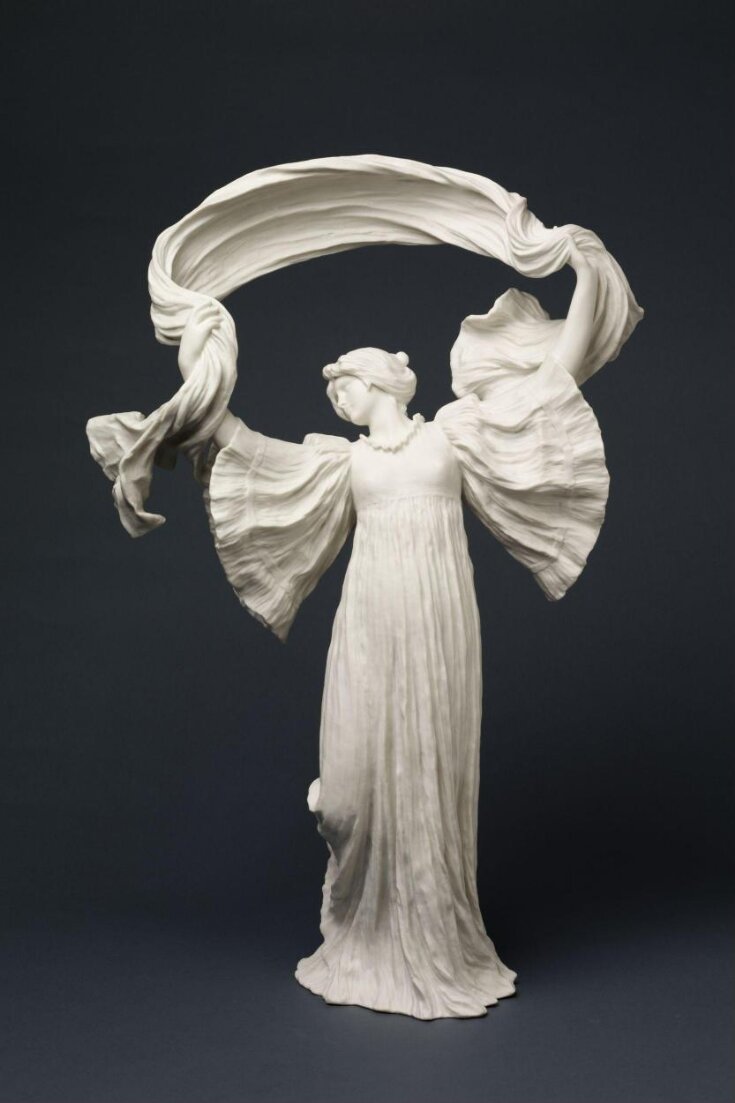
This figure conveys, in ceramic form, the movement and energy of dance and typifies the spirit of Art Nouveau style. It originally formed part of a group of 15, entitled 'Jeu de l'Echarpe' ('Scarf Dance'), and was inspired by the sensational dance performed by the American Loïe Fuller, a regular fixture at the Folies Bergère, Paris. The form of the free-flowing, silk-clad dancer was employed as early as 1893 in an iconic lithograph by the French artist Henri Toulouse-Lautrec, and the elegant theatricality of this Sèvres figure group further established the motif in turn-of-the-century Parisian art.
The group was designed by Agathon Léonard in 1898 and displayed at the Universal Exhibition in Paris in 1900, where Sèvres won a prize. The success of the figures, described in the exhibition report as 'a graceful and charming ensemble which were a great and deserved success', followed the adoption of a consciously progressive art policy at the factory, part of a national move towards the regeneration and celebration of French craft skills and design. The figures were produced by Sèvres in many editions and were also copied in bronze and porcelain by other factories.
Biscuit porcelain, of which this figure is made, was a material developed and pioneered by Sèvres in the mid-eighteenth century. It continued in popularity throughout the nineteenth century, as it was well suited to the popular classical forms of that period. Although porous and easily stained, biscuit porcelain was much used for table decoration during the eighteenth and early nineteenth centuries, particularly at dessert.
The group was designed by Agathon Léonard in 1898 and displayed at the Universal Exhibition in Paris in 1900, where Sèvres won a prize. The success of the figures, described in the exhibition report as 'a graceful and charming ensemble which were a great and deserved success', followed the adoption of a consciously progressive art policy at the factory, part of a national move towards the regeneration and celebration of French craft skills and design. The figures were produced by Sèvres in many editions and were also copied in bronze and porcelain by other factories.
Biscuit porcelain, of which this figure is made, was a material developed and pioneered by Sèvres in the mid-eighteenth century. It continued in popularity throughout the nineteenth century, as it was well suited to the popular classical forms of that period. Although porous and easily stained, biscuit porcelain was much used for table decoration during the eighteenth and early nineteenth centuries, particularly at dessert.
Object details
| Category | |
| Object type | |
| Materials and techniques | Biscuit porcelain |
| Brief description | Figure from a table setting, biscuit porcelain |
| Physical description | Biscuit porcelain female figure, head turned to one side, and one leg bent backwards, wearing wide-sleeved floor-length dress and holding a scarf aloft with both hands. |
| Dimensions |
|
| Style | |
| Marks and inscriptions | 'S' and '1904' in triangle, 'No 12 under base, '4' and back-to-front 'R' at base. (all incised) |
| Gallery label | FIGURES FROM
A TABLE SETTING
Sèvres Porcelain Factory
Manufacturer
Agathon Léonard
(born 1841)
Modeller
Paris (Sèvres): 1900
Biscuit Porcelain
C.89 & E-G, I, K, M-1971
Agathon Léonard, born Léonard Agathon van Weydeveldt of Belgian parents, trained as a sculptor, but also specialised in ceramic modelling. The full group, entitled 'Jeu de I'Echarpe', consists of fifteen figures. It was first shown in the Paris 1900 Exhibition at which Sèvres won a Grand Prix, and was described in the exhibition report as "elegant figures in a graceful and charming ensemble which were a great and deserved success". They were produced by Sèvres in many editions and were also copied in bronze and porcelain by other factories. They were probably inspired by the dancing of the American, Loïe Fuller. |
| Subjects depicted | |
| Summary | This figure conveys, in ceramic form, the movement and energy of dance and typifies the spirit of Art Nouveau style. It originally formed part of a group of 15, entitled 'Jeu de l'Echarpe' ('Scarf Dance'), and was inspired by the sensational dance performed by the American Loïe Fuller, a regular fixture at the Folies Bergère, Paris. The form of the free-flowing, silk-clad dancer was employed as early as 1893 in an iconic lithograph by the French artist Henri Toulouse-Lautrec, and the elegant theatricality of this Sèvres figure group further established the motif in turn-of-the-century Parisian art. The group was designed by Agathon Léonard in 1898 and displayed at the Universal Exhibition in Paris in 1900, where Sèvres won a prize. The success of the figures, described in the exhibition report as 'a graceful and charming ensemble which were a great and deserved success', followed the adoption of a consciously progressive art policy at the factory, part of a national move towards the regeneration and celebration of French craft skills and design. The figures were produced by Sèvres in many editions and were also copied in bronze and porcelain by other factories. Biscuit porcelain, of which this figure is made, was a material developed and pioneered by Sèvres in the mid-eighteenth century. It continued in popularity throughout the nineteenth century, as it was well suited to the popular classical forms of that period. Although porous and easily stained, biscuit porcelain was much used for table decoration during the eighteenth and early nineteenth centuries, particularly at dessert. |
| Bibliographic references |
|
| Collection | |
| Accession number | C.89A-1971 |
About this object record
Explore the Collections contains over a million catalogue records, and over half a million images. It is a working database that includes information compiled over the life of the museum. Some of our records may contain offensive and discriminatory language, or reflect outdated ideas, practice and analysis. We are committed to addressing these issues, and to review and update our records accordingly.
You can write to us to suggest improvements to the record.
Suggest feedback
You can write to us to suggest improvements to the record.
Suggest feedback
| Record created | October 20, 2008 |
| Record URL |
Download as: JSONIIIF Manifest
