
Costume Design
1625 (made)
| Artist/Maker | |
| Place of origin |
This is one of a group of 69 costume designs for the court ballets of Louis XIII, now in the V&A Theatre Collections. The designs, which date from 1615-1635, are from the workshop of Daniel Rabel (1578-1637), the artist responsible for creating costumes for the spectacular entertainments performed by and for the French court. The ballets were based on the social dances of the day, but this was social dance elevated to an elaborate art form which combined choreography with poetry, music, song and pageantry, and included elements of satire and burlesque. The ballets were enormously popular. Most were given at least three performances and all required a great amount of work from their creators and performers: the Ballet de Tancrède of 1619, which used elaborate stage machinery, is known to have had 30 rehearsals. Some professional dancers, actors and singers took part but the majority of the participants were members of the nobility. Many of these aristocratic amateurs were skilled performers, including the King, who adored dancing and devised some of the ballets himself.
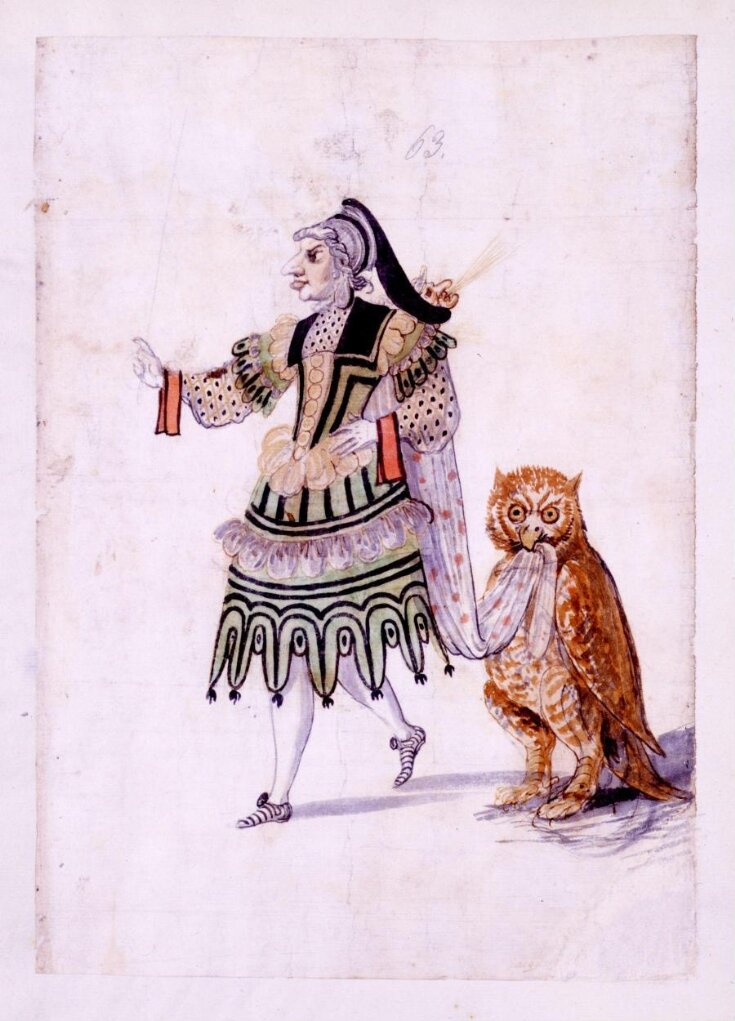
The Ballet des Fées de la Forest de Saint Germain (the Ballet of the Saint German Forest Fairies), also called the Ballet des Ridicles, was first performed on 9 February 1625. The King was happy to spend enormous sums of money on his entertainments and this ballet was one of the most expensive, the costumes costing more that 16,380 livres. Its creator, René Bordier, devised a simple plot in which to set the dances. Five fairies from the Forest of Saint Germain visit Paris to admire the beauty of the Queen and her ladies. Each fairy has an outlandish entourage (peasants, musicians, dancers, gamblers or madmen) whose dances burlesque different branches of learning. Jacqueline l'Entendue, 'the knowing one', is depicted in a parody of classic dress and accompanied by an owl, the symbol of wisdom. This, however, is ironic as Jacqueline is the fairy of the distracted mind. She presides over a band of fairies driven out of their wits by love, a group of doctors riding on mules and a collection of followers whose names, such as Cantankerous Alison and Macette the Caperer, reveal their character traits.
The Ballet des Fées de la Forest de Saint Germain (the Ballet of the Saint German Forest Fairies), also called the Ballet des Ridicles, was first performed on 9 February 1625. The King was happy to spend enormous sums of money on his entertainments and this ballet was one of the most expensive, the costumes costing more that 16,380 livres. Its creator, René Bordier, devised a simple plot in which to set the dances. Five fairies from the Forest of Saint Germain visit Paris to admire the beauty of the Queen and her ladies. Each fairy has an outlandish entourage (peasants, musicians, dancers, gamblers or madmen) whose dances burlesque different branches of learning. Jacqueline l'Entendue, 'the knowing one', is depicted in a parody of classic dress and accompanied by an owl, the symbol of wisdom. This, however, is ironic as Jacqueline is the fairy of the distracted mind. She presides over a band of fairies driven out of their wits by love, a group of doctors riding on mules and a collection of followers whose names, such as Cantankerous Alison and Macette the Caperer, reveal their character traits.
Object details
| Categories | |
| Object type | |
| Materials and techniques | Watercolour and pencil on paper |
| Brief description | Costume design for Jacqueline, the knowing one, in the Ballet des Fées de la Forest de Saint Germain, performed by the Ballet de Cour of Louis XIII, 1625 |
| Physical description | Costume design for Jacqueline, the knowing one. A caricatured female figure in an elaborately scalloped turquoise skirted tunic decorated with bands of black, over a full-sleeved white shirt patterned with a trellis of beige lines and black spots. She wears a silver classical helmet with a long black crest, to the end of which is a grotesque mask. A long spotted veil falling from her left shoulder is held by a large owl |
| Dimensions |
|
| Gallery label | 1
Costume design for Jacqueline in The Fairy Ballet in the Forest of Saint Germain
1625
This is one of the oldest designs in the Theatre
Collections, designed for a ballet performed at the court
of Louis XIII in 1625. It was one of the most extravagant
of the burlesque ballets that Louis commissioned.
Jacqueline led the frolics of an extraordinary entourage
that included an owl and a band of half-witted fairies.
Paper, pencil and watercolour
Workshop of Daniel Rabel (1578–1637)
Museum no. S.367-1988(March 2009-September 2013) |
| Object history | One of a group of 69 costume designs for the court ballets of Louis XIII acquired from a collection of 188 designs discovered in a private library in Germany. The designs were bound in an album, apparently dating from the 1580s. Each design is numbered, indicating that the collection as originally constituted contained 239 items. |
| Summary | This is one of a group of 69 costume designs for the court ballets of Louis XIII, now in the V&A Theatre Collections. The designs, which date from 1615-1635, are from the workshop of Daniel Rabel (1578-1637), the artist responsible for creating costumes for the spectacular entertainments performed by and for the French court. The ballets were based on the social dances of the day, but this was social dance elevated to an elaborate art form which combined choreography with poetry, music, song and pageantry, and included elements of satire and burlesque. The ballets were enormously popular. Most were given at least three performances and all required a great amount of work from their creators and performers: the Ballet de Tancrède of 1619, which used elaborate stage machinery, is known to have had 30 rehearsals. Some professional dancers, actors and singers took part but the majority of the participants were members of the nobility. Many of these aristocratic amateurs were skilled performers, including the King, who adored dancing and devised some of the ballets himself. The Ballet des Fées de la Forest de Saint Germain (the Ballet of the Saint German Forest Fairies), also called the Ballet des Ridicles, was first performed on 9 February 1625. The King was happy to spend enormous sums of money on his entertainments and this ballet was one of the most expensive, the costumes costing more that 16,380 livres. Its creator, René Bordier, devised a simple plot in which to set the dances. Five fairies from the Forest of Saint Germain visit Paris to admire the beauty of the Queen and her ladies. Each fairy has an outlandish entourage (peasants, musicians, dancers, gamblers or madmen) whose dances burlesque different branches of learning. Jacqueline l'Entendue, 'the knowing one', is depicted in a parody of classic dress and accompanied by an owl, the symbol of wisdom. This, however, is ironic as Jacqueline is the fairy of the distracted mind. She presides over a band of fairies driven out of their wits by love, a group of doctors riding on mules and a collection of followers whose names, such as Cantankerous Alison and Macette the Caperer, reveal their character traits. |
| Collection | |
| Accession number | S.367-1988 |
About this object record
Explore the Collections contains over a million catalogue records, and over half a million images. It is a working database that includes information compiled over the life of the museum. Some of our records may contain offensive and discriminatory language, or reflect outdated ideas, practice and analysis. We are committed to addressing these issues, and to review and update our records accordingly.
You can write to us to suggest improvements to the record.
Suggest feedback
You can write to us to suggest improvements to the record.
Suggest feedback
| Record created | October 3, 2008 |
| Record URL |
Download as: JSONIIIF Manifest
