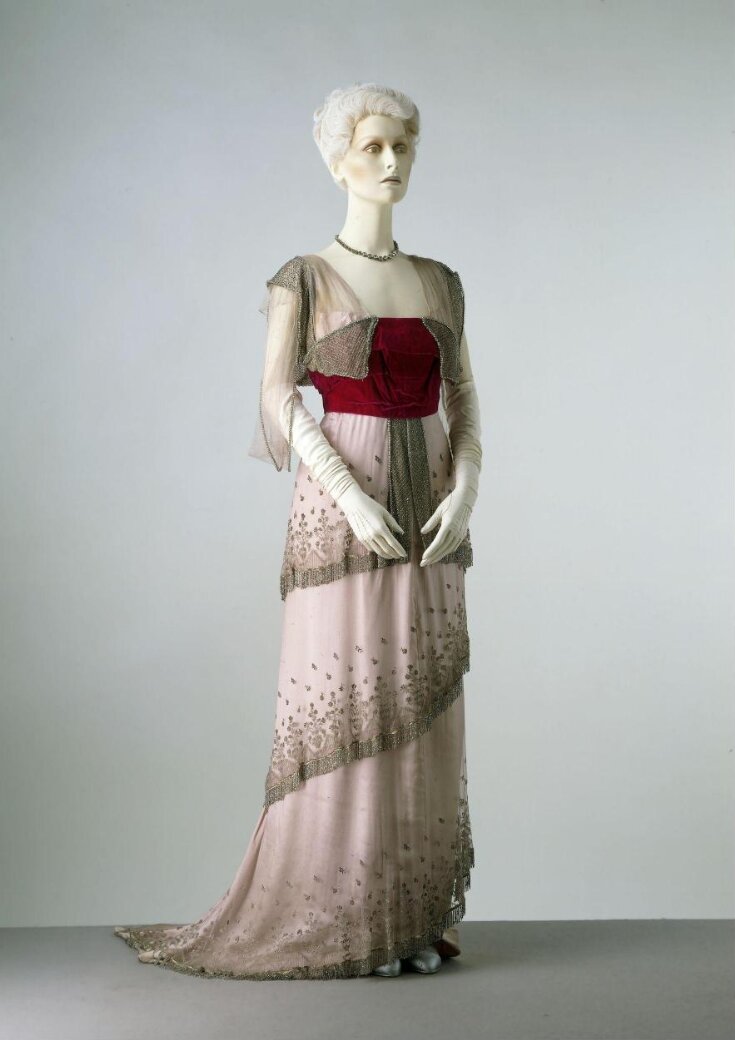

Evening Dress
ca. 1910 (made)
| Artist/Maker | |
| Place of origin |
Around 1910, leading fashion houses such as Worth created evening dresses with a straight silhouette. Their impact depended on the juxtaposition of colours and a variety of luxurious and richly decorated fabrics. On this garment, vivid velvet pile is set against light-reflecting beadwork, and the triple-tiered matt net overskirt covers the sheen of the trained satin skirt. The pillar-like look exemplified by this dress replaced the exaggerated curves of the early 1900s. It also shows how designers broke the strong vertical emphasis by creating overskirts with horizontal lines. The bodice, however, is still boned (nine bones).
Charles Frederick Worth (1825-1895) was a celebrated couture dressmaker in Paris. Born in England at Bourne in Lincolnshire, he started working at the age of 12 in a draper's shop in London. After working for various haberdashers and silk mercers, he left for Paris in 1845. In 1858 he went into partnership with a Swedish businessman, Otto Bobergh, and opened his own house. He was soon patronised by the Empress Eugénie (1826-1920), wife of the French Emperor, Napoleon III, and her influence was instrumental to his success. Obtaining made-to-measure clothes from his house was a symbol of social and financial success. They were appreciated for their beauty, elegance and fine workmanship.
Charles Frederick Worth (1825-1895) was a celebrated couture dressmaker in Paris. Born in England at Bourne in Lincolnshire, he started working at the age of 12 in a draper's shop in London. After working for various haberdashers and silk mercers, he left for Paris in 1845. In 1858 he went into partnership with a Swedish businessman, Otto Bobergh, and opened his own house. He was soon patronised by the Empress Eugénie (1826-1920), wife of the French Emperor, Napoleon III, and her influence was instrumental to his success. Obtaining made-to-measure clothes from his house was a symbol of social and financial success. They were appreciated for their beauty, elegance and fine workmanship.
Object details
| Categories | |
| Object type | |
| Materials and techniques | Embroidered silk net with metal thread, crystal and silver bugle beads over satin, velvet, boned, lined |
| Brief description | Evening dress of embroidered silk net and velvet, made by Worth, Paris, ca. 1910 |
| Physical description | Evening dress of pink silk net embroidered with silver metallic thread and crystal and silver bugle beads over satin, and with a ruched fuchsia silk velvet bodice. The velvet pile is set against light-reflecting beadwork and the triple-tiered matt net overskirt covers the sheen of the trained satin skirt until it reaches floor level. Nine bones shape the bodice. Short sleeves made of tulle. Lined with silk. Stitched inside the skirt is a white petticoat with a lilac tulle flounce. The dress fastens at the centre back with hooks and eyes. |
| Marks and inscriptions | 'WORTH PARIS 63196' (Inscribed on the waistband) |
| Credit line | Given by Lady Hoyer Millar |
| Summary | Around 1910, leading fashion houses such as Worth created evening dresses with a straight silhouette. Their impact depended on the juxtaposition of colours and a variety of luxurious and richly decorated fabrics. On this garment, vivid velvet pile is set against light-reflecting beadwork, and the triple-tiered matt net overskirt covers the sheen of the trained satin skirt. The pillar-like look exemplified by this dress replaced the exaggerated curves of the early 1900s. It also shows how designers broke the strong vertical emphasis by creating overskirts with horizontal lines. The bodice, however, is still boned (nine bones). Charles Frederick Worth (1825-1895) was a celebrated couture dressmaker in Paris. Born in England at Bourne in Lincolnshire, he started working at the age of 12 in a draper's shop in London. After working for various haberdashers and silk mercers, he left for Paris in 1845. In 1858 he went into partnership with a Swedish businessman, Otto Bobergh, and opened his own house. He was soon patronised by the Empress Eugénie (1826-1920), wife of the French Emperor, Napoleon III, and her influence was instrumental to his success. Obtaining made-to-measure clothes from his house was a symbol of social and financial success. They were appreciated for their beauty, elegance and fine workmanship. |
| Collection | |
| Accession number | T.57-1961 |
About this object record
Explore the Collections contains over a million catalogue records, and over half a million images. It is a working database that includes information compiled over the life of the museum. Some of our records may contain offensive and discriminatory language, or reflect outdated ideas, practice and analysis. We are committed to addressing these issues, and to review and update our records accordingly.
You can write to us to suggest improvements to the record.
Suggest feedback
You can write to us to suggest improvements to the record.
Suggest feedback
| Record created | December 15, 1999 |
| Record URL |
Download as: JSONIIIF Manifest
