Queen Victoria in Her Coronation Robes
Oil Painting
1838 (made)
1838 (made)
| Artist/Maker | |
| Place of origin |
Object Type
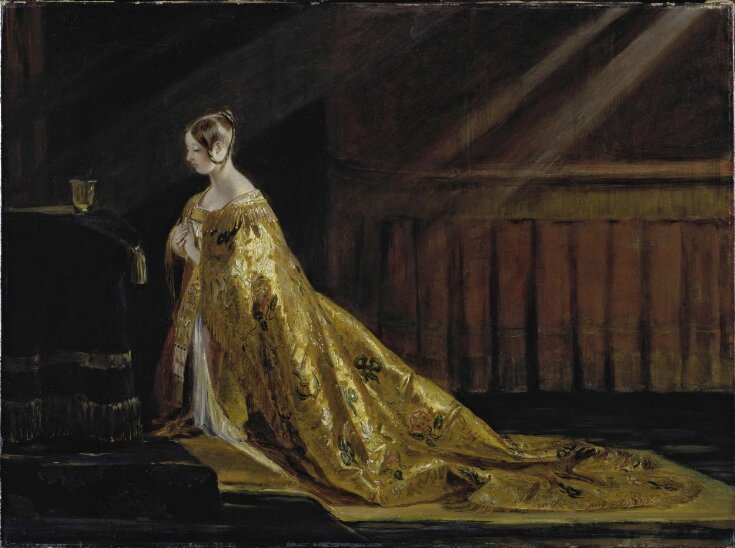
The Victorians frequently made commemorative oil paintings of significant people and events, and thus many pictures of Queen Victoria were painted. This sketch was made as a preparation for a large picture, which was exhibited at the Royal Academy and is now in the Royal Collection.
Subjects Depicted
Some months after her coronation in June 1837, Queen Victoria posed for this portrait. It shows the Queen dressed in her coronation robes and kneeling at the altar in Westminster Abbey. Even this small sketch reveals Leslie's skill as an artist who was able to combine the intimate and the historic in a single scene. This point was reinforced by the fact that the Queen later commissioned him to record the christening of her first child, the Princess Royal.
Historical Associations
The Coronation of the young Queen Victoria was the founding moment of a new era in British life. The Hanoverian Kings (particularly George IV) who had preceded her became unpopular because of their perceived vice and folly. A significant section of the population was being enticed towards the thought of a republic. The youth and innocence of Victoria represented a new start for the monarchy to some of her more moralistic subjects.
The Victorians frequently made commemorative oil paintings of significant people and events, and thus many pictures of Queen Victoria were painted. This sketch was made as a preparation for a large picture, which was exhibited at the Royal Academy and is now in the Royal Collection.
Subjects Depicted
Some months after her coronation in June 1837, Queen Victoria posed for this portrait. It shows the Queen dressed in her coronation robes and kneeling at the altar in Westminster Abbey. Even this small sketch reveals Leslie's skill as an artist who was able to combine the intimate and the historic in a single scene. This point was reinforced by the fact that the Queen later commissioned him to record the christening of her first child, the Princess Royal.
Historical Associations
The Coronation of the young Queen Victoria was the founding moment of a new era in British life. The Hanoverian Kings (particularly George IV) who had preceded her became unpopular because of their perceived vice and folly. A significant section of the population was being enticed towards the thought of a republic. The youth and innocence of Victoria represented a new start for the monarchy to some of her more moralistic subjects.
Object details
| Categories | |
| Object type | |
| Parts | This object consists of 2 parts.
|
| Title | Queen Victoria in Her Coronation Robes (generic title) |
| Materials and techniques | oil on canvas |
| Brief description | Oil painting, 'Queen Victoria in her Coronation Robes', Charles Robert Leslie, 1838 |
| Physical description | This painting depicts one of the most moving and private moments on the intricate five hour long medieval state ceremony. Immediately after the supreme moment of the Homage when she was presented to the people, she took off her Royal Crown and kneeling in her elaborate dalmatic robe, stiff with golden eagles, testified by receiving the sacrament to her personal Christian faith. |
| Dimensions |
|
| Styles | |
| Gallery label | British Galleries:
The artist shows the 18-year-old Queen kneeling at the altar in Westminster Abbey for her coronation on 20 June 1837. By setting the young Queen in her glowing coronation robes against the sombre background of the Abbey, he emphasised the heroic role that she was taking on.(27/03/2003) |
| Credit line | Given by John Sheepshanks, 1857 |
| Object history | Given by John Sheepshanks, 1857. By Charles Robert Leslie RA (born in London, 1794, died there in 1859) |
| Subjects depicted | |
| Summary | Object Type The Victorians frequently made commemorative oil paintings of significant people and events, and thus many pictures of Queen Victoria were painted. This sketch was made as a preparation for a large picture, which was exhibited at the Royal Academy and is now in the Royal Collection. Subjects Depicted Some months after her coronation in June 1837, Queen Victoria posed for this portrait. It shows the Queen dressed in her coronation robes and kneeling at the altar in Westminster Abbey. Even this small sketch reveals Leslie's skill as an artist who was able to combine the intimate and the historic in a single scene. This point was reinforced by the fact that the Queen later commissioned him to record the christening of her first child, the Princess Royal. Historical Associations The Coronation of the young Queen Victoria was the founding moment of a new era in British life. The Hanoverian Kings (particularly George IV) who had preceded her became unpopular because of their perceived vice and folly. A significant section of the population was being enticed towards the thought of a republic. The youth and innocence of Victoria represented a new start for the monarchy to some of her more moralistic subjects. |
| Bibliographic reference | Catalogue of British Oil Paintings 1820-1860, Ronald Parkinson, Victoria and Albert Museum, London: HMSO, 1990, pp. 173-74 |
| Collection | |
| Accession number | FA.129[O] |
About this object record
Explore the Collections contains over a million catalogue records, and over half a million images. It is a working database that includes information compiled over the life of the museum. Some of our records may contain offensive and discriminatory language, or reflect outdated ideas, practice and analysis. We are committed to addressing these issues, and to review and update our records accordingly.
You can write to us to suggest improvements to the record.
Suggest feedback
You can write to us to suggest improvements to the record.
Suggest feedback
| Record created | December 15, 1999 |
| Record URL |
Download as: JSONIIIF Manifest
