
Lidded Box
ca. 1850 (made)
| Artist/Maker | |
| Place of origin |
Object Type
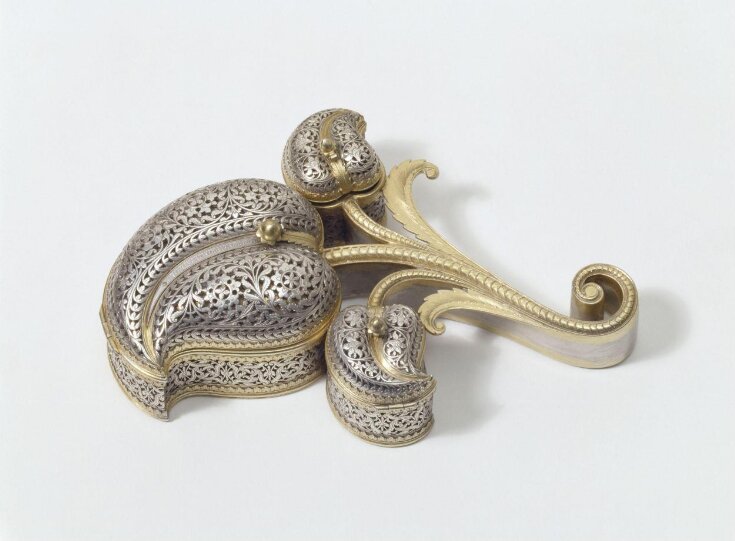
Boxes of various forms were traditionally used in the Indian subcontinent to store the leaves and nuts used in the preparation of pan (pronounced paan) and are conventionally called 'pandans', the Farsi (Persian) ending denoting something used as a container. Pan consists of chopped areca nuts mixed with spices and wrapped in a leaf from the Piper betel tree. The small pouch would be offered after meals as a digestif, or as part of the leaving ceremonies at formal gatherings, particularly at court. The shape of this silver gilt box is inspired by the shape of the leaves it held, and is extremely unusual.
Places
The box was made at Alwar ('Ulwar' according to Victorian spelling) in Rajasthan and bears the maker's name, Lalji, about whom nothing is otherwise known.
Historical Associations
This box was exhibited at the 1851 Exhibition and was bought by the Museum of Ornamental Art for £6.10s. Its relatively high price reflects the quality of the workmanship.
Boxes of various forms were traditionally used in the Indian subcontinent to store the leaves and nuts used in the preparation of pan (pronounced paan) and are conventionally called 'pandans', the Farsi (Persian) ending denoting something used as a container. Pan consists of chopped areca nuts mixed with spices and wrapped in a leaf from the Piper betel tree. The small pouch would be offered after meals as a digestif, or as part of the leaving ceremonies at formal gatherings, particularly at court. The shape of this silver gilt box is inspired by the shape of the leaves it held, and is extremely unusual.
Places
The box was made at Alwar ('Ulwar' according to Victorian spelling) in Rajasthan and bears the maker's name, Lalji, about whom nothing is otherwise known.
Historical Associations
This box was exhibited at the 1851 Exhibition and was bought by the Museum of Ornamental Art for £6.10s. Its relatively high price reflects the quality of the workmanship.
Object details
| Categories | |
| Object type | |
| Materials and techniques | Silver, gilt |
| Brief description | Lidded box, silver and gilt, Rajasthan, ca. 1850 |
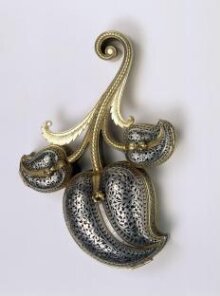
| Physical description | This box is in the form of a flower. The cover is very delicately pierced to reveal a plain gilt surface beneath, and gilding has been used in a restrained way to add definition to the shape. The underside of the largest section has a simple chased leaf design which runs across the surface in such a way that it echoes the tripartite division of the interior. |
| Dimensions |
|
| Gallery label | British Galleries:
This box, in the shape of a leaf from the Piper betel tree, has three compartments intended to contain the ingredients for 'pan', small quids or parcels of chopped nuts and spices wrapped in leaves. These parcels were chewed as an aid to digestion and might be offered at the end of a formal visit to an Indian home. The decoration of such boxes reflected the wealth and status of the household.(25/03/2003) |
| Object history | Signed by Lalji and made in Alwar, Rajasthan. Exhibited at the Great Exhibition, 1851, London. Purchased from the Great Exhibition of 1851 as 'modern'. |
| Subject depicted | |
| Summary | Object Type Boxes of various forms were traditionally used in the Indian subcontinent to store the leaves and nuts used in the preparation of pan (pronounced paan) and are conventionally called 'pandans', the Farsi (Persian) ending denoting something used as a container. Pan consists of chopped areca nuts mixed with spices and wrapped in a leaf from the Piper betel tree. The small pouch would be offered after meals as a digestif, or as part of the leaving ceremonies at formal gatherings, particularly at court. The shape of this silver gilt box is inspired by the shape of the leaves it held, and is extremely unusual. Places The box was made at Alwar ('Ulwar' according to Victorian spelling) in Rajasthan and bears the maker's name, Lalji, about whom nothing is otherwise known. Historical Associations This box was exhibited at the 1851 Exhibition and was bought by the Museum of Ornamental Art for £6.10s. Its relatively high price reflects the quality of the workmanship. |
| Bibliographic reference | Bryant, Julius and Weber, Susan; John Lockwood Kipling: Arts and Crafts in the Punjab and London Newhaven: Yale University Press, 2017
fig. 1.17, cat. 17, p. 9, and p. 527 |
| Collection | |
| Accession number | 132-1852 |
About this object record
Explore the Collections contains over a million catalogue records, and over half a million images. It is a working database that includes information compiled over the life of the museum. Some of our records may contain offensive and discriminatory language, or reflect outdated ideas, practice and analysis. We are committed to addressing these issues, and to review and update our records accordingly.
You can write to us to suggest improvements to the record.
Suggest feedback
You can write to us to suggest improvements to the record.
Suggest feedback
| Record created | December 15, 1999 |
| Record URL |
Download as: JSONIIIF Manifest
