
Wedding Dress
1857 (made)
| Artist/Maker | |
| Place of origin |
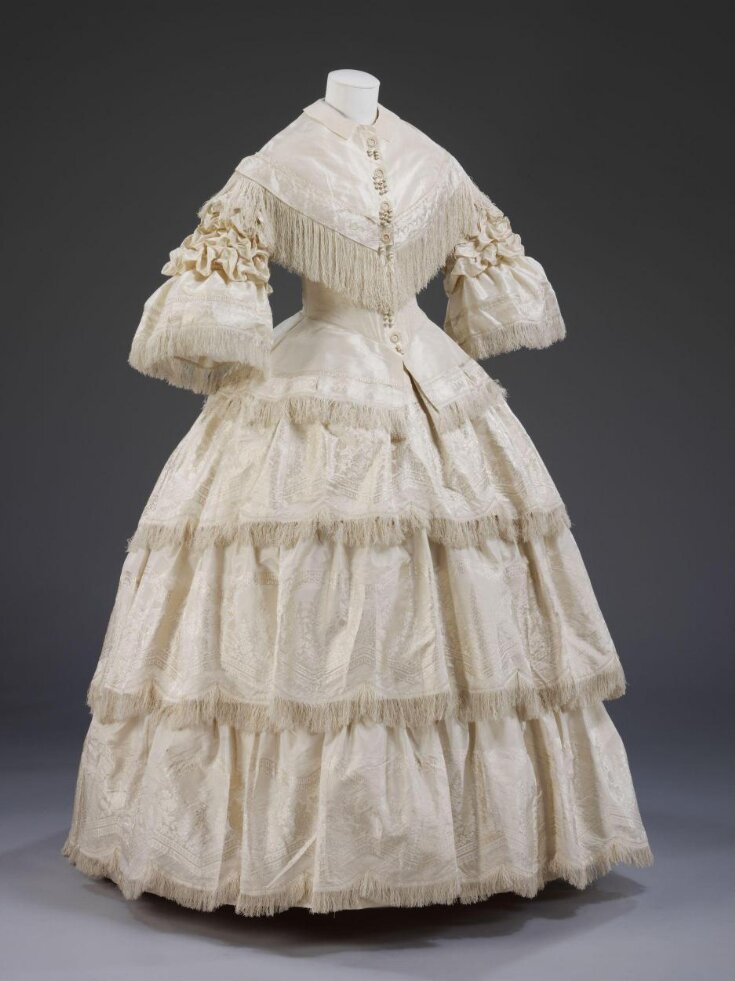
Wedding dress of ivory figured silk with a pattern woven 'en disposition' of formal flowers with an undulating band above and a scalloped band below.
The evening bodice has a low, wide, pointed neckline, short straight sleeves covered with gathered bands of matching tulle, and a point front and back. The waist is trimmed with a double rouleau of self material. The bodice is boned at front and side and back seams and lined with white glazed cotton. The neck is trimmed with a narrow frill of blond lace through which a black velvet ribbon passes. There is a lace fastening at the centre back with a hook at the top and bottom. On the front are stitch marks suggesting a jewel, flower or other trimming were attached.
The skirt is flat pleated except at the centre back where it is set in organ pleats. It has three flounces, the pattern en disposition, each trimmed with matching silk fringe. The dress is lined with tarlatan.
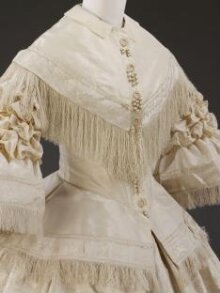
T.10A-1970 The jacket bodice has a cape and basque trimmed 'en disposition' and with white silk fringe. The neck is high and the jacket fastens down the centre front with concealed hooks and eyes. Circular motif with pendant balls are stitched to the front, two more at the back waist. The sleeved are elbow length with a gathered top and a wide frilled fringed cuff. Body lined in white glazed cotton, skirts with silk.
The outfit was worn with an orange blossom wreath.
The evening bodice has a low, wide, pointed neckline, short straight sleeves covered with gathered bands of matching tulle, and a point front and back. The waist is trimmed with a double rouleau of self material. The bodice is boned at front and side and back seams and lined with white glazed cotton. The neck is trimmed with a narrow frill of blond lace through which a black velvet ribbon passes. There is a lace fastening at the centre back with a hook at the top and bottom. On the front are stitch marks suggesting a jewel, flower or other trimming were attached.
The skirt is flat pleated except at the centre back where it is set in organ pleats. It has three flounces, the pattern en disposition, each trimmed with matching silk fringe. The dress is lined with tarlatan.
T.10A-1970 The jacket bodice has a cape and basque trimmed 'en disposition' and with white silk fringe. The neck is high and the jacket fastens down the centre front with concealed hooks and eyes. Circular motif with pendant balls are stitched to the front, two more at the back waist. The sleeved are elbow length with a gathered top and a wide frilled fringed cuff. Body lined in white glazed cotton, skirts with silk.
The outfit was worn with an orange blossom wreath.
Object details
| Categories | |
| Object type | |
| Parts | This object consists of 4 parts.
|
| Materials and techniques | Figured silk trimmed with silk fringe, buckram stiffening |
| Brief description | Wedding dress of ivory figured silk with second evening bodice, England, 1857 |
| Physical description | Wedding dress of ivory figured silk with a pattern woven 'en disposition' of formal flowers with an undulating band above and a scalloped band below. The evening bodice has a low, wide, pointed neckline, short straight sleeves covered with gathered bands of matching tulle, and a point front and back. The waist is trimmed with a double rouleau of self material. The bodice is boned at front and side and back seams and lined with white glazed cotton. The neck is trimmed with a narrow frill of blond lace through which a black velvet ribbon passes. There is a lace fastening at the centre back with a hook at the top and bottom. On the front are stitch marks suggesting a jewel, flower or other trimming were attached. The skirt is flat pleated except at the centre back where it is set in organ pleats. It has three flounces, the pattern en disposition, each trimmed with matching silk fringe. The dress is lined with tarlatan. T.10A-1970 The jacket bodice has a cape and basque trimmed 'en disposition' and with white silk fringe. The neck is high and the jacket fastens down the centre front with concealed hooks and eyes. Circular motif with pendant balls are stitched to the front, two more at the back waist. The sleeved are elbow length with a gathered top and a wide frilled fringed cuff. Body lined in white glazed cotton, skirts with silk. The outfit was worn with an orange blossom wreath. |
| Gallery label | Wedding dress and orange-blossom wreath
Britain
1857
Bridal styles in the 19th century followed fashion. The cut and decorative details of Margaret Scott Lang's 1857 dress are typical of their date. Her wreath of artificial orange-blossom was probably worn with a veil. Orange-blossom was prized for its fragrance. Scent was sometimes applied to artificial orange-blossom to recreate this.
Dress: silk bodice lined with glazed cotton, with silk skirt lined with stiffened buckram
Wreath: wax and paper
Given by the Misses I. & N. Turner
V&A: T.10A to C-1970(2011) |
| Credit line | Given by the Misses I. and N. Turner |
| Object history | This dress was worn by Margaret Scott Lang for her marriage to Henry Scott at Marylebone Presbyterian Church, London, in 1857 |
| Association | |
| Collection | |
| Accession number | T.10 to C-1970 |
About this object record
Explore the Collections contains over a million catalogue records, and over half a million images. It is a working database that includes information compiled over the life of the museum. Some of our records may contain offensive and discriminatory language, or reflect outdated ideas, practice and analysis. We are committed to addressing these issues, and to review and update our records accordingly.
You can write to us to suggest improvements to the record.
Suggest feedback
You can write to us to suggest improvements to the record.
Suggest feedback
| Record created | September 11, 2008 |
| Record URL |
Download as: JSONIIIF Manifest
