
Wedding Dress
1885 (made)
| Artist/Maker | |
| Place of origin |
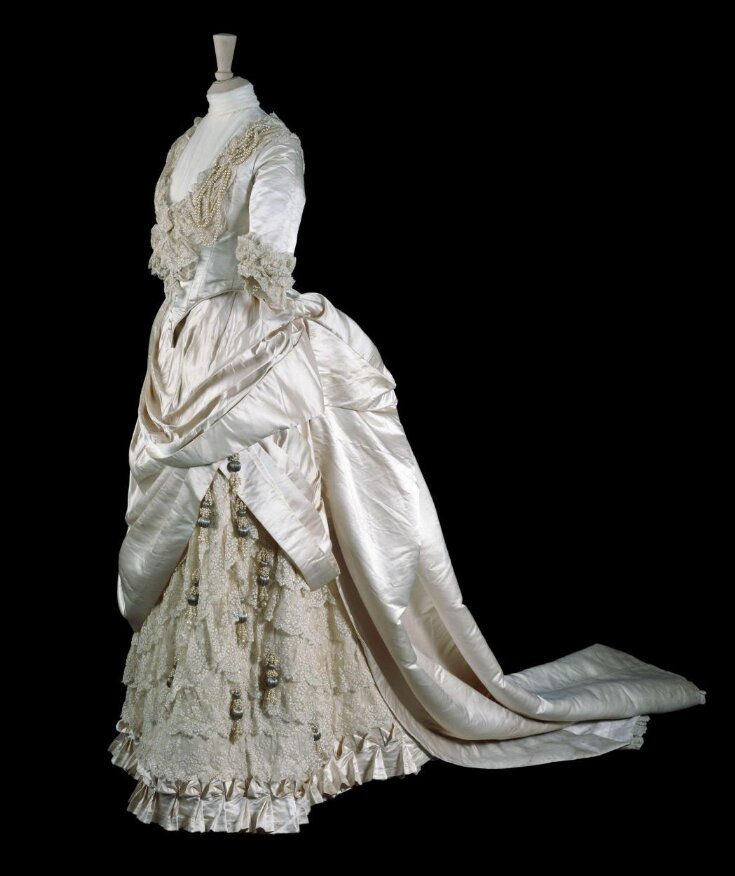
Wedding dress consisting of a cream silk satin bodice and draped and trained skirt decorated with embroidered net and artificial pearls, and a veil and a non-associated petticoat.
Object details
| Categories | |
| Object type | |
| Parts | This object consists of 4 parts.
|
| Materials and techniques | Silk satin, cotton machine-embroidered net, artificial pearls and metal thread, boned, laced, and lined with cotton |
| Brief description | Wedding dress consisting of a silk satin bodice, a skirt, a veil and petticoat, made by Gladman & Womack, London, 1885 |
| Physical description | Wedding dress consisting of a cream silk satin bodice and draped and trained skirt decorated with embroidered net and artificial pearls, and a veil and a non-associated petticoat. |
| Production type | Haute couture |
| Gallery label | Wedding dress
Gladman & Womack
London
1885
In the 1880s the cut and decoration of fashionable dress frequently drew on historical styles. The drapery of this wedding dress, worn by May Primrose for her marriage to Major Herbert Littledale in June 1885, has similarities with a late 17th-century informal gown called a mantua. When the bride died only a year after her marriage, her family carefully preserved her dress.
Silk satin, skirt decorated with embroidered net, artificial pearls and metal thread tassels
Given by the Hon. Mrs S.F. Tyser
V&A: T.428&A-1990(2011) |
| Credit line | Given by the Hon. Mrs S. F. Tyser |
| Object history | Registered File number 1990/1787. Part of a wedding ensemble T.428 to I-1990. Worn by Mary Primrose for her wedding on 10 June, 1885, to Major Herbert Littledale at SS Phillip and James, Cheltenham. On 26 April 1886, Mary gave birth to their daughter, Elsie Mary Littledale. Her husband held the rank of Major in the York and Lancaster Regiment. The regiment in 1886 was at its Barracks in Sheffield, having returned from a tour of duty in India. Tragically, on 18 May 1886, Mary died in Sheffield. Due to the close dates of Elsie's birth and Mary's death, it may be that Mary died as a result of complications after childbirth. While the cause is not clear, it is certain that she did not die in India, as previously thought, but in Yorkshire where her husband's regiment was stationed. Gladman & Womack were Court Dress Makers with premises at 26 Portman Street, London. |
| Collection | |
| Accession number | T.428 to B, G-1990 |
About this object record
Explore the Collections contains over a million catalogue records, and over half a million images. It is a working database that includes information compiled over the life of the museum. Some of our records may contain offensive and discriminatory language, or reflect outdated ideas, practice and analysis. We are committed to addressing these issues, and to review and update our records accordingly.
You can write to us to suggest improvements to the record.
Suggest feedback
You can write to us to suggest improvements to the record.
Suggest feedback
| Record created | August 21, 2008 |
| Record URL |
Download as: JSONIIIF Manifest
