Miniatures showing the labours of the months
Manuscript Cutting
late 1540s-early 1550s (painted)
late 1540s-early 1550s (painted)
| Artist/Maker | |
| Place of origin |
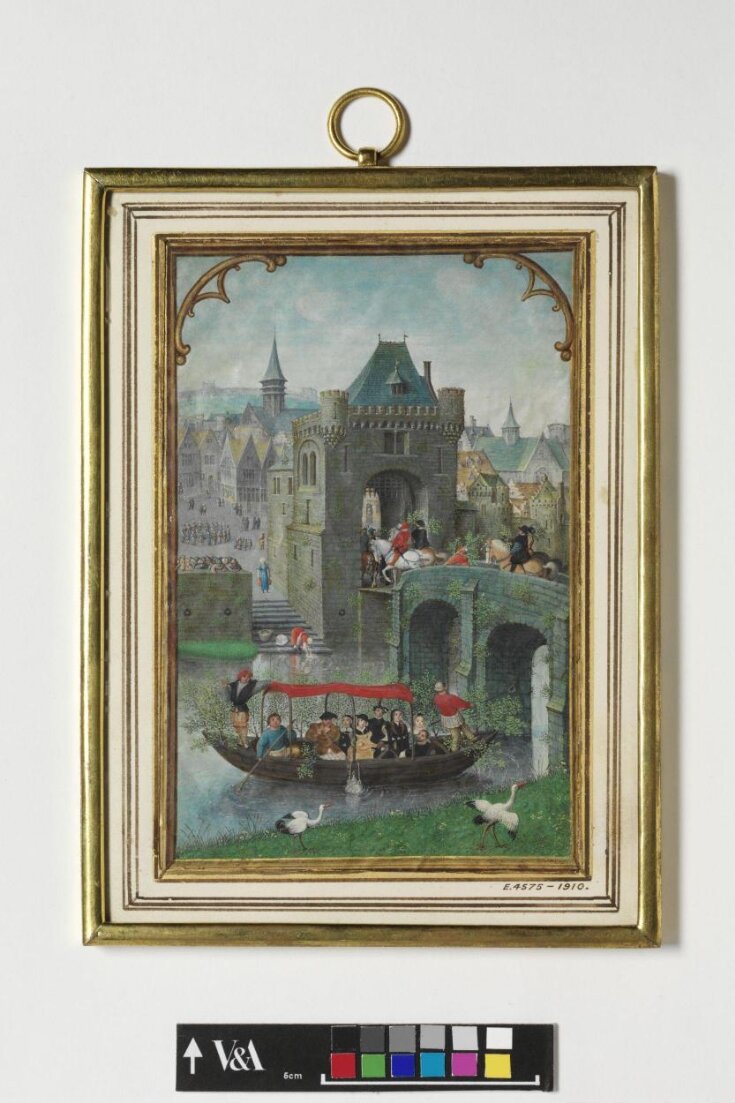
This double-sided leaf, possibly from the calendar of a book of hours, seems to illustrate on one side the month of April and on the other side the month of May. April shows lovers making music by a canal while in the fields beyond a cow is milked, the sheep are taken out to graze and on a chimney pot a stork makes itís nest. May shows a scene of May Day merrymaking; a boat trip with musicians, a floral procession and dancing in the square.
Simon Bening was one of the most celebrated illuminators of his time. He worked mainly in Bruges. His work often comes close to contemporary panel painting, particularly in full-page miniatures, such as these, where the image is surrounded by a simple border similar to a picture frame.
In the late medieval period Books of Hours were a type of prayerbook for private use by the laity, containing psalms and devotions for the eight canonical hours of the day. They were typically small and portable. Simon Bening’s workshop made many Books of Hours, often containing calendar illustrations.
Simon Bening was one of the most celebrated illuminators of his time. He worked mainly in Bruges. His work often comes close to contemporary panel painting, particularly in full-page miniatures, such as these, where the image is surrounded by a simple border similar to a picture frame.
In the late medieval period Books of Hours were a type of prayerbook for private use by the laity, containing psalms and devotions for the eight canonical hours of the day. They were typically small and portable. Simon Bening’s workshop made many Books of Hours, often containing calendar illustrations.
Object details
| Categories | |
| Object type | |
| Title | Miniatures showing the labours of the months |
| Materials and techniques | Watercolour on vellum |
| Brief description | Leaf with labours of the months, probably from a book of hours, attributed to Simon Bening, Flanders (Bruges), late 1540s-early 1550s. |
| Physical description | Double sided leaf, probably from a Book of Hours. The scenes are typical of illustrations for religious calendars listing the saint's days month by month at the beginning of books of hours. One side shows the Month of May - with a boating party in the foreground. The other side shows the Month of April (not August as stated in the Summary Catalogue (1981) - with courting couples in a meadow. In a modern gilt frame. |
| Dimensions |
|
| Production type | Unique |
| Credit line | Salting Bequest |
| Object history | Hollingworth Magniac (1786–1867), Colworth, by 1861: his sale, Christie's London, sale beginning 2 July 1892, lot 193 (4 July 1892). George Salting (1839-1909), by 1908: acquired as part of the Salting Bequest in 1910 (Salting 2538). Cuttings from the same manuscript in the V&A collection: E.4575-1910 and E.4576-1910. Cuttings from the same manuscript in other collections: London, British Library, Add. Ms. 18855, ff. 108-9. |
| Subjects depicted | |
| Summary | This double-sided leaf, possibly from the calendar of a book of hours, seems to illustrate on one side the month of April and on the other side the month of May. April shows lovers making music by a canal while in the fields beyond a cow is milked, the sheep are taken out to graze and on a chimney pot a stork makes itís nest. May shows a scene of May Day merrymaking; a boat trip with musicians, a floral procession and dancing in the square. Simon Bening was one of the most celebrated illuminators of his time. He worked mainly in Bruges. His work often comes close to contemporary panel painting, particularly in full-page miniatures, such as these, where the image is surrounded by a simple border similar to a picture frame. In the late medieval period Books of Hours were a type of prayerbook for private use by the laity, containing psalms and devotions for the eight canonical hours of the day. They were typically small and portable. Simon Bening’s workshop made many Books of Hours, often containing calendar illustrations. |
| Associated object | E.4576-1910 (Object) |
| Bibliographic references |
|
| Other number | 2538 - Salting Bequest |
| Collection | |
| Accession number | E.4575-1910 |
About this object record
Explore the Collections contains over a million catalogue records, and over half a million images. It is a working database that includes information compiled over the life of the museum. Some of our records may contain offensive and discriminatory language, or reflect outdated ideas, practice and analysis. We are committed to addressing these issues, and to review and update our records accordingly.
You can write to us to suggest improvements to the record.
Suggest feedback
You can write to us to suggest improvements to the record.
Suggest feedback
| Record created | December 15, 1999 |
| Record URL |
Download as: JSONIIIF Manifest
