
Beatrice
Photograph
1866 (photographed)
1866 (photographed)
| Artist/Maker | |
| Place of origin |
In late 1865, Julia Margaret Cameron began using a larger camera. It held a 15 x 12 inch glass negative, rather than the 12 x 10 inch negative of her first camera. Early the next year she wrote to Henry Cole with great enthusiasm – but little modesty – about the new turn she had taken in her work.
Cameron initiated a series of large-scale, closeup heads that fulfilled her photographic vision. She saw them as a rejection of ‘mere conventional topographic photography – map-making and skeleton rendering of feature and form’ in favour of a less precise but more emotionally penetrating form of portraiture. Cameron also continued to make narrative and allegorical tableaux, which were larger and bolder than her previous efforts.
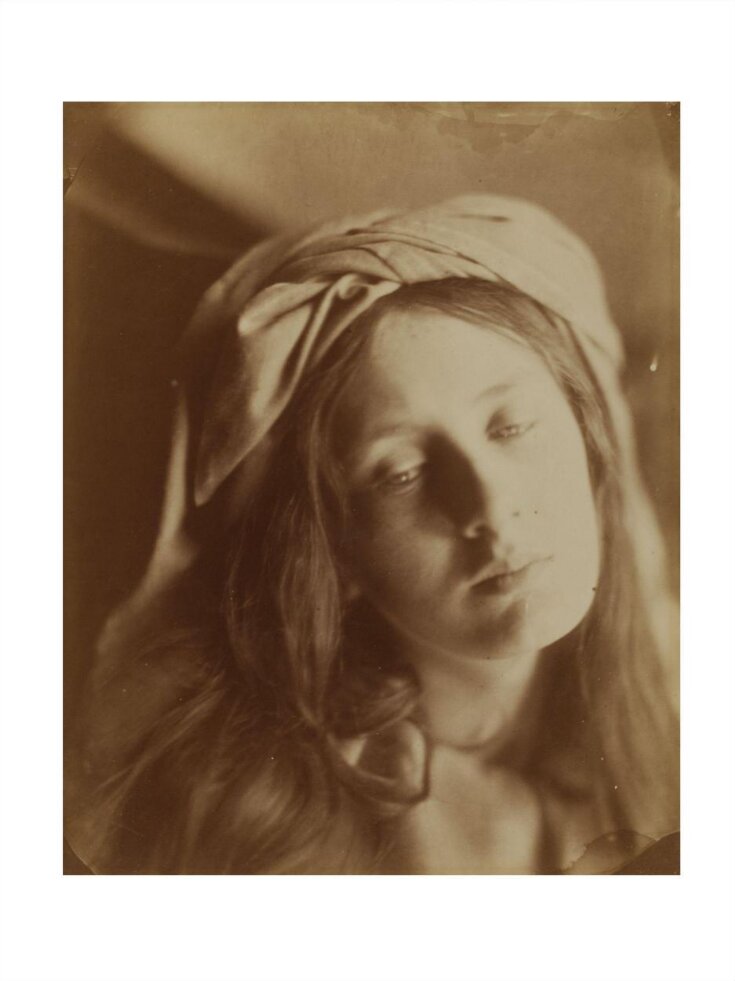
Cameron based the model’s pose, drapery and sad expression on a painting attributed to Guido Reni that was famous at the time. The subject is the 16th-century Italian noblewoman Beatrice Cenci, executed for arranging the murder of her abusive father. One review admired Cameron’s soft rendering of ‘the pensive sweetness of the expression of the original picture’ while another mocked her for claiming to have photographed a historical figure ‘from the life’.
Cameron initiated a series of large-scale, closeup heads that fulfilled her photographic vision. She saw them as a rejection of ‘mere conventional topographic photography – map-making and skeleton rendering of feature and form’ in favour of a less precise but more emotionally penetrating form of portraiture. Cameron also continued to make narrative and allegorical tableaux, which were larger and bolder than her previous efforts.
Cameron based the model’s pose, drapery and sad expression on a painting attributed to Guido Reni that was famous at the time. The subject is the 16th-century Italian noblewoman Beatrice Cenci, executed for arranging the murder of her abusive father. One review admired Cameron’s soft rendering of ‘the pensive sweetness of the expression of the original picture’ while another mocked her for claiming to have photographed a historical figure ‘from the life’.
Object details
| Categories | |
| Object type | |
| Title | Beatrice (assigned by artist) |
| Materials and techniques | Albumen print from wet collodion glass negative |
| Brief description | Photograph by Julia Margaret Cameron, 'Beatrice' (sitter May Prinsep), albumen print, 1866 |
| Physical description | A photograph of a woman (May Prinsep) from the shoulders up as a 3/4 profile. Her hair is loose and the top of her head is covered by a large turban. |
| Dimensions |
|
| Content description | The true story of the Cenci, which took place in sixteenth-century Italy, inspired Shelley's poetic drama, 'The Cenci', published in 1819. The debauched Count Cenci conceived an incestuous passion for his daughter Beatrice. The young woman devised, with her step-mother and brother, a desperate plan - hiring assassins to murder the Count. Despite the justice of their cause, Beatrice and her helpers are arrested, admit their guilt, and are sentenced to death by the Pope. The simple title invites this dramatic reading of the life-size, close-up head. |
| Style | |
| Gallery label |
|
| Credit line | Given by Alan S. Cole, 19 April 1913 |
| Object history | Julia Margaret Cameron (1815–79) was one of the most important and innovative photographers of the 19th century. Her photographs were rule-breaking: purposely out of focus, and often including scratches, smudges and other traces of the artist’s process. Best known for her powerful portraits, she also posed her sitters – friends, family and servants – as characters from biblical, historical or allegorical stories. Born in Calcutta on 11 June 1815, the fourth of seven sisters, her father was an East India Company official and her mother descended from French aristocracy. Educated mainly in France, Cameron returned to India in 1834. In 1842, the British astronomer Sir John Herschel (1792 – 1871) introduced Cameron to photography, sending her examples of the new invention. They had met in 1836 while Cameron was convalescing from an illness in the Cape of Good Hope, South Africa. He remained a life-long friend and correspondent on technical photographic matters. That same year she met Charles Hay Cameron (1795–1880), 20 years her senior, a reformer of Indian law and education. They married in Calcutta in 1838 and she became a prominent hostess in colonial society. A decade later, the Camerons moved to England. By then they had four children; two more were born in England. Several of Cameron’s sisters were already living there, and had established literary, artistic and social connections. The Camerons eventually settled in Freshwater, on the Isle of Wight. At the age of 48 Cameron received a camera as a gift from her daughter and son-in-law. It was accompanied by the words, ‘It may amuse you, Mother, to try to photograph during your solitude at Freshwater.’ Cameron had compiled albums and even printed photographs before, but her work as a photographer now began in earnest. The Camerons lived at Freshwater until 1875, when they moved to Ceylon (now Sri Lanka) where Charles Cameron had purchased coffee and rubber plantations, managed under difficult agricultural and financial conditions by three of their sons. Cameron continued her photographic practice at her new home yet her output decreased significantly and only a small body of photographs from this time remains. After moving to Ceylon the Camerons made only one more visit to England in May 1878. Julia Margaret Cameron died after a brief illness in Ceylon in 1879. Cameron’s relationship with the Victoria and Albert Museum dates to the earliest years of her photographic career. The first museum exhibition of Cameron's work was held in 1865 at the South Kensington Museum, London (now the V&A). The South Kensington Museum was not only the sole museum to exhibit Cameron’s work in her lifetime, but also the institution that collected her photographs most extensively in her day. In 1868 the Museum gave Cameron the use of two rooms as a portrait studio, perhaps qualifying her as its first artist-in-residence. Today the V&A’s Cameron collection includes photographs acquired directly from the artist, others collected later from various sources, and five letters from Cameron to Sir Henry Cole (1808–82), the Museum’s founding director and an early supporter of photography. |
| Production | Another print of this was inscribed by Mrs Cameron: 'Study of the Beatrice Cenci from May Prinsep' (the photographer's niece). |
| Subjects depicted | |
| Association | |
| Literary reference | Shelley, Percy Bysshe , 'The Cenci' (1819) |
| Summary | In late 1865, Julia Margaret Cameron began using a larger camera. It held a 15 x 12 inch glass negative, rather than the 12 x 10 inch negative of her first camera. Early the next year she wrote to Henry Cole with great enthusiasm – but little modesty – about the new turn she had taken in her work. Cameron initiated a series of large-scale, closeup heads that fulfilled her photographic vision. She saw them as a rejection of ‘mere conventional topographic photography – map-making and skeleton rendering of feature and form’ in favour of a less precise but more emotionally penetrating form of portraiture. Cameron also continued to make narrative and allegorical tableaux, which were larger and bolder than her previous efforts. Cameron based the model’s pose, drapery and sad expression on a painting attributed to Guido Reni that was famous at the time. The subject is the 16th-century Italian noblewoman Beatrice Cenci, executed for arranging the murder of her abusive father. One review admired Cameron’s soft rendering of ‘the pensive sweetness of the expression of the original picture’ while another mocked her for claiming to have photographed a historical figure ‘from the life’. |
| Associated object | 944-1913 (version) |
| Bibliographic references |
|
| Collection | |
| Accession number | 945-1913 |
About this object record
Explore the Collections contains over a million catalogue records, and over half a million images. It is a working database that includes information compiled over the life of the museum. Some of our records may contain offensive and discriminatory language, or reflect outdated ideas, practice and analysis. We are committed to addressing these issues, and to review and update our records accordingly.
You can write to us to suggest improvements to the record.
Suggest feedback
You can write to us to suggest improvements to the record.
Suggest feedback
| Record created | December 15, 1999 |
| Record URL |
Download as: JSONIIIF Manifest
