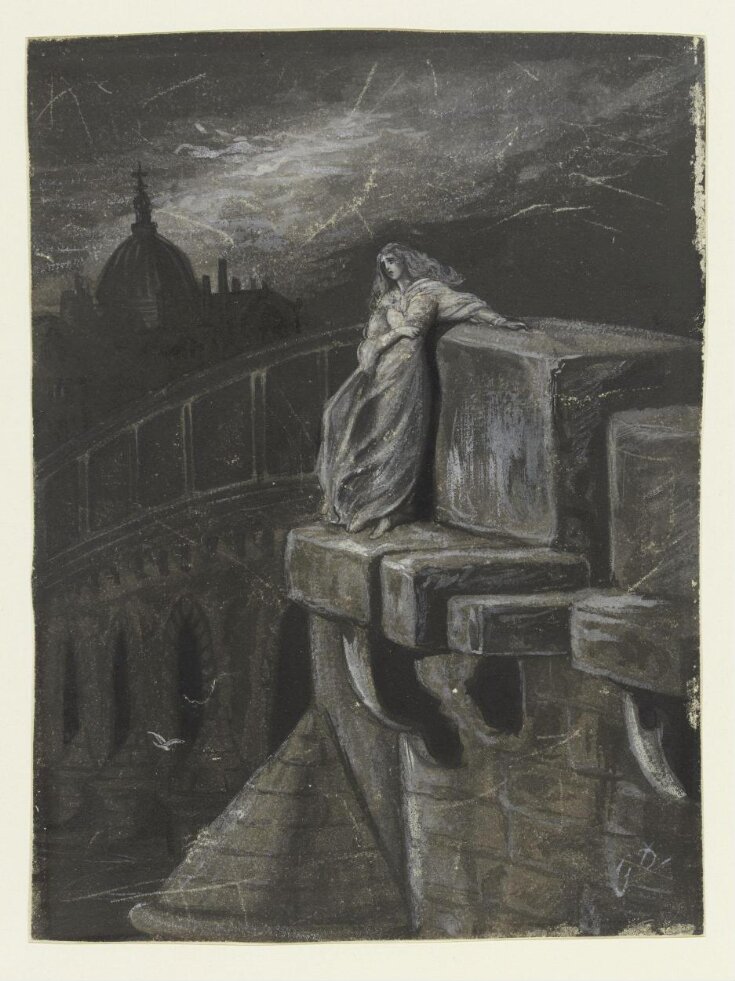

Glad to death's mystery, Swift to be hurl'd,/Anywhere, anywhere out of the world!
Drawing
1871 (drawn)
1871 (drawn)
| Artist/Maker | |
| Place of origin |
Victorian painters and writers were to some degree obsessed with the image of the fallen woman. The antithesis of the virtuous ideal, the prostitute was deemed to have committed the 'greatest sin of all' and such women were outcasts from family and society. Victorian society saw the prostitute as a once-innocent victim, a pure creature seduced and degraded, who must welcome death as her only escape from an insupportable life of guilt and despair. There was pity - in art, if not in life - for these 'soiled doves'. The fate of the prostitute was usually shown to be poverty, disease, and death, a death chosen by the girl herself in preference to her unhappy life. Thomas Hood's poem The Bridge of Sighs (1844) became a classic stereotype of the harlot and her destiny. Dore's illustration to the poem shows the psychologically dramatic moment when the girl chooses suicide; minutes later she will jump from the bridge and drown in the river below.
Object details
| Categories | |
| Object type | |
| Titles |
|
| Materials and techniques | Indian ink heightened with white |
| Brief description | Drawing by Gustave Doré entitled "Glad to Death's mystery, swift to be hurl'd,/Anywhere, anywhere out of the World" for the title page of 'The Poetical Works of Thomas Hood' and the poem 'The Bridge of Sighs'. French School, Great Britain, 1871. |
| Physical description | Drawing in Indian ink heightened with white illustrating Thomas Hood's poem 'The Bridge of Sighs' (1844) became a classic stereotype of the harlot and her destiny. Doré's illustration to the poem shows the psychologically dramatic moment when the girl chooses suicide; minutes later she will jump from the bridge and drown in the river below. Initialled by the artist. |
| Dimensions |
|
| Credit line | Bequeathed by Henry Herbert Harrod |
| Subjects depicted | |
| Literary reference | Thomas Hood |
| Summary | Victorian painters and writers were to some degree obsessed with the image of the fallen woman. The antithesis of the virtuous ideal, the prostitute was deemed to have committed the 'greatest sin of all' and such women were outcasts from family and society. Victorian society saw the prostitute as a once-innocent victim, a pure creature seduced and degraded, who must welcome death as her only escape from an insupportable life of guilt and despair. There was pity - in art, if not in life - for these 'soiled doves'. The fate of the prostitute was usually shown to be poverty, disease, and death, a death chosen by the girl herself in preference to her unhappy life. Thomas Hood's poem The Bridge of Sighs (1844) became a classic stereotype of the harlot and her destiny. Dore's illustration to the poem shows the psychologically dramatic moment when the girl chooses suicide; minutes later she will jump from the bridge and drown in the river below. |
| Bibliographic references |
|
| Collection | |
| Accession number | E.358-1948 |
About this object record
Explore the Collections contains over a million catalogue records, and over half a million images. It is a working database that includes information compiled over the life of the museum. Some of our records may contain offensive and discriminatory language, or reflect outdated ideas, practice and analysis. We are committed to addressing these issues, and to review and update our records accordingly.
You can write to us to suggest improvements to the record.
Suggest feedback
You can write to us to suggest improvements to the record.
Suggest feedback
| Record created | December 15, 1999 |
| Record URL |
Download as: JSONIIIF Manifest
