
Life in the Hareem, Cairo
Watercolour
1858 (painted)
1858 (painted)
| Artist/Maker | |
| Place of origin |
Object Type
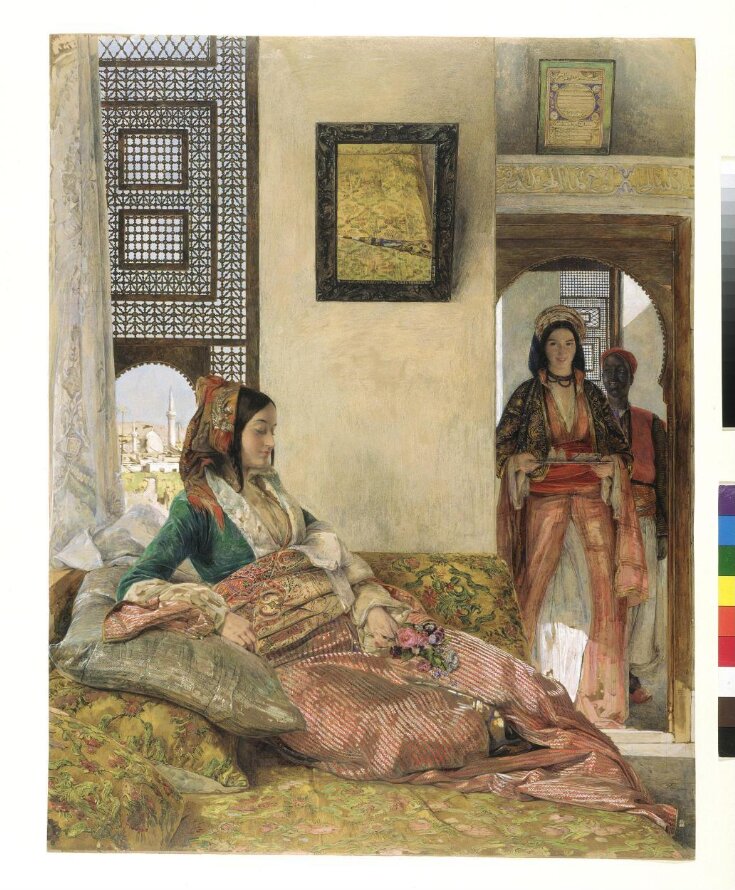
At first sight Life in the Hareem, Cairo is another `Orientalist' picture with no obvious story. Yet the posy of flowers held in the lap of the main figure is a love letter, in the language of flowers, used in Turkey and Egypt as well as Britain. This was a favourite theme in Lewis's work. The whole scene could be interpreted as a showing a woman about to take coffee with her confidante to discuss the newly arrived love letter and its implicit offer. Then they will read the future in the coffee grounds in the traditional manner (still practised in Cairo), to see how the affair may turn out.
People
Lewis painted various versions of this theme. He arrived in Egypt in 1841 and lived for nearly a decade as a wealthy Turk in a grand 16th-century house in Cairo. Lewis was obliged to do this, as at that time his neighbours would not have tolerated Western customs in this district of the City. In 1847 he married Marian Harper, who appears as a model in many of his pictures, including this one. In Cairo he lived with his bride like a Turkish Bey, or grandee, in everything except the actual practice of the faith of Islam, so the decorous pictures of Marian in her robes in that splendid house are not really fantasies at all.
At first sight Life in the Hareem, Cairo is another `Orientalist' picture with no obvious story. Yet the posy of flowers held in the lap of the main figure is a love letter, in the language of flowers, used in Turkey and Egypt as well as Britain. This was a favourite theme in Lewis's work. The whole scene could be interpreted as a showing a woman about to take coffee with her confidante to discuss the newly arrived love letter and its implicit offer. Then they will read the future in the coffee grounds in the traditional manner (still practised in Cairo), to see how the affair may turn out.
People
Lewis painted various versions of this theme. He arrived in Egypt in 1841 and lived for nearly a decade as a wealthy Turk in a grand 16th-century house in Cairo. Lewis was obliged to do this, as at that time his neighbours would not have tolerated Western customs in this district of the City. In 1847 he married Marian Harper, who appears as a model in many of his pictures, including this one. In Cairo he lived with his bride like a Turkish Bey, or grandee, in everything except the actual practice of the faith of Islam, so the decorous pictures of Marian in her robes in that splendid house are not really fantasies at all.
Object details
| Categories | |
| Object type | |
| Titles |
|
| Materials and techniques | Watercolour and bodycolour |
| Brief description | Water and bodycolour painting showing a view of the the interior of the women's quarters of a Mamluk house in Cairo. |
| Physical description | View of the the interior of the women's quarters of a Mamluk house in Cairo, a richly dressed woman reclining on cushions, holding a posy of flowers and another woman bringing a tray with coffee cups. In the background, beyond the doorway, a male African servant. |
| Dimensions |
|
| Styles | |
| Production type | Unique |
| Marks and inscriptions | JFL 1858 (Signature; date; 1858) |
| Gallery label |
|
| Object history | According to Robert Hewison, (see Tate Exhibition catalogue below) this is probably the painting that was exhibited at the Royal Academy in 1858 as number 122, `An inmate of the Hhareem, Cairo.' It was bought by James John Ruskin, the father of John Ruskin., as a gift for his son. Joan and Joseph Severn, John Ruskin's guardians, began to sell off works from his collection in the 1890s. According to Museum records this painting was bought from the dealers Thomas Agnew & Sons on the advice of George Howard, 9th Earl of Carlisle, a noted painter and friend of the Pre-Raphaelites. The spelling of Hhareem with a double `h' is Lewis's attempt to represent the Arabic letter `ha' which is more strongly aspirated than the English `h' sound. Lewis had Arabic lessons while he lived in Cairo. |
| Subjects depicted | |
| Place depicted | |
| Association | |
| Summary | Object Type At first sight Life in the Hareem, Cairo is another `Orientalist' picture with no obvious story. Yet the posy of flowers held in the lap of the main figure is a love letter, in the language of flowers, used in Turkey and Egypt as well as Britain. This was a favourite theme in Lewis's work. The whole scene could be interpreted as a showing a woman about to take coffee with her confidante to discuss the newly arrived love letter and its implicit offer. Then they will read the future in the coffee grounds in the traditional manner (still practised in Cairo), to see how the affair may turn out. People Lewis painted various versions of this theme. He arrived in Egypt in 1841 and lived for nearly a decade as a wealthy Turk in a grand 16th-century house in Cairo. Lewis was obliged to do this, as at that time his neighbours would not have tolerated Western customs in this district of the City. In 1847 he married Marian Harper, who appears as a model in many of his pictures, including this one. In Cairo he lived with his bride like a Turkish Bey, or grandee, in everything except the actual practice of the faith of Islam, so the decorous pictures of Marian in her robes in that splendid house are not really fantasies at all. |
| Bibliographic references |
|
| Collection | |
| Accession number | 679-1893 |
About this object record
Explore the Collections contains over a million catalogue records, and over half a million images. It is a working database that includes information compiled over the life of the museum. Some of our records may contain offensive and discriminatory language, or reflect outdated ideas, practice and analysis. We are committed to addressing these issues, and to review and update our records accordingly.
You can write to us to suggest improvements to the record.
Suggest feedback
You can write to us to suggest improvements to the record.
Suggest feedback
| Record created | December 15, 1999 |
| Record URL |
Download as: JSONIIIF Manifest
