
Sappho
Watercolour
1871-1872 (painted)
1871-1872 (painted)
| Artist/Maker | |
| Place of origin |
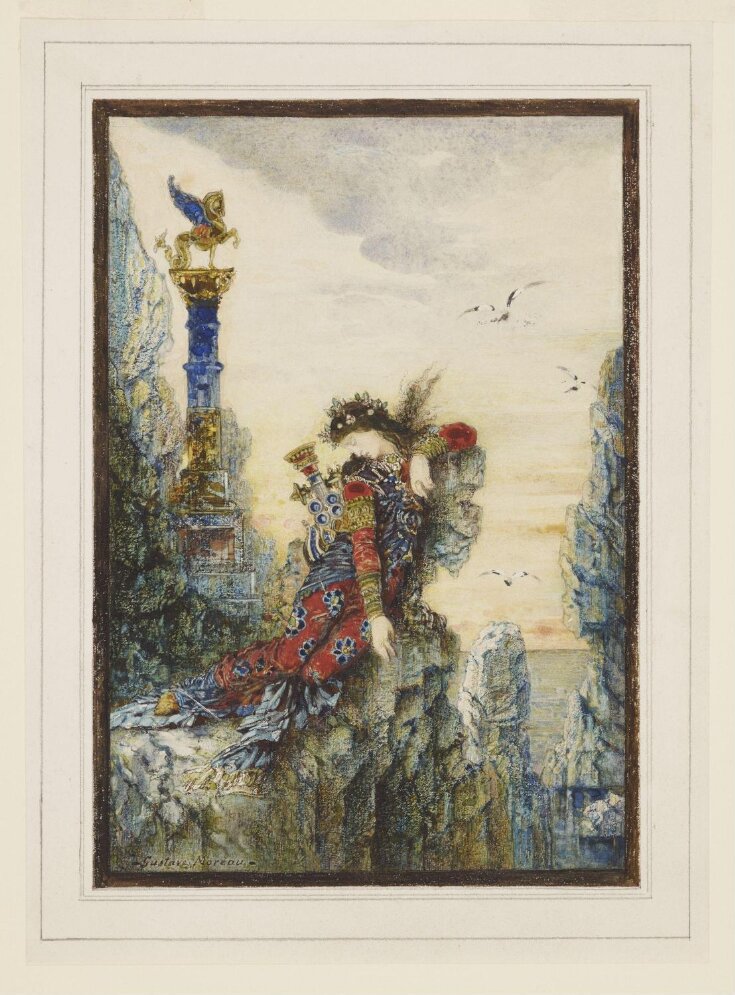
This watercolour is part one of three scenes surrounding the suicide of Greek poetess, Sappho, a subject that Moreau frequently represented. It shows the Ancient poetess Sappho on the top of a cliff lamenting over the desertion of her lover, Phaon. The lyre, slung over her shoulder, is the traditionnal attribute of poets. As a precurser to Symbolism, Moreau sought inspiration from mythological, literary, and biblical references.
Object details
| Categories | |
| Object type | |
| Title | Sappho (assigned by artist) |
| Materials and techniques | Watercolour |
| Brief description | Watercolour, Sappho, by Gustave Moreau, 1871-2. |
| Physical description | Sappho rests on the promontory of Leucadia in an attitude of despair, wearing an elaborately patterned red and purple gown apparently based on kimonos in a Japanese print Moreau owned. Her lyre is slung over her shoulder. Seagulls circle overhead and the setting sun presages her impending suicide. At left, a pillar surmounted by the griffon of Apollo further emphasises Sappho's status as a poet. |
| Dimensions |
|
| Style | |
| Marks and inscriptions | '--Gustave Moreau--' (Signed in lower left corner) |
| Gallery label | Gustave Moreau 1926-1897
Sappho
Probably about 1884; signed
Moreau was a French Symbolist painter. This work, inspired by an opera by Gounod, depicts the Greek poet Sappho. She committed suicide after being abandoned by her female lover. It belonged to John Gray, a homosexual poet who was said to be the inspiration for The Picture of Dorian Gray by Oscar Wilde.
Watercolour on paper
Given by John Gray in memory of Andre Raffalovich 1934
Museum no. P.11-1934 |
| Credit line | Given by Canon Gray in memory of André S. Raffalovich |
| Object history | Moreau exhibited Sappho at the annual exhibition of the Cercle des Arts in March 1872 (which belies the prevailing notion that his work remained out of the public eye between the Salons of 1869 and 1876), where it caught the eye of Parisian salon hostess Marie Raffalovich. She bought the watercolour from Moreau in June of the same year, thus beginning more than two decades of patronage. Although Madame Raffalovich bought several other paintings by Moreau, a collection of letters she wrote to Moreau which are preserved in the Musée Gustave Moreau in Paris shows that Sappho remained her firm favourite -- she even wrote a fairy tale (never published) based on it. The watercolour passed to her son, André, a poet, salon host and rival of Oscar Wilde in 1890s London, at an unknown date. However, it was definitely in his possession by 1894, as a letter that year from Aubrey Beardsley mentions 'your beautiful Moreau'. When he died, André left instructions for his companion, the poet and priest John Gray (the presumed model for Dorian Gray in The Picture of Dorian Gray) to donate it to the V&A. Historical significance: This is one of the only works by Moreau in the national collections (along with Costume design for a dancer, also in the V&A, and St George and the Dragon in the National Gallery). |
| Historical context | This watercolour, with its rich, jewel-like colours is characteristic of Moreau’s later period. It shows the Ancient poetess Sappho on the top of a cliff lamenting over the desertion of her lover, Phaon. The lyre, slung over her shoulder, is the traditionnal attribute of poets. At left, a pillar surmounted by the griffon of Apollo, the Greco-Roman god of poetry, further emphasises Sappho's status as a poet. Both Sappho’s vivid gown and her pose are taken from a Japanese woodcut by Utagawa Kunisada titled Genji taking the air in summer on the Sumida, which Moreau had purchased from E. Desoye’s gallery ‘Spécialités des objets du Japon’, the leading Japanese art dealer in Paris in the 1860s. Signed ‘Gustave Moreau’ the work titled Sappho by the artist was exhibited at the annual exhibition of the Cercle des Arts, which opened on the 20 January 1872. There it caught the eye of Parisian salon hostess and great collector Marie Raffalovich. She bought the watercolour from Moreau in June of the same year, thus beginning more than two decades of patronage. Although Madame Raffalovich bought several other paintings by Moreau, it is known from her correpsondence with the artist that Sappho remained her firm favourite. The watercolour passed to her son, André, a poet, salon host and rival of Oscar Wilde in 1890s London, at an unknown date. However, it was definitely in his possession by 1894, as a letter that year from Aubrey Beardsley mentions 'your beautiful Moreau'. When he died, André left instructions for his companion, the poet and priest John Gray (the presumed model for Dorian Gray in The Picture of Dorian Gray) to donate it to the V&A. Moreau’s fastination with Sappho as a subject began in 1849, after which he produced several cycles into the 1870s in both watercolour and oil. Sappho is part one of three distinct episodes depicting her death; the other two are entitled Sappho flinging herself into the Sea (in a private collection in Paris) and Sappho lying at the foot of the Cliff (formerly in the Esnault-Pelterie Collection; the smaller version now in the museum at Saint-Lo). This is one of the only works by Moreau in a British national collection (along with Costume design for a dancer (E.49-1968), also in the V&A, and St George and the Dragon in the National Gallery). A key work of the Symbolists was J K Huysmans' novel A Rebours, which contains an enthusiastic description of Moreau's exhibits in the Salon of 1876. Moreau's paintings were admired by Marcel Proust and by the Symbolists of the 1880s and 1890s, the group reacted against the fin-de-siècle realism in art. |
| Subjects depicted | |
| Place depicted | |
| Associations | |
| Summary | This watercolour is part one of three scenes surrounding the suicide of Greek poetess, Sappho, a subject that Moreau frequently represented. It shows the Ancient poetess Sappho on the top of a cliff lamenting over the desertion of her lover, Phaon. The lyre, slung over her shoulder, is the traditionnal attribute of poets. As a precurser to Symbolism, Moreau sought inspiration from mythological, literary, and biblical references. |
| Associated object | |
| Bibliographic references |
|
| Collection | |
| Accession number | P.11-1934 |
About this object record
Explore the Collections contains over a million catalogue records, and over half a million images. It is a working database that includes information compiled over the life of the museum. Some of our records may contain offensive and discriminatory language, or reflect outdated ideas, practice and analysis. We are committed to addressing these issues, and to review and update our records accordingly.
You can write to us to suggest improvements to the record.
Suggest feedback
You can write to us to suggest improvements to the record.
Suggest feedback
| Record created | December 15, 1999 |
| Record URL |
Download as: JSONIIIF Manifest
