Unknown woman, formerly called Frances Howard, Countess of Somerset
Portrait Miniature
1596-1600 (painted)
1596-1600 (painted)
| Artist/Maker | |
| Place of origin |
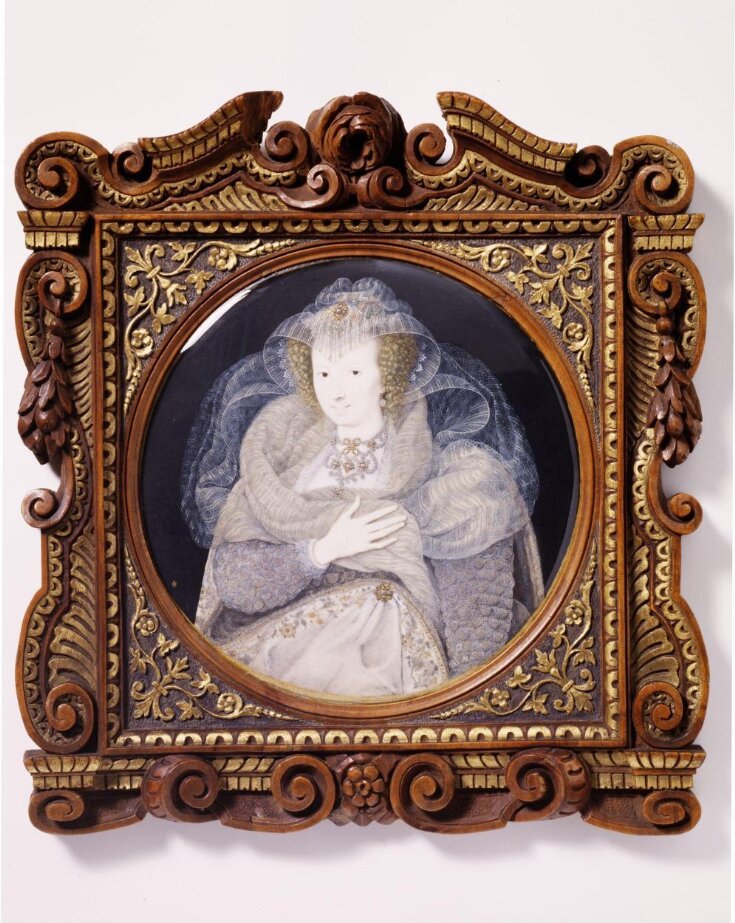
This miniature, one of Oliver's masterpieces, could not be more different from the brightly coloured, brightly lit, iconic formality of his master, Nicholas Hilliard. An example of the influence that Oliver's trip in 1596 to Italy had on him, it is a virtuoso performance of chiaroscuro, or 'light and shade', rendered in monochromatic colouring, with subtle gradations from grey into grey-black, and delicately touched with white, gold and silver. The figure emerges from the shadows enveloped in billowing veils and with an elusive and enigmatic half smile reminiscent of Leonardo's Mona Lisa. These veils would have been a form of ‘undress’, and with the lady's gesture of hand on heart, indicate that this is a private love token.
Unfortunately the red pigment used at that time for painting features fades easily, and here one can only imagine the striking effect the colour of her cheeks and lips would have had, seen within the cool monochrome of this elegant work.
Unfortunately the red pigment used at that time for painting features fades easily, and here one can only imagine the striking effect the colour of her cheeks and lips would have had, seen within the cool monochrome of this elegant work.
Delve deeper
Discover more about this object

Object details
| Categories | |
| Object type | |
| Title | Unknown woman, formerly called Frances Howard, Countess of Somerset (generic title) |
| Materials and techniques | Watercolour on vellum stuck to plain card |
| Brief description | Portrait miniature of an unknown woman, formerly called Frances Howard, Countess of Somerset, watercolour on vellum, painted by Isaac Oliver, 1596-1600. |
| Physical description | Portrait miniature of a woman, circular, half-length, in a carved frame with scrolling at the edges. |
| Dimensions |
|
| Content description | Portrait of a woman, half-length, looking to front, with her right hand held to her breast. The sitter is wearing a veiled headdress which extends to her shoulders. |
| Styles | |
| Marks and inscriptions |
|
| Credit line | Purchased with Art Fund support and the assistance of the Pilgrim Trust |
| Object history | COLLECTIONS: James West (1704?-1772); sold at Langford’s 27th February 1773 (lot 74): “A large and remarkable fine haead of the Countess of Somerset”; bought Morgan, £3.17.6; Horace Walpole at Strawberry Hill (Description of the Villa…at Strawberry Hill, 1774, p. 98); sold Strawberry Hill sale, May 9th 1842 (13th day) (lot 52); bought by the 13th Earl of Derby for 18gns; Earl of Derby at Knowsley Hall; sold Christie’s June 8th 1971 (lot 80); purchased by the V&A with the aid of the N.A.C.F. and the Pilgrim Trust. |
| Subjects depicted | |
| Summary | This miniature, one of Oliver's masterpieces, could not be more different from the brightly coloured, brightly lit, iconic formality of his master, Nicholas Hilliard. An example of the influence that Oliver's trip in 1596 to Italy had on him, it is a virtuoso performance of chiaroscuro, or 'light and shade', rendered in monochromatic colouring, with subtle gradations from grey into grey-black, and delicately touched with white, gold and silver. The figure emerges from the shadows enveloped in billowing veils and with an elusive and enigmatic half smile reminiscent of Leonardo's Mona Lisa. These veils would have been a form of ‘undress’, and with the lady's gesture of hand on heart, indicate that this is a private love token. Unfortunately the red pigment used at that time for painting features fades easily, and here one can only imagine the striking effect the colour of her cheeks and lips would have had, seen within the cool monochrome of this elegant work. |
| Bibliographic references |
|
| Collection | |
| Accession number | P.12-1971 |
About this object record
Explore the Collections contains over a million catalogue records, and over half a million images. It is a working database that includes information compiled over the life of the museum. Some of our records may contain offensive and discriminatory language, or reflect outdated ideas, practice and analysis. We are committed to addressing these issues, and to review and update our records accordingly.
You can write to us to suggest improvements to the record.
Suggest feedback
You can write to us to suggest improvements to the record.
Suggest feedback
| Record created | December 15, 1999 |
| Record URL |
Download as: JSONIIIF Manifest
