Henrietta Anne, Duchess of Orleans
Portrait Miniature
1660-1661 (painted)
1660-1661 (painted)
| Artist/Maker | |
| Place of origin |
The word ‘miniature’ describes a technique of painting in watercolour rather than the size of a painting. Miniature painting developed as a separate art in the 16th century and in Britain it became predominantly a portrait art.
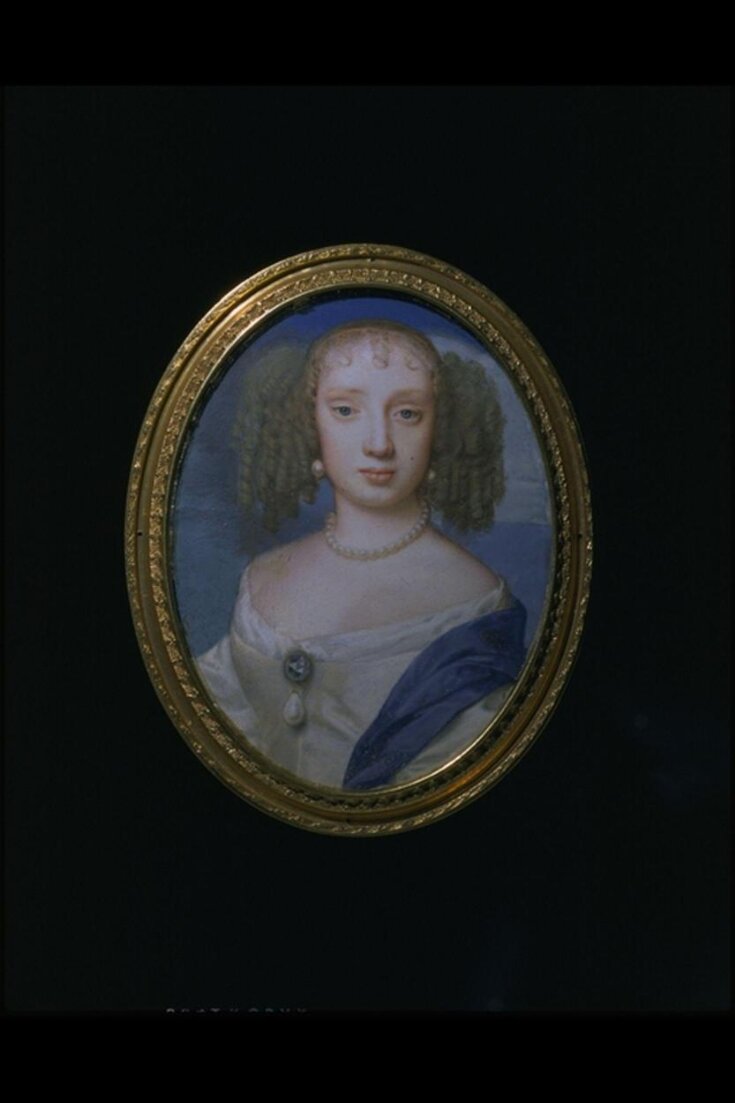
This miniature is inscribed in graphite on the back ‘Dutches of Orleance’, identifying the sitter as Princess Henrietta Anne, the youngest child of Charles I. She remained close to her brother, Charles II, after the Restoration, having married the Duke of Orleans, brother of Louis XIV, in 1661. The stark frontal treatment of her face is rarely found in Cooper’s work, and seems to represent a genuinely fresh response by Cooper to the particularity of Henrietta Anne’s looks and personality. It has even been suggested recently that it reflects her adopted French nationality, apparently resembling French Court portraiture and demonstrating ‘the sort of boldness and amorality which were already seen in England as associated with France’. It is certainly a very bold image, with Henrietta looking directly at the viewer wide-eyed and unabashed. It was undoubtedly painted in London before Henrietta moved back to France, where she had spent the Commonwealth years in exile with her siblings. Such was Cooper’s reputation internationally that foreigners sought him out when they were in London.
This miniature is inscribed in graphite on the back ‘Dutches of Orleance’, identifying the sitter as Princess Henrietta Anne, the youngest child of Charles I. She remained close to her brother, Charles II, after the Restoration, having married the Duke of Orleans, brother of Louis XIV, in 1661. The stark frontal treatment of her face is rarely found in Cooper’s work, and seems to represent a genuinely fresh response by Cooper to the particularity of Henrietta Anne’s looks and personality. It has even been suggested recently that it reflects her adopted French nationality, apparently resembling French Court portraiture and demonstrating ‘the sort of boldness and amorality which were already seen in England as associated with France’. It is certainly a very bold image, with Henrietta looking directly at the viewer wide-eyed and unabashed. It was undoubtedly painted in London before Henrietta moved back to France, where she had spent the Commonwealth years in exile with her siblings. Such was Cooper’s reputation internationally that foreigners sought him out when they were in London.
Object details
| Categories | |
| Object type | |
| Title | Henrietta Anne, Duchess of Orleans (generic title) |
| Materials and techniques | Watercolour on vellum, put down on a leaf from a table-book |
| Brief description | Portrait miniature of Henrietta Anne, Duchess of Orleans, watercolour on vellum, painted by Samuel Cooper, 1660-1661. |
| Physical description | Portrait, half-length, facing to front; the sitter is wearing a pearl necklace, earrings and a pendant on her dress. Features delicately hatched in brown and sanguine with slight grey shadow blended with white onto a pale creamy carnation ground; touches of white in the eyes; hair in pale brown wash, freely hatched in opaque browns and yellows; dress in white shadowed with yellow and grey; the jewel in dark grey-blue, hatched with darker colour and some white heightening; robe in blue wash, modelled with darker colour and with pale lights; sky and sea background in opaque washes; on vellum put down on a leaf from a table-book. Frame See Cat. No. 85. The frame is overall a smaller and simplified version of that on the James IT; the engraved laurel border is wider, but the centre remains blank, without cypher or inscriptions; on the front of the rim, the two inner rows of leaves are conflated, and separated from the outer laurel border by a plain cavetto moulding; the back has a plain bolection moulding; the hanger is a poor quality modern replacement. |
| Dimensions |
|
| Content description | Miniature portrait of a woman wearing a pearl necklace and earrings. |
| Styles | |
| Production type | Unique |
| Marks and inscriptions |
|
| Credit line | Bequeathed by George Salting |
| Object history | Provenance George Salting, by him bequeathed to the Museum, 1910. The earlier history is obscure. Long (l) stated that Salting acquired the miniature in 1893; the information probably came from Salting's notebooks, which are now lost. Foster on the other hand stated that it came from Propert's Collection, but Propert's Henrietta Anne was of the Mignard/ Petitot type (2) and cannot have been this miniature. Foster's no. 258, apparently from the E M Hodgkin Collection, might from his description be compatible with the miniature under discussion, but Foster's possibly unreliable record is that the miniature was still with Hodgkin in 1914-16.(3) Foster also refers to a portrait said to be of Henrietta Anne by Cooper, (4) but he gives no description. A Sotheby provenance, as might be suggested by the frame type, cannot be sustained by the references to a Duchess of Orleans in the Sotheby MSS: (5) Charles Sotheby bought his Henrietta Anne from Whitehead the dealer in 1865, but he is unlikely to have sold an object of this quality soon after buying it. |
| Subjects depicted | |
| Summary | The word ‘miniature’ describes a technique of painting in watercolour rather than the size of a painting. Miniature painting developed as a separate art in the 16th century and in Britain it became predominantly a portrait art. This miniature is inscribed in graphite on the back ‘Dutches of Orleance’, identifying the sitter as Princess Henrietta Anne, the youngest child of Charles I. She remained close to her brother, Charles II, after the Restoration, having married the Duke of Orleans, brother of Louis XIV, in 1661. The stark frontal treatment of her face is rarely found in Cooper’s work, and seems to represent a genuinely fresh response by Cooper to the particularity of Henrietta Anne’s looks and personality. It has even been suggested recently that it reflects her adopted French nationality, apparently resembling French Court portraiture and demonstrating ‘the sort of boldness and amorality which were already seen in England as associated with France’. It is certainly a very bold image, with Henrietta looking directly at the viewer wide-eyed and unabashed. It was undoubtedly painted in London before Henrietta moved back to France, where she had spent the Commonwealth years in exile with her siblings. Such was Cooper’s reputation internationally that foreigners sought him out when they were in London. |
| Bibliographic reference | Murdoch, John. Seventeenth-century English Miniatures in the collection of the Victoria and Albert Museum. London: The Stationery Office, 1997. |
| Collection | |
| Accession number | P.110-1910 |
About this object record
Explore the Collections contains over a million catalogue records, and over half a million images. It is a working database that includes information compiled over the life of the museum. Some of our records may contain offensive and discriminatory language, or reflect outdated ideas, practice and analysis. We are committed to addressing these issues, and to review and update our records accordingly.
You can write to us to suggest improvements to the record.
Suggest feedback
You can write to us to suggest improvements to the record.
Suggest feedback
| Record created | December 15, 1999 |
| Record URL |
Download as: JSONIIIF Manifest
