Please complete the form to email this item.
-
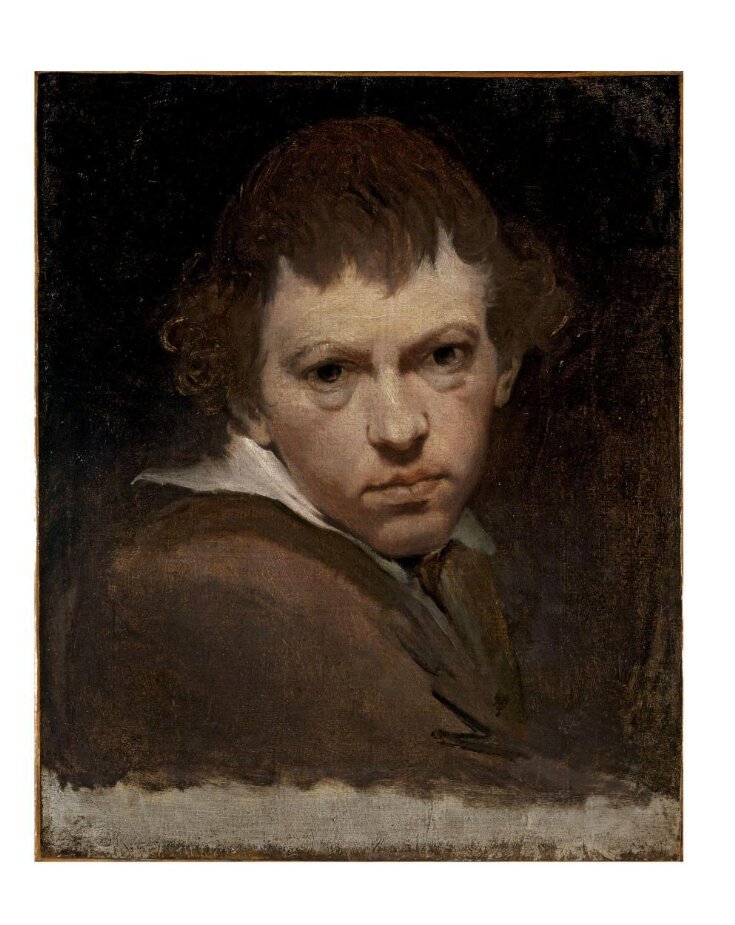
Self-Portrait
James Barry, born 1741 - died 1806 - Enlarge image
Explore related objects
-
Category
-
Material
-
Subject
-
Style
-
Technique
-
Name
-
Place
-
Exhibition
-
Gallery
-
Collection
Self-Portrait; Portrait of the Artist
- Object:
Oil painting
- Place of origin:
Great Britain, UK (probably, painted)
- Date:
ca. 1777 (painted)
- Artist/Maker:
James Barry, born 1741 - died 1806 (painter (artist))
- Materials and Techniques:
oil on canvas
- Credit Line:
Bequeathed by John M. Parsons
- Museum number:
564-1870
- Gallery location:
Paintings, room 82, case SOUTH WALL
- Download image
Barry was born in Ireland and settled in London in 1771. This self-portrait is an intense depiction of himself. His preference for grand historical subjects over conventional portraiture meant he had few wealthy patrons and Barry died in poverty in 1806.
Physical description
We see Barry here on the evidence of his apparent age during or just after the completion of his greatest work, the cycle of oils commissioned for the Adelphi. He depicts himself perhaps contemplating the results of recent hardships in painting this commission gratis.
Place of Origin
Great Britain, UK (probably, painted)
Date
ca. 1777 (painted)
Artist/maker
James Barry, born 1741 - died 1806 (painter (artist))
Materials and Techniques
oil on canvas
Dimensions
Height: 42 cm, Width: 34.4 cm, Height: 56.5 cm frame, Width: 49 cm frame
Object history note
Bequeathed by John M. Parsons, 1870
Descriptive line
Oil painting, Self Portrait by James Barry, ca, 1777.
Bibliographic References (Citation, Note/Abstract, NAL no)
James Barry, 1741-1806 : 'the great historical painter ' / editor: Tom Dunne ; with contributions by William L. Pressly ... [et al.]. Cork : Crawford Art Gallery, 2005, p. 68.
Exhibition catalogue
Sturgis, Alexander, Rupert Christiansen, Lois Oliver and Michael Wilson Rebels and Martyrs. The Image of the Artist in the Nineteen Century. London: The National Gallery Company Limited, 2006. ISBN: 1857093461
Exhibition catalogue
100 Great Paintings in The Victoria & Albert Museum. London: V&A, 1985, p. 72
The following is the full text of the entry:
"James Barry 1741-1806
British School
SELF PORTRAIT
Oil on paper, 42 X 34.4 cm
564-1870
In his fourth discourse, Sir Joshua Reynolds states that 'History painting and sculpture should be the main views of any people desirous of gaining honours by the Arts. These are the texts by which the national character will be judged in the after ages.' Barry's uncompromising adherence to this doctrine and his vehement criticism of those who fell short in this matter was eventually to lead to his expulsion from the Royal Academy in 1799.
We see him here, on the evidence of his apparent age, during, or just after the completion of his greatest work; the cycle of oils commissioned by the Society for the Encouragement of Arts, Manufactures and Commerce in 1777 to decorate their rooms in the Adelphi. Each of these massive paintings - the largest being 12 feet by 43 feet - symbolizes a crucial episode in the attainment of 'human culture'. It is only in the context of this series and of Barry's relationship with his contemporaries at the Academy that we can fully understand this depiction of himself.
In one panel of the cycle he uses his own portrait as that of the classical Greek artist Timanthes. Though not a study for Timanthes, the present portrait is certainly a closely related work. Within the Adelphi cycle Barry subtly deflects meaning away from a celebration of the achievements of the society, towards a declaration of the artist's central role in the process of civilization. Such an act exemplifies his conception of the primary function of his profession and makes clear his identification of himself as the chief civilizing influence, and by extension, 'saviour', in Britain at the time. When seen in the light of his quarrelsome relationship with the Academy, this observation allows us to make a distinction between the abstracted look that traditionally signifies intellectual concerns in contemporary self-portraiture and Barry's pensive expression here - clearly we are looking to the face of a martyr.
Barry's attitude to portraiture is often misunderstood. Though a less elevated genre than History, it was certainly of the second order, and thus not beneath his interest. However, artists who specialized in portraits, he believed, could not attempt History, for they were 'incapable of studying the entire man, body and mind'; nevertheless, a History painter could 'occasionally confine himself to any part of his subject (i.e. the face) and carry a meaning, a dignity and a propriety into his work that a mere portrait painter must be a stranger to.' In these ideas he is consistent with general European History theory, which not only considered the human figure art's most expressive vehicle, but in the study of physiognomy as codified by Le Brun, considered facial expression capable of embodying man's intellect and soul.
Barry depicts himself here perhaps contemplating not only his recent hardships in painting the Adelphi gratis, but also in a wider sense the project's demonstration of the fundamentally untenable position of the British painter of History. His resultant posture as martyred saviour helps explain his importance for historians of Romanticism; for in this role his classicism can be connected to the cult of melancholy and alienation that was later to surround the Romantic philosopher Jean Jacques Rousseau.
Christopher Titterington"
James Barry, 1741-1806 : 'the great historical painter ' / editor: Tom Dunne ; with contributions by William L. Pressly ... [et al.]. exh.cat. Cork: Crawford Art Gallery, 2005, p. 68, cat. no. P.3
The following is the full text of the entry:
" P.3
Self-Portrait Sketch
c.1780, oil on canvas, 42 x 34.3 cm (Pressly P63)
(Victoria and Albert Museum)
Beginning in the Renaissance, artists and creative figures in general adopted the two pre-eminent concepts derived from antiquity concerning the origins of genius. On the one hand, Plato had described the furor poeticus, or poetic frenzy, as being of divine origin, while, on the other, the Aristotelian tradition argued that genius is attributable to the melancholy humour. While these arguments - one positing a supernatural origin, the other offering a naturalistic one - were philosophically incompatible, this stopped few from simultaneously embracing both. Each depicts the creative genius as a man of exceptional powers who stands apart, and the Aristotelian view in particular encourages seeing creativity as a solitary pursuit, requiring introspective meditation rather than a life of sociability. Barry identified strongly with the role of melancholy genius, but his exploration of this theme occurs most frequently in his intimate, private works.
The artist's small oil sketch of c.1780 belongs to the category of the brooding, intense, melancholy genius. While Rembrandt provides a stylistic source of inspiration, the content is an early expression of the Romantic movement's obsession with the artist as an alienated and tortured soul. His eyes cast in shadow, inhabiting a dark, nightmarish world, Barry grimly looks out at the viewer. The slashes of paint at the lower right suggest his arm is extended out to the side, giving this work a sense of direct immediacy as if he is recording himself in the act of painting. The creamy whites defining the forehead suggest the artist's intellectual powers; at the same time the partings of the fringe at either side suggest horns. This is the artist as defiant rebel, one of the fallen angels who is here a rival to God as the Supreme Creator. Yet this defiance comes at a cost, Barry revealing the agonising nature of this lonely and arduous undertaking.
Barry's later self-portraits, executed as private drawings (cat. DR48-DR50) or as prints with limited circulation (cat. PR40), continue to depict the haunted and haunting face of the long-suffering melancholy genius. But in these later works he shows the reverse side of the coin, exploring instead the long-standing connection between melancholy genius and Christ as the Man of Sorrows. All these works, however, have in common the acute sadness and defiant courage required of the artist in his painful struggles."
Pressly, William L. James Barry: the artist as hero. exh.cat. London: Tate Gallery, 1983, p.150-151, cat. no. 93
The following is the full text of the entry:
"93 SELF-PORTRAIT, A SKETCH c.1780
Oil on canvas, 16½ x 13½ (42 x 34.3)
Pressly: P63
Victoria and Albert Museum. London
Recalling Edward Fryer's comment that in Barry's face 'one could see lines prematurely engraven by the workings of impassioned mind, so that he appeared older than he really was' (Works, I. p.337), one might tentatively date this work to around 1780, when the artist was in his late thirties or early forties. This small, intimate portrayal in a Rembrandtesque mode may well have been executed as part of the preparation for his self-portrait as Timanthes in the painting 'Crowning the Victors at Olympia' (no.28C). Of course the figure only loosely approximates the final pose, but this is also the case of the male model (see no.78) which was sketched in preparation for a figure of an athlete that appears in this same painting.
It is a work of gripping power. At this period only Fuseli was capable of such an emotionally intense self-image. One senses the artist's defiant determination in the face of his bitter loneliness and haunting fears. In later years W.H. Curran described Barry's appearance, and his account captures some of the fierce, almost demonic, energy present in this painting:
His face was striking. An Englishman would
call it an Irish, an Irishman a Munster face; but
Barry's had a character independent of national
or provincial peculiarities. It had vulgar
features, but no vulgar expression. It was
rugged, austere, and passion-beaten; but the
passions traced there were those of aspiring
thought, and unconquerable energy, asserting
itself to the last, and sullenly exulting in its
resources (Sketches of the Irish Bar, London,
1855, II, p.174)."
Vikutoria & Arub?to Bijutsukan-z? : eikoku romanshugi kaigaten = The Romantic tradition in British painting, 1800-1950 : masterpieces from the Victoria and Albert Museum / selected by Mark Evans [Japan : Brain Trust], 2002. 185 p. : ill. (chiefly col.) ; 30 cm.
Exhibition History
Rebels and Martyrs. The Image of the Artist in the Nineteen Century (National Gallery (London) 28/06/2006-28/08/2006)
James Barry, 1741-1806 : 'the great historical painter ' (Crawford Art Gallery, Cork 25/10/2005-28/02/2006)
The Romantic Tradition in British Painting 1800-1950: Masterpieces from the Victoria and Albert Museum (Prefectural Museum of Art, Hyogo, Kobe, Japan 28/01/2003-06/04/2003)
The Romantic Tradition in British Painting 1800-1950: Masterpieces from the Victoria and Albert Museum (Koriyama City Museum of Art 22/11/2002-27/12/2002)
The Romantic Tradition in British Painting 1800-1950: Masterpieces from the Victoria and Albert Museum (Matsuzakaya Museum, Nagoya, Japan 19/10/2002-11/11/2002)
The Romantic Tradition in British Painting 1800-1950: Masterpieces from the Victoria and Albert Museum (Chiba Prefectural Museum of Art, Japan 24/08/2002-06/10/2002)
Materials
Oil paint; Canvas
Techniques
Oil painting
Subjects depicted
Barry, James
Categories
Portraits; Paintings
Collection code
PDP

