St. George and the Dragon
Relief
ca. 1550 - 1600 (made)
ca. 1550 - 1600 (made)
| Artist/Maker | |
| Place of origin |
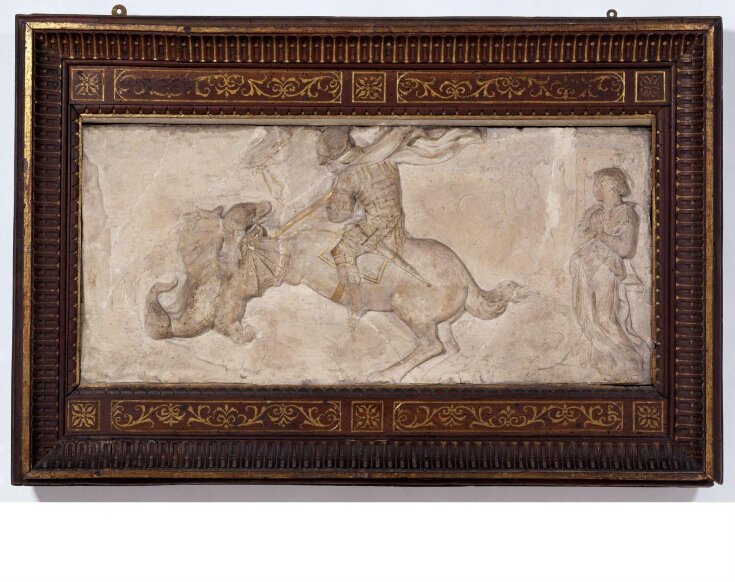
This relief is a cast from the marble relief of Donatello’s St George and the Dragon, which was carved at the foot of the niche for his statue of St George on Orsanmichele, Florence in 1417. The marble relief is the first example in Donatello’s work of shallow relief carving and includes linear perspective. The stucco replica perhaps dates from the 16th century. The replica does not represent the full height of the marble relief and is slightly cut above the horse’s head and beneath the hooves. The areas to the right of the princess and to the left of the entrance to the cave are also omitted. The stucco is broken irregularly down the right edge and repaired on the left and was perhaps at one time complete. The frame seems to date from the mid 16th century.
Orsanmichele had a double function in the fifteenth century as a church and grain market. In 1404 the guilds of Florence were invited to decorate the niches on its exterior. Each commissioned statues of its patron saint, in bronze for the major guilds and marble for the lesser ones.
Orsanmichele had a double function in the fifteenth century as a church and grain market. In 1404 the guilds of Florence were invited to decorate the niches on its exterior. Each commissioned statues of its patron saint, in bronze for the major guilds and marble for the lesser ones.
Object details
| Categories | |
| Object type | |
| Parts | This object consists of 2 parts.
|
| Title | St. George and the Dragon (generic title) |
| Materials and techniques | Stucco, painted and gilded in low relief |
| Brief description | Relief, 'St George and the Dragon', stucco, painted and gilded in low relief in wooden frame, after Donatello, Italy (Florence), ca. 1550-1600 (?) |
| Physical description | Relief shows in the centre St. George, in left profile on a rearing horse, drives his spear into the dragon. To the right stands the princess before a portico. Five trees are visible in the distance on the right side of the relief |
| Dimensions |
|
| Gallery label | ST GEORGE AND THE DRAGON
About 1417
After Donatello (about 1386-1466)
This is a partial cast of a marble relief beneath the tabernacle of the Armourers' Guild, originally made for Orsanmichele in Florence. The arcade to the right of the princess (only partially shown in this cast) is one of the most important early examples of linear perspective used to define space.
Italy, Florence
Painted and gilded stucco
Museum no. 7607-1861(2008) |
| Object history | The relief is a cast from the marble relief of St. George and the Dragon beneath the tabernacle of he Arte dei Corrazzai on Or San Michele, Florence. The marble relief was carved by Donatello about 1417, and the stucco replica perhaps dates from the sixteenth century. The replica does not represent the full height of the marble relief, and is slightly cut above the horse's head and beneath the hooves. |
| Subjects depicted | |
| Summary | This relief is a cast from the marble relief of Donatello’s St George and the Dragon, which was carved at the foot of the niche for his statue of St George on Orsanmichele, Florence in 1417. The marble relief is the first example in Donatello’s work of shallow relief carving and includes linear perspective. The stucco replica perhaps dates from the 16th century. The replica does not represent the full height of the marble relief and is slightly cut above the horse’s head and beneath the hooves. The areas to the right of the princess and to the left of the entrance to the cave are also omitted. The stucco is broken irregularly down the right edge and repaired on the left and was perhaps at one time complete. The frame seems to date from the mid 16th century. Orsanmichele had a double function in the fifteenth century as a church and grain market. In 1404 the guilds of Florence were invited to decorate the niches on its exterior. Each commissioned statues of its patron saint, in bronze for the major guilds and marble for the lesser ones. |
| Bibliographic references |
|
| Collection | |
| Accession number | 7607&A-1861 |
About this object record
Explore the Collections contains over a million catalogue records, and over half a million images. It is a working database that includes information compiled over the life of the museum. Some of our records may contain offensive and discriminatory language, or reflect outdated ideas, practice and analysis. We are committed to addressing these issues, and to review and update our records accordingly.
You can write to us to suggest improvements to the record.
Suggest feedback
You can write to us to suggest improvements to the record.
Suggest feedback
| Record created | December 15, 1999 |
| Record URL |
Download as: JSONIIIF Manifest
