Writing Box
1700-1800 (made)
| Artist/Maker | |
| Place of origin |
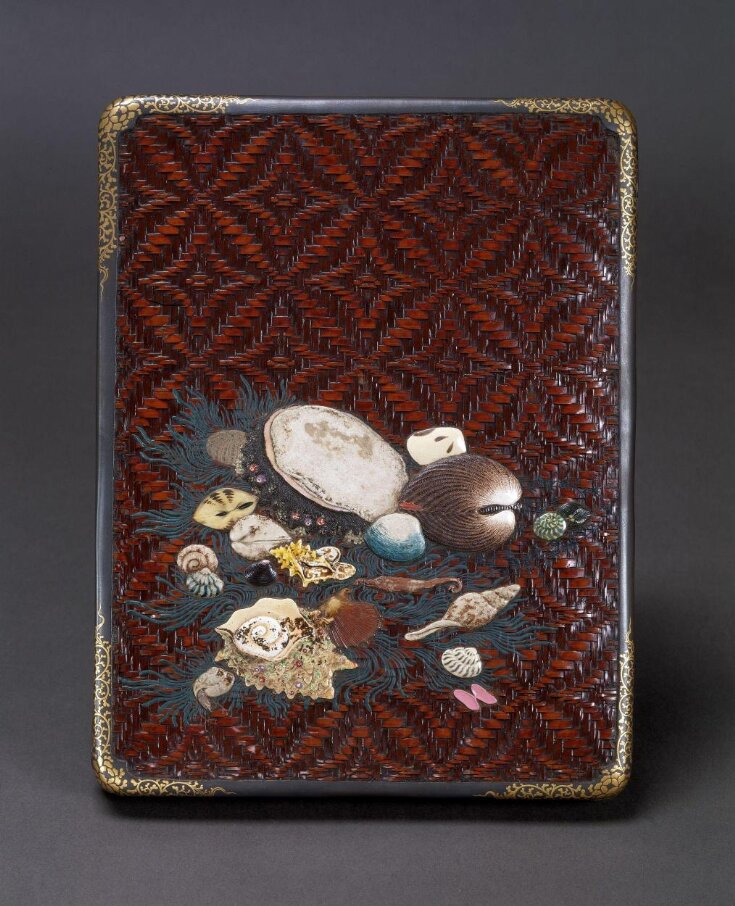
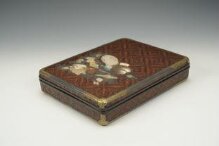
Writing box (suzuribako); lacquered bamboo in two shades plaited in a repeated pattern with a group of fishes and seaweed in lacquer, carved and lacquered wood, pottery, tortoiseshell and horn; the box contains a frame with an ink stone in the form of Ebisu (God of Good Fortune) in green, black and yellow pottery and a water bottle in bronze in the shape of a fish, on the upper surface are shells in other metals, Japan.
Object details
| Categories | |
| Object type | |
| Parts | This object consists of 6 parts.
|
| Materials and techniques | Wood, covered in woven bamboo and decorated in lacquer, enamelled pottery and horn |
| Brief description | Writing box (suzuribako); lacquered bamboo in two shades plaited in a repeated pattern with a group of molluscus and seaweed in lacquer, carved and lacquered wood, pottery, tortoise shell and horn; the box contains a frame with an ink stone in the form of Ebisu (God of Good Fortune) in green, black and yellow pottery and a water bottle in bronze in the shape of a fish, on the upper surface are shells in other metals, Japan, 17th-18th century. |
| Physical description | Writing box (suzuribako); lacquered bamboo in two shades plaited in a repeated pattern with a group of fishes and seaweed in lacquer, carved and lacquered wood, pottery, tortoiseshell and horn; the box contains a frame with an ink stone in the form of Ebisu (God of Good Fortune) in green, black and yellow pottery and a water bottle in bronze in the shape of a fish, on the upper surface are shells in other metals, Japan. |
| Dimensions |
|
| Style | |
| Credit line | Tomkinson Memorial Fund |
| Subject depicted | |
| Bibliographic reference | Japanese Art: the great European collections. vol. 4. Kodansha International, 1994. Colour plate No.50-51. |
| Collection | |
| Accession number | W.56 to E-1922 |
About this object record
Explore the Collections contains over a million catalogue records, and over half a million images. It is a working database that includes information compiled over the life of the museum. Some of our records may contain offensive and discriminatory language, or reflect outdated ideas, practice and analysis. We are committed to addressing these issues, and to review and update our records accordingly.
You can write to us to suggest improvements to the record.
Suggest feedback
You can write to us to suggest improvements to the record.
Suggest feedback
| Record created | December 15, 1999 |
| Record URL |
Download as: JSONIIIF Manifest
