Bodhisattva
Figure
1200-1250 (made)
1200-1250 (made)
| Artist/Maker | |
| Place of origin |
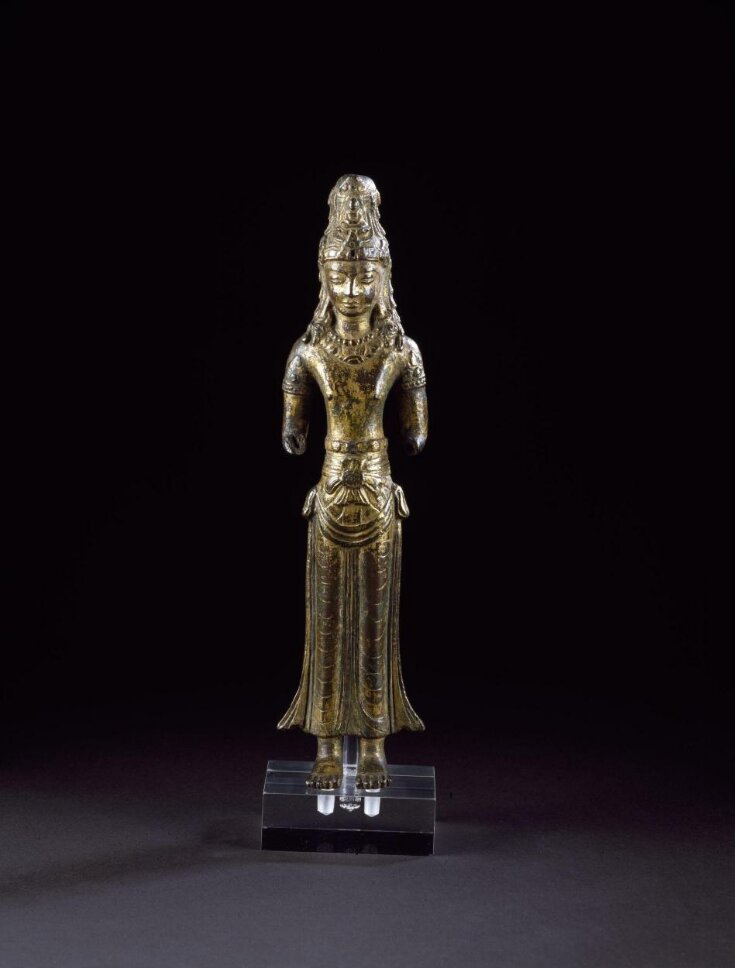
This gilt bronze piece is a rare and distinctive Buddhist figure made in the Yunnan region of south-west China in a style reflecting influences from India, Tibet, Burma, China and south-east Asia. At the time it was cast, between 1200-1250, Yunnan was an independent kingdom ruled by the Duan family. The figure represents Avalokitesvara (or Guanyin in Chinese), one of the holy beings (or Bodhisattvas) of the Buddhist tradition who has obtained the final enlightenment, but chosen to return to earth to help humanity. The Duan kings believed that an Indian monk of the 7th century, who was said to have introduced Buddhism to the kingdom, was actually the embodiment of the Bodhisattva Guanyin. He took the form of an Indian monk, hence the princely Indian dress of this figure. Images of Bodhisattvas were used in temples and shrines, and were particularly popular among devotees. Guanyin is specifically associated with the virtue of compassion and was considered a tutelary divinity for the royal house.
Object details
| Categories | |
| Object type | |
| Title | Bodhisattva (generic title) |
| Materials and techniques | Gilt bronze |
| Brief description | Met, China, human figures |
| Physical description | This Bodhisattva is known as Guanyin Acuoye, who was a deity worshipped in the 13th century in Dali Kingdom, in present-day Yunnan province. |
| Dimensions |
|
| Credit line | Purchased with Art Fund support, the Vallentin Bequest, Sir Percival David and the Universities China Committee |
| Object history | exhibited in Ghent 1979-80 |
| Subjects depicted | |
| Summary | This gilt bronze piece is a rare and distinctive Buddhist figure made in the Yunnan region of south-west China in a style reflecting influences from India, Tibet, Burma, China and south-east Asia. At the time it was cast, between 1200-1250, Yunnan was an independent kingdom ruled by the Duan family. The figure represents Avalokitesvara (or Guanyin in Chinese), one of the holy beings (or Bodhisattvas) of the Buddhist tradition who has obtained the final enlightenment, but chosen to return to earth to help humanity. The Duan kings believed that an Indian monk of the 7th century, who was said to have introduced Buddhism to the kingdom, was actually the embodiment of the Bodhisattva Guanyin. He took the form of an Indian monk, hence the princely Indian dress of this figure. Images of Bodhisattvas were used in temples and shrines, and were particularly popular among devotees. Guanyin is specifically associated with the virtue of compassion and was considered a tutelary divinity for the royal house. |
| Bibliographic reference | Yetts C115 |
| Collection | |
| Accession number | M.155-1938 |
About this object record
Explore the Collections contains over a million catalogue records, and over half a million images. It is a working database that includes information compiled over the life of the museum. Some of our records may contain offensive and discriminatory language, or reflect outdated ideas, practice and analysis. We are committed to addressing these issues, and to review and update our records accordingly.
You can write to us to suggest improvements to the record.
Suggest feedback
You can write to us to suggest improvements to the record.
Suggest feedback
| Record created | December 15, 1999 |
| Record URL |
Download as: JSONIIIF Manifest
