
Miniature
1645-1650 (made)
| Artist/Maker | |
| Place of origin |
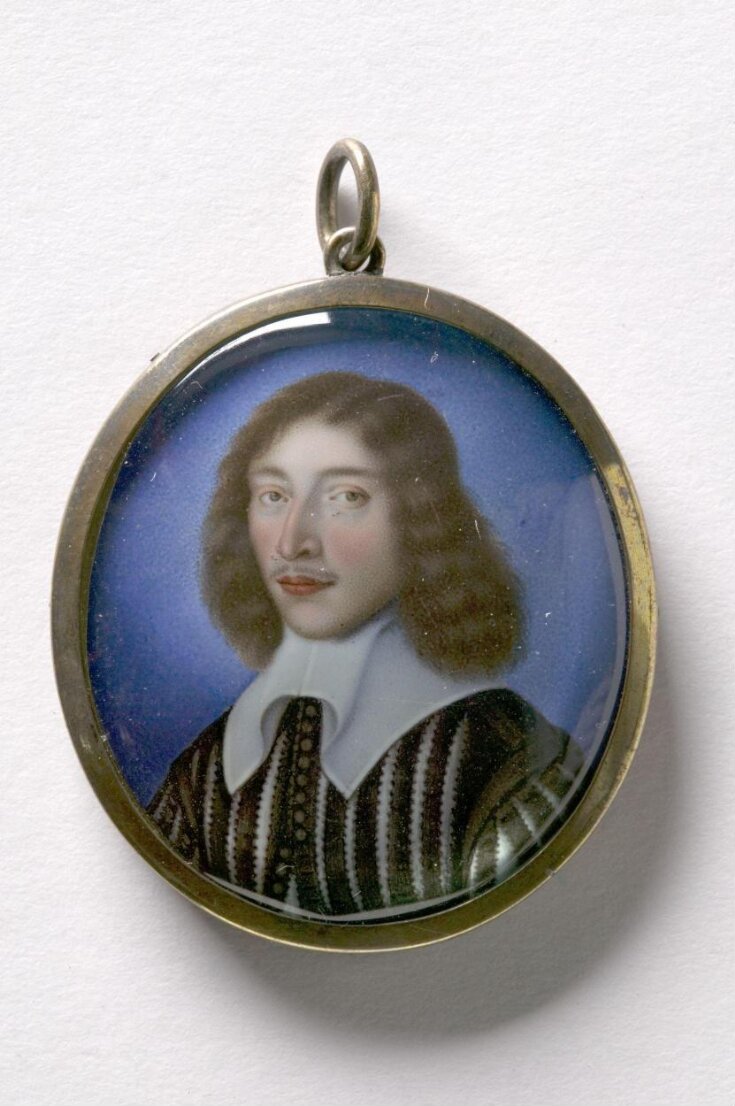
The artist Paul Prieur probably learned enamel painting in Paris around 1640. He worked at the Danish court from 1655, where he was the first to produce portrait miniatures in enamel. Here he has applied the colours in small dots, a technique known as 'stippling'.
In the 17th century, new techniques of painting enamels allowed delicate portraits resembling tiny oil paintings to be created. These enamel miniatures were first fashionable in continental Europe, but were particularly in vogue in Britain from the 1720s to 1760s. Painted enamels were made by firing finely milled glass which had been coloured with metal oxides onto a metal base, usually gold or copper. The colours had to be applied and fired in several stages, according to the firing temperature required by each colour. Incredible precision was needed for a successful enamel portrait, since each firing carried risks of cracks and bubbles that might ruin the entire effort.
Sir Arthur Gilbert and his wife Rosalinde formed one of the world's great decorative art collections, including silver, mosaics, enamelled portrait miniatures and gold boxes. Arthur Gilbert donated his extraordinary collection to Britain in 1996.
In the 17th century, new techniques of painting enamels allowed delicate portraits resembling tiny oil paintings to be created. These enamel miniatures were first fashionable in continental Europe, but were particularly in vogue in Britain from the 1720s to 1760s. Painted enamels were made by firing finely milled glass which had been coloured with metal oxides onto a metal base, usually gold or copper. The colours had to be applied and fired in several stages, according to the firing temperature required by each colour. Incredible precision was needed for a successful enamel portrait, since each firing carried risks of cracks and bubbles that might ruin the entire effort.
Sir Arthur Gilbert and his wife Rosalinde formed one of the world's great decorative art collections, including silver, mosaics, enamelled portrait miniatures and gold boxes. Arthur Gilbert donated his extraordinary collection to Britain in 1996.
Object details
| Categories | |
| Object type | |
| Materials and techniques | Enamel on gold, frame a silver-copper alloy |
| Brief description | Enamel miniature on gold, in a silver-copper alloy frame, Paris, 1645-50, by Paul Prieur. |
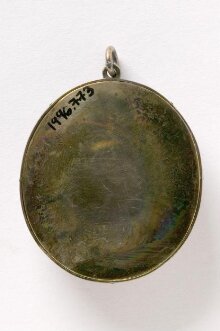
| Physical description | Oval portrait miniature of a gentleman with long brown hair and a slight moustache wearing a white lawn collar, a white shirt with a black slashed doublet. The miniature is enamel on gold and the frame is a silver copper alloy. |
| Dimensions |
|
| Gallery label |
|
| Credit line | The Rosalinde and Arthur Gilbert Collection on loan to the Victoria and Albert Museum, London |
| Object history | Provenance: Dr. Adolph List Collection, Magdeburg. Sale, Hans W. Lange, Berlin, lot 511, 28-30 March 1939. Galerie Dr. Hans Rudolph, Hamburg, Hotel Atlantic, lot 180, 28-29 September 1950. Günther Muthmann Collection, Wuppertal. Sale, Sotheby's Zurich, lot 35, 17/05/1979. Acquired by Arthur Gilbert from S.J. Phillips Ltd, London, 1979. Adolph List's Jewish parents converted to Protestantism, but in 1937, an anonymous letter denounced him and his wife Clara Helene as Jewish. He was removed from his own company and died in 1938. After Adolph's death, his widow Clara Helene was made to prove that she was not of Jewish heritage. As a result, she was not persecuted by the Nazis on racial grounds. There is no indication that she was forced to sell her husband's collection at auction in 1939, or that the auction proceeds were seized from her. This object formed part of the V&A's special provenance display 'Concealed Histories: Uncovering the Story of Nazi Looting' (December 2019 - June 2021) |
| Subject depicted | |
| Summary | The artist Paul Prieur probably learned enamel painting in Paris around 1640. He worked at the Danish court from 1655, where he was the first to produce portrait miniatures in enamel. Here he has applied the colours in small dots, a technique known as 'stippling'. In the 17th century, new techniques of painting enamels allowed delicate portraits resembling tiny oil paintings to be created. These enamel miniatures were first fashionable in continental Europe, but were particularly in vogue in Britain from the 1720s to 1760s. Painted enamels were made by firing finely milled glass which had been coloured with metal oxides onto a metal base, usually gold or copper. The colours had to be applied and fired in several stages, according to the firing temperature required by each colour. Incredible precision was needed for a successful enamel portrait, since each firing carried risks of cracks and bubbles that might ruin the entire effort. Sir Arthur Gilbert and his wife Rosalinde formed one of the world's great decorative art collections, including silver, mosaics, enamelled portrait miniatures and gold boxes. Arthur Gilbert donated his extraordinary collection to Britain in 1996. |
| Bibliographic references |
|
| Other numbers |
|
| Collection | |
| Accession number | LOAN:GILBERT.295-2008 |
About this object record
Explore the Collections contains over a million catalogue records, and over half a million images. It is a working database that includes information compiled over the life of the museum. Some of our records may contain offensive and discriminatory language, or reflect outdated ideas, practice and analysis. We are committed to addressing these issues, and to review and update our records accordingly.
You can write to us to suggest improvements to the record.
Suggest feedback
You can write to us to suggest improvements to the record.
Suggest feedback
| Record created | June 26, 2008 |
| Record URL |
Download as: JSONIIIF Manifest
