
Florentine Court Cabinet and Clock
1704-1705 (made)
| Artist/Maker | |
| Place of origin |
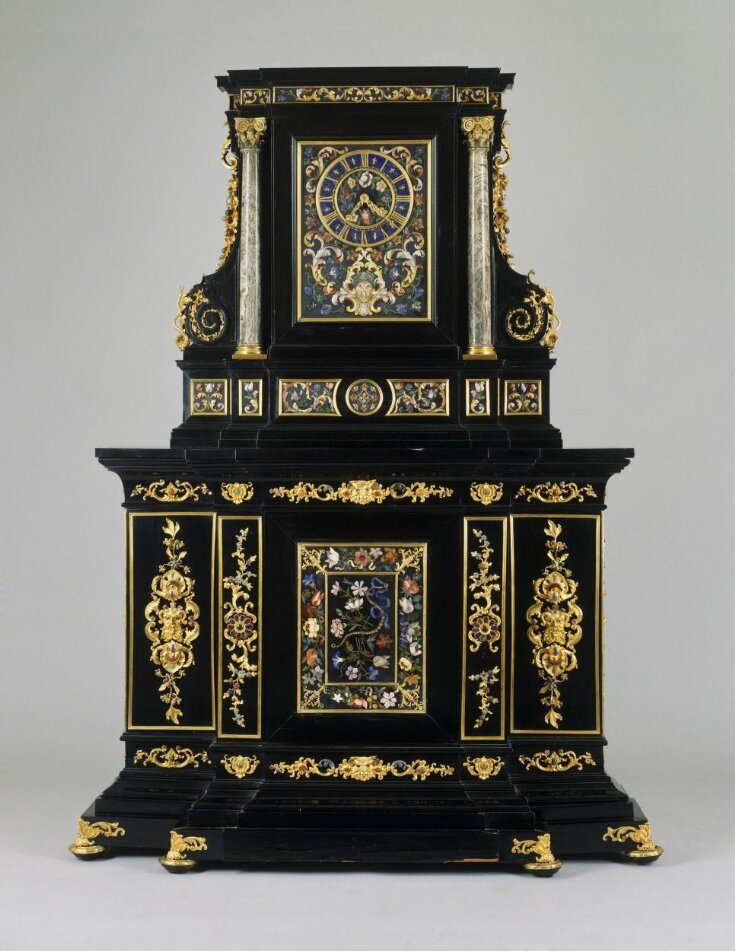
This extraordinary clock cabinet was made in the Grand Ducal workshops in Florence for the daughter of Grand Duke Cosimo III, Anna Maria Luisa de' Medici, who was married to the Elector Palatine, Johann Wilhelm von der Pfalz. When the elector died, Anna returned to Florence. She was the last of the Medici to live in the Pitti Palace. She left all the Medici treasures to the Florentine state, provided that nothing was ever removed from Florence.
The cabinet was not amongst the objects taken back to Florence by the Electress. It was made by two of the greatest artists of the time: Leonard van der Vinne and Giovanni Battista Foggini (1652-1725). Foggini was first appointed Grand Ducal sculptor in 1687, and in 1695 court architect as well as director of the Galleria dei lavori (Grand Ducal workshops). During his tenure (1694-1725) he introduced innovative high-relief carvings to the production of commessi di pietre dure objects. Many if his designs were cenceived as part of extravagent furnishing schemes for the Medici. Among its elegant details was the use of chalcedony to represent pearls - one of the ways in which Florentine workers showed their skill in making hardstone mosaics in the 17th century.
The face of Dionysos in the central panel of the top half of the cabinet was probably carved by the lapidarist Giuseppe Antonio Torricelli (1659-1719). The pink stone used for the skin is calcedonio di volterra, a stone that’s natural hues enhaced the realistic appearance of flesh and facial expressions.
The top half and central mosaic below predate the cabinet's enlargement, probably in the 19th century. Hittorff's clock movement has replaced an earlier English movement by Ignatius Huggeford. The cabinet was later acquired for Dorchester House, Park Lane, London.
Sir Arthur Gilbert and his wife Rosalinde formed one of the world's great decorative art collections, including silver, mosaics, enamelled portrait miniatures and gold boxes. Arthur Gilbert donated his extraordinary collection to Britain in 1996.
The cabinet was not amongst the objects taken back to Florence by the Electress. It was made by two of the greatest artists of the time: Leonard van der Vinne and Giovanni Battista Foggini (1652-1725). Foggini was first appointed Grand Ducal sculptor in 1687, and in 1695 court architect as well as director of the Galleria dei lavori (Grand Ducal workshops). During his tenure (1694-1725) he introduced innovative high-relief carvings to the production of commessi di pietre dure objects. Many if his designs were cenceived as part of extravagent furnishing schemes for the Medici. Among its elegant details was the use of chalcedony to represent pearls - one of the ways in which Florentine workers showed their skill in making hardstone mosaics in the 17th century.
The face of Dionysos in the central panel of the top half of the cabinet was probably carved by the lapidarist Giuseppe Antonio Torricelli (1659-1719). The pink stone used for the skin is calcedonio di volterra, a stone that’s natural hues enhaced the realistic appearance of flesh and facial expressions.
The top half and central mosaic below predate the cabinet's enlargement, probably in the 19th century. Hittorff's clock movement has replaced an earlier English movement by Ignatius Huggeford. The cabinet was later acquired for Dorchester House, Park Lane, London.
Sir Arthur Gilbert and his wife Rosalinde formed one of the world's great decorative art collections, including silver, mosaics, enamelled portrait miniatures and gold boxes. Arthur Gilbert donated his extraordinary collection to Britain in 1996.
Object details
| Categories | |
| Object type | |
| Parts | This object consists of 5 parts.
|
| Materials and techniques | Clock movement, pietre dure (hardstone), mother-of-pearl, gilt-bronze, ebonised wood, ebony and brass. |
| Brief description | A table clock composed of stone mosaic panels and gilt bronze elements, Giovanni Battista Foggini, Grand Ducal workshops, Florence, 1704-05; clock movement Johannes Hittorff, Bonn, 1704; on a lower section ca. 1860 (central panel in lower section ca. 1700). |
| Physical description | Cabinet of ebonised wood with a projecting middle section and a high, moulded plinth. The facade has three doors with gilt bronze grotesque mounts. The upper cabinet is of ebony with stone mosaicc (commessi di pietre dure) panels and includes a clock with a lapis lazuli dial mounted on a pietre dure grotesque face. It is of architectural form with elaborate carved volutes and columns. The interior is lined with silk and embroidered with the initials of Anna Maria, Electress Palatine; the lower section, circa 1860, of ebonised wood, gilt bronze, brass, etc. with an earlier commesso panel, circa 1700. |
| Dimensions |
|
| Marks and inscriptions | 'AMEP' (for Anna Maria Electress Palatine) embroidered in gold thread and surmounted by the coronet of the palatinate on the silk lining inside the clock cabinet |
| Gallery label |
|
| Credit line | The Rosalinde and Arthur Gilbert Collection on loan to the Victoria and Albert Museum, London. |
| Object history | Provenance: Anna Maria Luisa, Electress Palatine, Düsseldorf. Robert Staynor Holford. Sir George Lindsay Holford, Dorchester House, England. Sale, Christie's London, lot 81, 13-14 July 1927. Petite Musée, Montreal, Canada, 1974. Historical significance: The upper cabinet is the work of Leonardo van der Vinne (fl.1662-1713) and Giovanni Battista Foggini (1652-1725). The use of pietre dure in relief is typical of the Grand Ducal workshops under Foggini. His designs for similar work are contained in his journal of sketches preserved in Florence. The lower plinth was probably made for Robert Staynor Holford (1808-92) who bought the clock cabinet for display at his palatial London home, Dorchester House, Park Lane, which was designed by Lewis Vulliamy (1791-1871) based on the Villa Farnesina in Rome and built between 1857 and 1859. His collection included important Italian paintings, furniture and works of art. The lower plinth incorporates a panel which dates from about 1700 and incorporates the representation of a pearl necklace - a tromp l'oeil motif produced from the mid-17th century by the Florentine workshops. The art critic Filippo Baldinucci described a table made in 1658 for Cardinal Antonio Barberini (1608-71) citing 'the pearl necklace, so realistic that it deceives the eye and the hand too of anyone who touches it'. |
| Historical context | It is probable that the clock cabinet (the upper section) was made in 1704-05 as a present from Cosimo III de' Medici to his daughter Anna Maria Luisa (1667-1743) who had married the Elector Palatine, Johann Wilhelm von der Pfalz (r. 1690-1716), in 1691. Anna Maria Luisa returned to Florence after her husband's death where she enjoyed the Medici family collections. |
| Production | Upper section 1704-05; central panel on lower section ca. 1700; lower section ca. 1860. |
| Subjects depicted | |
| Summary | This extraordinary clock cabinet was made in the Grand Ducal workshops in Florence for the daughter of Grand Duke Cosimo III, Anna Maria Luisa de' Medici, who was married to the Elector Palatine, Johann Wilhelm von der Pfalz. When the elector died, Anna returned to Florence. She was the last of the Medici to live in the Pitti Palace. She left all the Medici treasures to the Florentine state, provided that nothing was ever removed from Florence. The cabinet was not amongst the objects taken back to Florence by the Electress. It was made by two of the greatest artists of the time: Leonard van der Vinne and Giovanni Battista Foggini (1652-1725). Foggini was first appointed Grand Ducal sculptor in 1687, and in 1695 court architect as well as director of the Galleria dei lavori (Grand Ducal workshops). During his tenure (1694-1725) he introduced innovative high-relief carvings to the production of commessi di pietre dure objects. Many if his designs were cenceived as part of extravagent furnishing schemes for the Medici. Among its elegant details was the use of chalcedony to represent pearls - one of the ways in which Florentine workers showed their skill in making hardstone mosaics in the 17th century. The face of Dionysos in the central panel of the top half of the cabinet was probably carved by the lapidarist Giuseppe Antonio Torricelli (1659-1719). The pink stone used for the skin is calcedonio di volterra, a stone that’s natural hues enhaced the realistic appearance of flesh and facial expressions. The top half and central mosaic below predate the cabinet's enlargement, probably in the 19th century. Hittorff's clock movement has replaced an earlier English movement by Ignatius Huggeford. The cabinet was later acquired for Dorchester House, Park Lane, London. Sir Arthur Gilbert and his wife Rosalinde formed one of the world's great decorative art collections, including silver, mosaics, enamelled portrait miniatures and gold boxes. Arthur Gilbert donated his extraordinary collection to Britain in 1996. |
| Bibliographic references |
|
| Other numbers |
|
| Collection | |
| Accession number | LOAN:GILBERT.74:1 to 4-2008 |
About this object record
Explore the Collections contains over a million catalogue records, and over half a million images. It is a working database that includes information compiled over the life of the museum. Some of our records may contain offensive and discriminatory language, or reflect outdated ideas, practice and analysis. We are committed to addressing these issues, and to review and update our records accordingly.
You can write to us to suggest improvements to the record.
Suggest feedback
You can write to us to suggest improvements to the record.
Suggest feedback
| Record created | June 26, 2008 |
| Record URL |
Download as: JSONIIIF Manifest
