
Hot-Water Urn
1742-1743 (marked)
| Artist/Maker | |
| Place of origin |
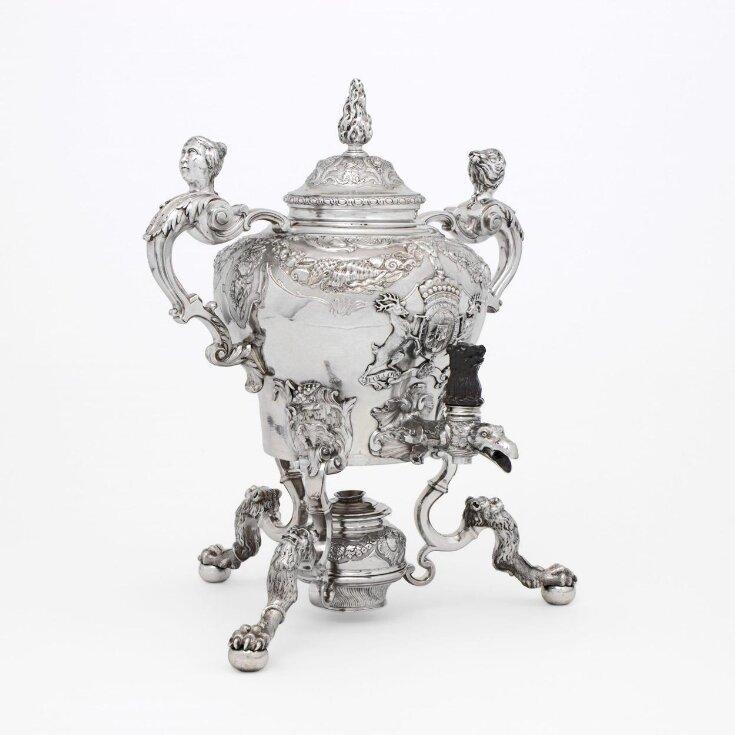
This is the earliest recorded English hot-water urn. The urn originally served the same function as the kettle. Sir John Campbell (1696-1782), for whom it was made, served as ambassador to Russia, Lord of the Admiralty and Keeper of the Privy Seal.
When the Catholic King Louis XIV revoked the Edict of Nantes in 1685, Huguenots (French Protestants) were forced to leave France or abjure their faith. Many were craftsmen who settled in London. Their technical skills and fashionable French style ensured the luxury silver, furniture, watches and jewellery they made were highly sought after. Huguenot specialists transformed English silver by introducing higher standards of craftsmanship. They promoted new forms, such as the soup tureen and sauceboat, and introduced a new repertoire of ornament, with cast sculptural details and exquisite engraving.
Sir Arthur Gilbert and his wife Rosalinde formed one of the world's great decorative art collections, including silver, mosaics, enamelled portrait miniatures and gold boxes. Arthur Gilbert donated his extraordinary collection to Britain in 1996.
When the Catholic King Louis XIV revoked the Edict of Nantes in 1685, Huguenots (French Protestants) were forced to leave France or abjure their faith. Many were craftsmen who settled in London. Their technical skills and fashionable French style ensured the luxury silver, furniture, watches and jewellery they made were highly sought after. Huguenot specialists transformed English silver by introducing higher standards of craftsmanship. They promoted new forms, such as the soup tureen and sauceboat, and introduced a new repertoire of ornament, with cast sculptural details and exquisite engraving.
Sir Arthur Gilbert and his wife Rosalinde formed one of the world's great decorative art collections, including silver, mosaics, enamelled portrait miniatures and gold boxes. Arthur Gilbert donated his extraordinary collection to Britain in 1996.
Object details
| Categories | |
| Object type | |
| Parts | This object consists of 4 parts. (Some alternative part names are also shown below)
|
| Materials and techniques | Silver and ebony |
| Brief description | Silver and wood, London hallmarks for 1742-3, mark of Peter Archambo |
| Physical description | The urn is of inverted baluster form and stands on three scroll feet that are each formed as a lion's paw above a plain, compressed spherical ball, the legs decorated with a lion mask and a scroll molding around the octagonal section above. The body has a flattened base and applied panels of shellwork at the junctions with the feet. A cast coat of arms for Sir John Campbell (showing the arms of Campbell with Pershall in pretence surrounded by the badge of the Order of the Bath) is applied to the front and back. The upper part of the body is chased with shells, scrolls, a goat mask, and faun masks on punched matted ground. The spout is shaped as a bird's head, with a carved ebony spigot in the form of boar's head, the heraldic crest of the Campbell family. The scroll handles are chased with foliage and surmounted by a female head. The hinged, domed cover, chased similarly to the upper part of the body, has an ovolo border and flame finial. The lamp is also of inverted baluster form chased with flowers and rococo cartouches on a matted ground; it is engraved four times with a crest and coronet. |
| Dimensions |
|
| Style | |
| Production type | Unique |
| Marks and inscriptions |
|
| Gallery label | 8. Hot water urn
1742–43
This is the earliest known English silver hot water urn. It was commissioned by Sir John Campbell, British ambassador to Russia, Lord
of the Admiralty and Keeper of the Privy Seal.
London, England; Peter Archambo (active 1720–50)
Silver
Museum no. Loan:Gilbert.674:1 to 4-2008(16/11/2016) |
| Credit line | The Rosalinde and Arthur Gilbert Collection on loan to the Victoria and Albert Museum, London |
| Object history | Provenance: John Campbell, third earl of Breadalbane.. The Campbell family. Purchased from Asprey and Company, London, 1986. Campbell had a distinguished career. Campbell married first in 1712 Lady Amabell de Grey, daughter of Henry Duke of Kent. In 1720 Campbell was appointed envoy-extraordinary and minister-plenipotentiary to the court of Denmark, where he remained until March 1729. While in Copenhagen he was invested with the Order of the Bath at its revival in May 1725 and styled Lord Glenorchy. After the death of his first wife he remairred Arabella Pershall in 1730. In December 1731 he became ambassador to Russia. In 1727 and 1734 he was elected MP for the borough of Saltash, and between 1741 and 1746 he represented Orford, Suffolk. He gave his support to Sir Robert Walpole's administration, and in May 1741 he was appointed one of the lords of the Admiralty, an office that he held until the dissolution of Walpole's government in 1742. In 1745 he was nominated master of the king's Jewel House. In February 1752 he succeeded his father as earl of Breadalbane; in July of that year he was chosen as a representative peer for Scotland and sat in the Lords (1752-68 and 1774-80). He was appointed lord chief justice in the eyre south of the Trent in 1756, an office he held until October 1765. He was keeper of the privy seal of Scotland (1765-6), was sworn of the privy council in May 1766, and was appointed vice-admiral of Scotland on 26 October 1776. He died at Holyroodhouse, Edinburgh, on 26 January 1782. |
| Historical context | Peter Archambo was the son of a staymaker of the same name who fled from Ile d'Oléron and Ile de Ré near La Rochelle in France. He was apprenticed to fellow Huguenot Jacob Margas in 1710 through the Butchers’ rather than Goldsmiths’ Company and obtained his freedom in 1720. The tea urn bears the sterling standard maker's mark PA in cursive script registered at Goldsmiths' Hall in 1739. when Archambo's address was at the sign of the Golden Cup, Coventry Street, near Piccadilly, London. This is the earliest known English tea urn, a form that may have originated in Scotland. It may be significant that this was supplied for a Scottish patron who had served as British Ambassador in Russia, where the tea urn or samovar was a national speciality. Peter Archambo's enjoyed the patronage of George Booth, 2nd Earl of Warrington. Archambo's spectacular wine fountain, 1728 weighting 575 ounces and 1729 wine cistern weighing 1,024oz can be seen in the museum room at the Earl of Warrington's former home Dunham Massey, Cheshire (National Trust). Archambo supplied Warrington with 13 dozen dinner plates and two dozen soup plates – over 4,000oz of silver. A set of six sconces for the Great Bedchamber, 1730, are embellished in relief with mythological subjects. Four are at Dunham Massey, and two at the Clark Art Institute, Williamstown, Masschusetts. |
| Subjects depicted | |
| Association | |
| Summary | This is the earliest recorded English hot-water urn. The urn originally served the same function as the kettle. Sir John Campbell (1696-1782), for whom it was made, served as ambassador to Russia, Lord of the Admiralty and Keeper of the Privy Seal. When the Catholic King Louis XIV revoked the Edict of Nantes in 1685, Huguenots (French Protestants) were forced to leave France or abjure their faith. Many were craftsmen who settled in London. Their technical skills and fashionable French style ensured the luxury silver, furniture, watches and jewellery they made were highly sought after. Huguenot specialists transformed English silver by introducing higher standards of craftsmanship. They promoted new forms, such as the soup tureen and sauceboat, and introduced a new repertoire of ornament, with cast sculptural details and exquisite engraving. Sir Arthur Gilbert and his wife Rosalinde formed one of the world's great decorative art collections, including silver, mosaics, enamelled portrait miniatures and gold boxes. Arthur Gilbert donated his extraordinary collection to Britain in 1996. |
| Bibliographic reference | Schroder, Timothy. The Gilbert collection of gold and silver, Los Angeles (Los Angeles County Museum of Art) 1988, cat. no. 68, pp. 265-7. ISBN.0875871445
Judith Banister, 'Peter Archambo, Free Butcher and Goldsmith', Country Life 9 June 1983 , pp.1594-5 |
| Other numbers |
|
| Collection | |
| Accession number | LOAN:GILBERT.674:1 to 4-2008 |
About this object record
Explore the Collections contains over a million catalogue records, and over half a million images. It is a working database that includes information compiled over the life of the museum. Some of our records may contain offensive and discriminatory language, or reflect outdated ideas, practice and analysis. We are committed to addressing these issues, and to review and update our records accordingly.
You can write to us to suggest improvements to the record.
Suggest feedback
You can write to us to suggest improvements to the record.
Suggest feedback
| Record created | June 26, 2008 |
| Record URL |
Download as: JSONIIIF Manifest
