
Snuffbox
ca.1830 (made)
| Artist/Maker | |
| Place of origin |
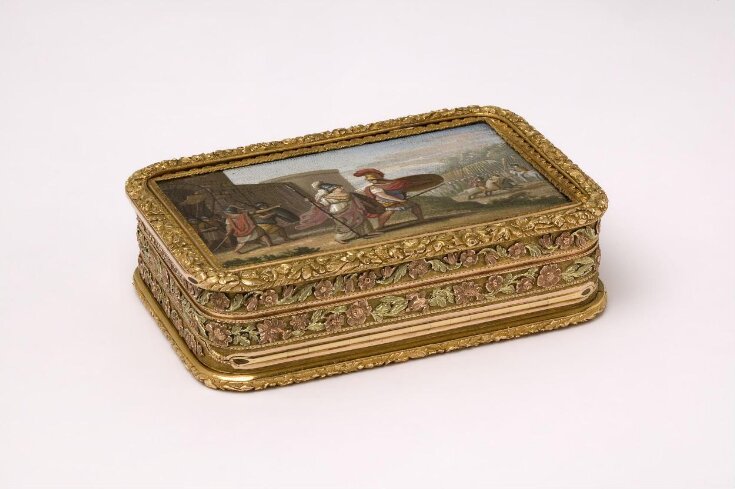
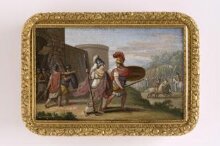
This snuffbox bears a number of markings which contradict each other, making it difficult to date this piece. Stylistically the work of the goldsmith would appear to date to about 1830. The earlier markings, that are not in agreement with this dating, would suggest that this box has been altered over the years. That this box has been modified is also evident when examining the micromosaic that adorns the cover. It is relatively rare to find mythological scenes depicted in micromosaic, and those that do exist tend to date from around 1820, the date put forward for this example. The frame that surrounds the micromosaic is of a different design to the one decorating the box, and does not have rounded corners. These details are further evidence that this micromosaic was probably added at a later date.
Micromosaics have their roots in the larger mosaics of ancient Rome used to decorate their walls and floors. The first micromosaics were created in the 18th century, but it was not until Arthur Gilbert himself became interested in collecting them and invented the term 'micromosaics' that they became known as such. The tesserae are minute pieces cut from thin pieces of glass known as smalti filati, and some of the finest micomosaics can consist of as many as 5,000 tesserae per square inch (ca. 3 by 3cm). By the late 18th century Rome had become central to the production of micromosaics and sold them as souvenirs to wealthy foreigners visiting the city. From small elegant snuffboxes to large monumental tabletops, micromosaics could be used to decorate objects of all shapes and sizes. They could even be made to resemble full-sized canvas paintings, and indeed Arthur Gilbert himself mistook his very first micromosaic for a painting. When he brought it home to show his wife, he had to convince her that it was not in fact a cracked painting, as she supposed, but a mosaic.
Sir Arthur Gilbert and his wife Rosalinde formed one of the world's great decorative art collections, including silver, mosaics, enamelled portrait miniatures and gold boxes. Arthur Gilbert donated his extraordinary collection to Britain in 1996.
Micromosaics have their roots in the larger mosaics of ancient Rome used to decorate their walls and floors. The first micromosaics were created in the 18th century, but it was not until Arthur Gilbert himself became interested in collecting them and invented the term 'micromosaics' that they became known as such. The tesserae are minute pieces cut from thin pieces of glass known as smalti filati, and some of the finest micomosaics can consist of as many as 5,000 tesserae per square inch (ca. 3 by 3cm). By the late 18th century Rome had become central to the production of micromosaics and sold them as souvenirs to wealthy foreigners visiting the city. From small elegant snuffboxes to large monumental tabletops, micromosaics could be used to decorate objects of all shapes and sizes. They could even be made to resemble full-sized canvas paintings, and indeed Arthur Gilbert himself mistook his very first micromosaic for a painting. When he brought it home to show his wife, he had to convince her that it was not in fact a cracked painting, as she supposed, but a mosaic.
Sir Arthur Gilbert and his wife Rosalinde formed one of the world's great decorative art collections, including silver, mosaics, enamelled portrait miniatures and gold boxes. Arthur Gilbert donated his extraordinary collection to Britain in 1996.
Object details
| Categories | |
| Object type | |
| Materials and techniques | Gold, malachite, micromosaic |
| Brief description | Varicoloured gold malachite panel, micromosaic panel, Austria, ca.1830 |
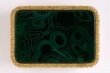
| Physical description | Rectangular varicoloured gold snuffbox with rounded corners and two hinged covers, one set with a malachite panel (restored), the other with a micromosaic panel depicting Athena exhorting Achilles to join battle with Troy, mounted in gold chased with foliage and flowers. |
| Dimensions |
|
| Marks and inscriptions |
|
| Credit line | The Rosalinde and Arthur Gilbert Collection on loan to the Victoria and Albert Museum, London |
| Object history | Provenance: Sotheby's, Geneva, 19-20 May, 1997, lot 414. Acquired by Arthur Gilbert from S.J. Phillips Ltd, London, 1997. |
| Production | The mosaic is Roman, and was made in ca.1820 |
| Subjects depicted | |
| Literary reference | Trojan wars |
| Summary | This snuffbox bears a number of markings which contradict each other, making it difficult to date this piece. Stylistically the work of the goldsmith would appear to date to about 1830. The earlier markings, that are not in agreement with this dating, would suggest that this box has been altered over the years. That this box has been modified is also evident when examining the micromosaic that adorns the cover. It is relatively rare to find mythological scenes depicted in micromosaic, and those that do exist tend to date from around 1820, the date put forward for this example. The frame that surrounds the micromosaic is of a different design to the one decorating the box, and does not have rounded corners. These details are further evidence that this micromosaic was probably added at a later date. Micromosaics have their roots in the larger mosaics of ancient Rome used to decorate their walls and floors. The first micromosaics were created in the 18th century, but it was not until Arthur Gilbert himself became interested in collecting them and invented the term 'micromosaics' that they became known as such. The tesserae are minute pieces cut from thin pieces of glass known as smalti filati, and some of the finest micomosaics can consist of as many as 5,000 tesserae per square inch (ca. 3 by 3cm). By the late 18th century Rome had become central to the production of micromosaics and sold them as souvenirs to wealthy foreigners visiting the city. From small elegant snuffboxes to large monumental tabletops, micromosaics could be used to decorate objects of all shapes and sizes. They could even be made to resemble full-sized canvas paintings, and indeed Arthur Gilbert himself mistook his very first micromosaic for a painting. When he brought it home to show his wife, he had to convince her that it was not in fact a cracked painting, as she supposed, but a mosaic. Sir Arthur Gilbert and his wife Rosalinde formed one of the world's great decorative art collections, including silver, mosaics, enamelled portrait miniatures and gold boxes. Arthur Gilbert donated his extraordinary collection to Britain in 1996. |
| Bibliographic reference | Truman, Charles.The Gilbert collection of gold boxes, volume II. London: Philip Wilson Publishers Ltd., 1999, cat. no. 59, p. 94. ISBN.0856675210 |
| Other numbers |
|
| Collection | |
| Accession number | LOAN:GILBERT.432-2008 |
About this object record
Explore the Collections contains over a million catalogue records, and over half a million images. It is a working database that includes information compiled over the life of the museum. Some of our records may contain offensive and discriminatory language, or reflect outdated ideas, practice and analysis. We are committed to addressing these issues, and to review and update our records accordingly.
You can write to us to suggest improvements to the record.
Suggest feedback
You can write to us to suggest improvements to the record.
Suggest feedback
| Record created | June 19, 2008 |
| Record URL |
Download as: JSONIIIF Manifest
