
Day Dress
1947 (designed)
| Artist/Maker | |
| Place of origin |
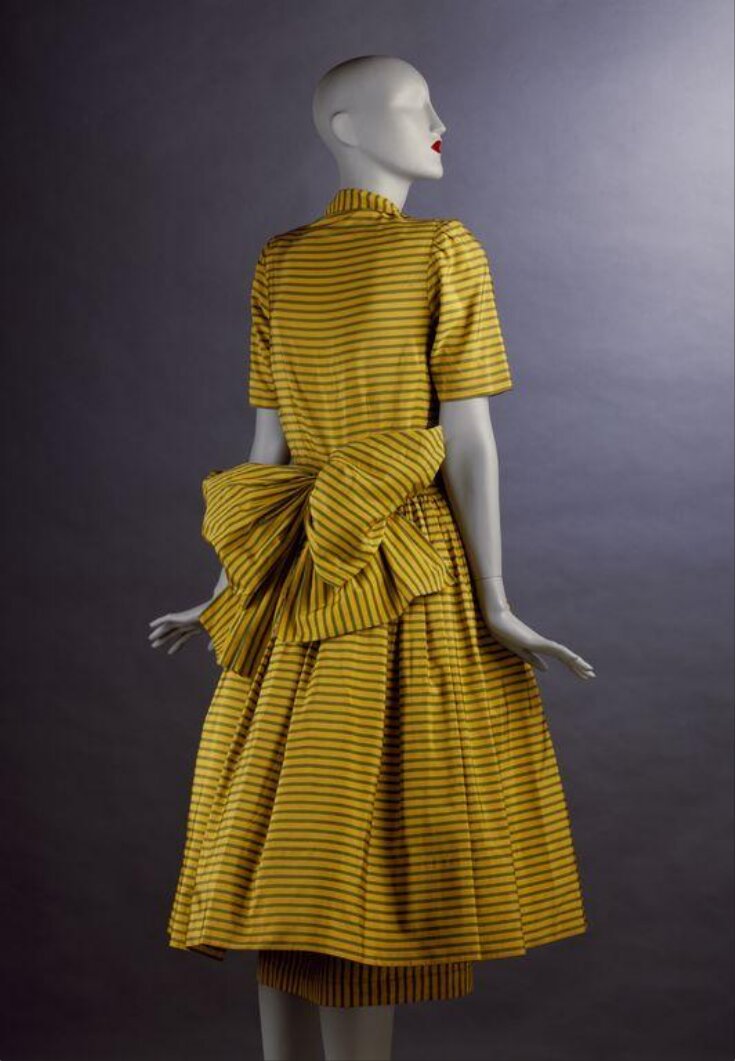
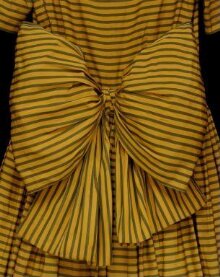
An enormous bustle bow dominates this striped silk dress by Victor Steibel. In February 1947 Christian Dior had launched the New Look featuring pinched waists, full skirts and a soft shoulder line. It was an attempt to reinstate feminity in dress after a period of wartime austerity and shortage. The impractical scale and frivolity of Steibel's bow was clearly a defiant gesture against rationing. It makes lavish use of material and is so large and weighty that it requires the support of a sturdy horsehair frill beneath the skirts.
Victor Steibel was born in South Africa. He moved to London in 1924 to study at Cambridge. Following an apprenticeship with the Reville and Rossiter fashion house, he opened his own Bruton Street couture house in 1932. After the Second World War he worked with Jacqmar and reopened his couture house in Cavendish Square in 1958. Steibel was a highly successful British designer, celebrated for his stylish feminine clothing, striped fabrics and evening wear.
Victor Steibel was born in South Africa. He moved to London in 1924 to study at Cambridge. Following an apprenticeship with the Reville and Rossiter fashion house, he opened his own Bruton Street couture house in 1932. After the Second World War he worked with Jacqmar and reopened his couture house in Cavendish Square in 1958. Steibel was a highly successful British designer, celebrated for his stylish feminine clothing, striped fabrics and evening wear.
Object details
| Categories | |
| Object type | |
| Materials and techniques | Silk grosgrain with net and a horsehair frill |
| Brief description | Silk grosgrain day dress with net, designed by Victor Stiebel, London, 1947 |
| Physical description | Silk grosgrain day dress supported with net petticoats and a horsehair frill. Enormous bustle bow at the rear, an unusually extravagant touch for day wear. Green and yellow stripes. |
| Style | |
| Gallery label |
|
| Credit line | Given by Lady Cornwallis |
| Object history | Worn by Lady Cornwallis: Esme Ethel Alice d'Beaumont (1901-1969) is the daughter of Captian Montmorency d'Beaumont. She married, firstly, Major Sir Robert James Milo Walker, 4 Bt., on 23 January 1923. She married, secondly, Sir Wykeham Stanley Cornwallis (1892-1982), 2nd Baron Cornwallis on 26 February 1948. Given by the 3rd Lord and Lady Cornwallis. The dominating feature of this dress is the enormous bustle bow at the rear, an unusually extravagant touch for day wear. The lavish use of material for a decorative, non-functioning trimming was a defiant gesture in this time of austerity and rationing. Victor Steibel at Jacqmar, 16 Grosvenor Street, London, W1. |
| Summary | An enormous bustle bow dominates this striped silk dress by Victor Steibel. In February 1947 Christian Dior had launched the New Look featuring pinched waists, full skirts and a soft shoulder line. It was an attempt to reinstate feminity in dress after a period of wartime austerity and shortage. The impractical scale and frivolity of Steibel's bow was clearly a defiant gesture against rationing. It makes lavish use of material and is so large and weighty that it requires the support of a sturdy horsehair frill beneath the skirts. Victor Steibel was born in South Africa. He moved to London in 1924 to study at Cambridge. Following an apprenticeship with the Reville and Rossiter fashion house, he opened his own Bruton Street couture house in 1932. After the Second World War he worked with Jacqmar and reopened his couture house in Cavendish Square in 1958. Steibel was a highly successful British designer, celebrated for his stylish feminine clothing, striped fabrics and evening wear. |
| Bibliographic references |
|
| Collection | |
| Accession number | T.292-1984 |
About this object record
Explore the Collections contains over a million catalogue records, and over half a million images. It is a working database that includes information compiled over the life of the museum. Some of our records may contain offensive and discriminatory language, or reflect outdated ideas, practice and analysis. We are committed to addressing these issues, and to review and update our records accordingly.
You can write to us to suggest improvements to the record.
Suggest feedback
You can write to us to suggest improvements to the record.
Suggest feedback
| Record created | December 15, 1999 |
| Record URL |
Download as: JSON
