
Design
ca. 1788-1792 (made)
| Artist/Maker | |
| Place of origin |
Design for a printed cotton by William Kilburn. He was born in Dublin and was apprenticed to a cotton and linen printer at Lucan, near Dublin. He moved to London and sold designs to calico printers, and drawings and engravings to print shops. The botanist William Curtis employed him to do some of the plates for the . Subsequently Kilburn managed and then purchased a calico-printing factory at Wallington in Surrey. Dismayed at the pirating of his designs, he was involved in a successful petition to parliament in 1787 to protect the copyright of designs. Kilburn's pieces of muslin chintz are said to have sold for as much as a guinea a yard and he presented one of them (a seaweed pattern) to Queen Charlotte. But his exquisitely detailed fabrics had been copied, printed and marketed by rival firms within ten days of their first appearance at Brown, Rogers & Co., the wholesale linen drapers in Cheapside who were the proprietors of most of Kilburn's designs. These imitations were printed in fewer colours on cheaper cloth and, although coarser in appearance, were offered for sale at two-thirds of the price of the original.
Object details
| Categories | |
| Object type | |
| Materials and techniques | painted in watercolour on paper |
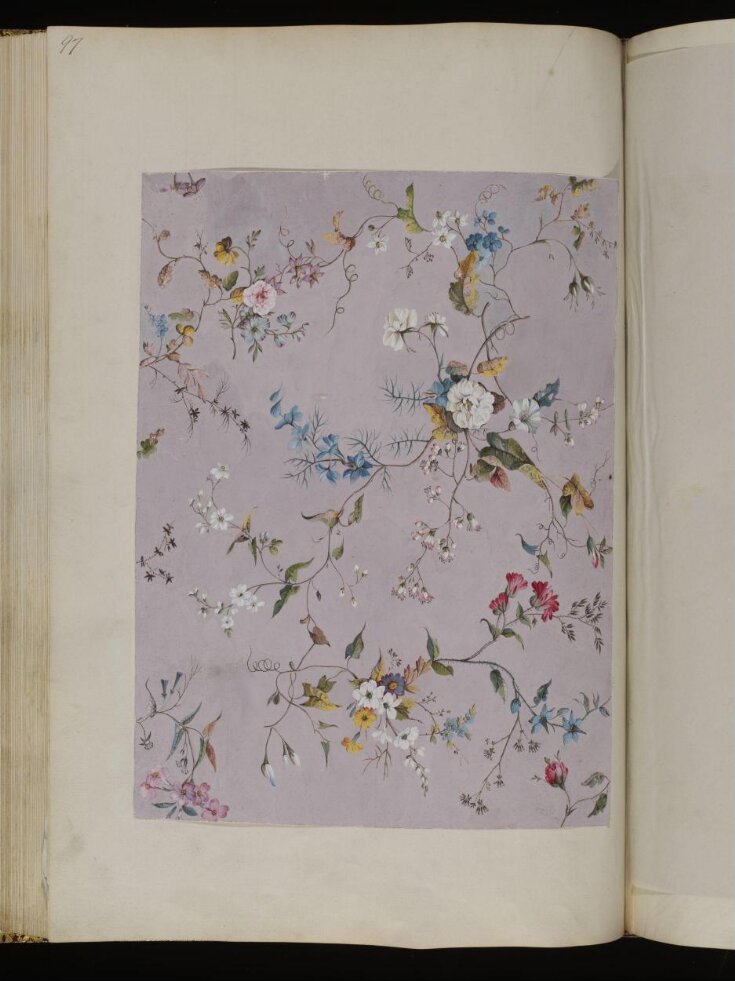
| Brief description | Design from an album of designs for printed textiles (1788-1792) by William Kilburn |
| Physical description | This design shows long stems in green, brown and blue that are intertwined in a Z-shape, which takes up the whole design. The stems have green, brown, light-red, yellow and blue leaves, and pink, blue, yellow, white and purple flowers and buds. There is a pink rose bud in the right hand corner. The background is lilac in colour. |
| Dimensions |
|
| Credit line | Purchased from the funds of the Capt. H. B. Murray Bequest |
| Object history | William Kilburn was born in Dublin and was apprenticed to a cotton and linen printer at Lucan. He moved to London and sold designs to calico printers, and drawings and engravings to print shops. The botanist William Curtis employed him to do some of the plates for the Flora Londiniensis. Subsequently Kilburn managed and then purchased a calico-printing factory at Wallington in Surrey. Dismayed at the pirating of his designs, he was involved in a successful petition to parliament in 1787 to protect the copyright of designs. Kilburn's pieces of muslin chintz are said to have sold for as much as a guinea a yard and he presented one of them (a seaweed pattern) to Queen Charlotte. But his exquisitely detailed fabrics had been copied, printed and marketed by rival firms within ten days of their first appearance at Brown, Rogers & Co., the wholesale linen drapers in Cheapside who were the proprietors of most of Kilburn's designs. These imitations were printed in fewer colours on cheaper cloth and, although coarser in appearance, were offered for sale at two-thirds of the price of the original. In spite of his invention of so many original patterns, particularly his delicate seaweed motifs, Kilburn went bankrupt in April 1802. |
| Production | There is a furnishing fabric by William Kilburn, 1775, Circ.91-1960, and a printed cotton of about 1800 with a seaweed-like pattern which is possibly by William Kilburn, T.84-1991 in FTF. |
| Subject depicted | |
| Summary | Design for a printed cotton by William Kilburn. He was born in Dublin and was apprenticed to a cotton and linen printer at Lucan, near Dublin. He moved to London and sold designs to calico printers, and drawings and engravings to print shops. The botanist William Curtis employed him to do some of the plates for the |
| Bibliographic references |
|
| Collection | |
| Accession number | E.894:97-1978 |
About this object record
Explore the Collections contains over a million catalogue records, and over half a million images. It is a working database that includes information compiled over the life of the museum. Some of our records may contain offensive and discriminatory language, or reflect outdated ideas, practice and analysis. We are committed to addressing these issues, and to review and update our records accordingly.
You can write to us to suggest improvements to the record.
Suggest feedback
You can write to us to suggest improvements to the record.
Suggest feedback
| Record created | June 16, 2008 |
| Record URL |
Download as: JSONIIIF Manifest
