
Doublet
1660-1665 (made)
| Artist/Maker | |
| Place of origin |
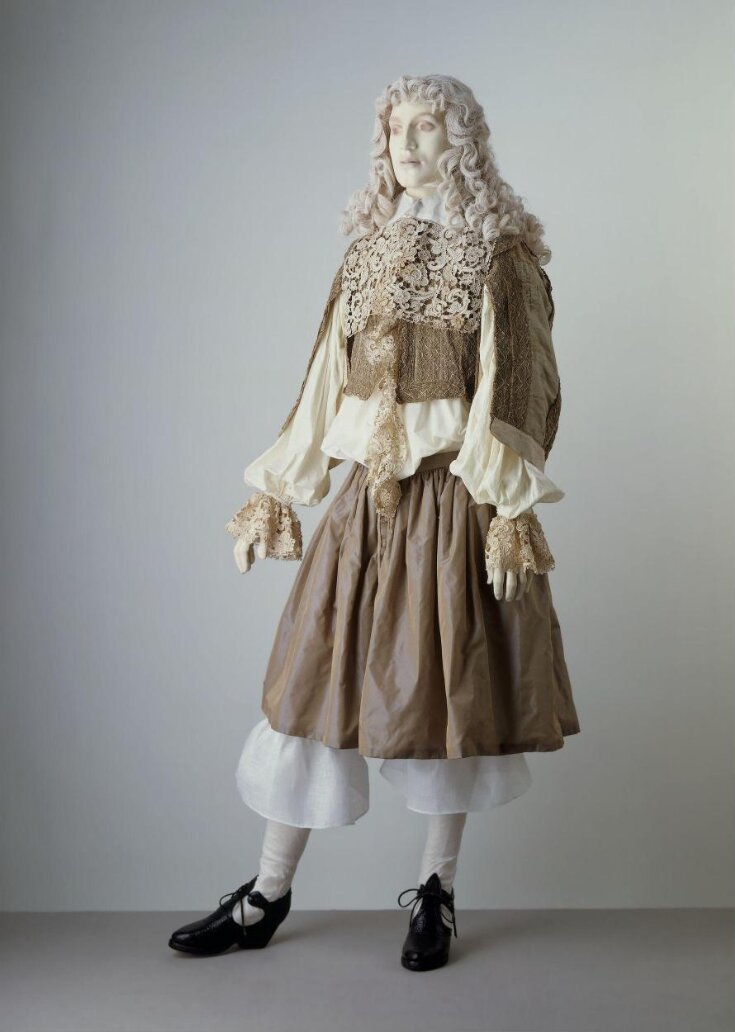
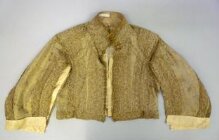
By the 1660s the traditional doublet and hose had altered from their forms earlier in the century. The doublet had become a very short garment that exposed the shirt underneath at the waist. This particular example is made of beige watered silk and decorated with parchment lace. The centre back and inside sleeve seams are open to reveal the shirt. The doublet has a matching cassock.
Object details
| Categories | |
| Object type | |
| Materials and techniques | Silk, linen, parchment; hand-woven, hand-sewn, hand-made bobbin lace |
| Brief description | Man's doublet, 1660-65, English or French; Beige watered silk and parchment lace |
| Physical description | Man’s doublet of beige watered silk interlined with linen and lined with cream watered silk. It has a 2-inch (5 cm) standing collar, short wide sleeves and 6 shallow laps. The centre back seam is open, as are the sleeves including the 1¾-inch (4.5 cm) turned-back cuffs. Beige silk and parchment bobbin lace, 1⅝-inch (4 cm) wide is applied to the fronts, back, sleeves, collar and laps The belly pieces, under the silk lining, are probably made with layers of stiffened linen. There are 20 worked buttonholes on the left front with 5 button loops of braided beige silk on the left side of the collar. The buttons have a wooden core, covered with beige silk thread; 23 remain. There is a button on each shoulder near the collar. At the waist seam inside there are 6 silk tabs each with a metal eye. The doublet matches the cassock, T.323-1980. |
| Dimensions |
|
| Summary | By the 1660s the traditional doublet and hose had altered from their forms earlier in the century. The doublet had become a very short garment that exposed the shirt underneath at the waist. This particular example is made of beige watered silk and decorated with parchment lace. The centre back and inside sleeve seams are open to reveal the shirt. The doublet has a matching cassock. |
| Associated object | T.323-1980 (Set) |
| Collection | |
| Accession number | T.324-1980 |
About this object record
Explore the Collections contains over a million catalogue records, and over half a million images. It is a working database that includes information compiled over the life of the museum. Some of our records may contain offensive and discriminatory language, or reflect outdated ideas, practice and analysis. We are committed to addressing these issues, and to review and update our records accordingly.
You can write to us to suggest improvements to the record.
Suggest feedback
You can write to us to suggest improvements to the record.
Suggest feedback
| Record created | December 15, 1999 |
| Record URL |
Download as: JSONIIIF Manifest
