Queen Victoria
Bust
1843 (made)
1843 (made)
| Artist/Maker | |
| Place of origin |
Object Type
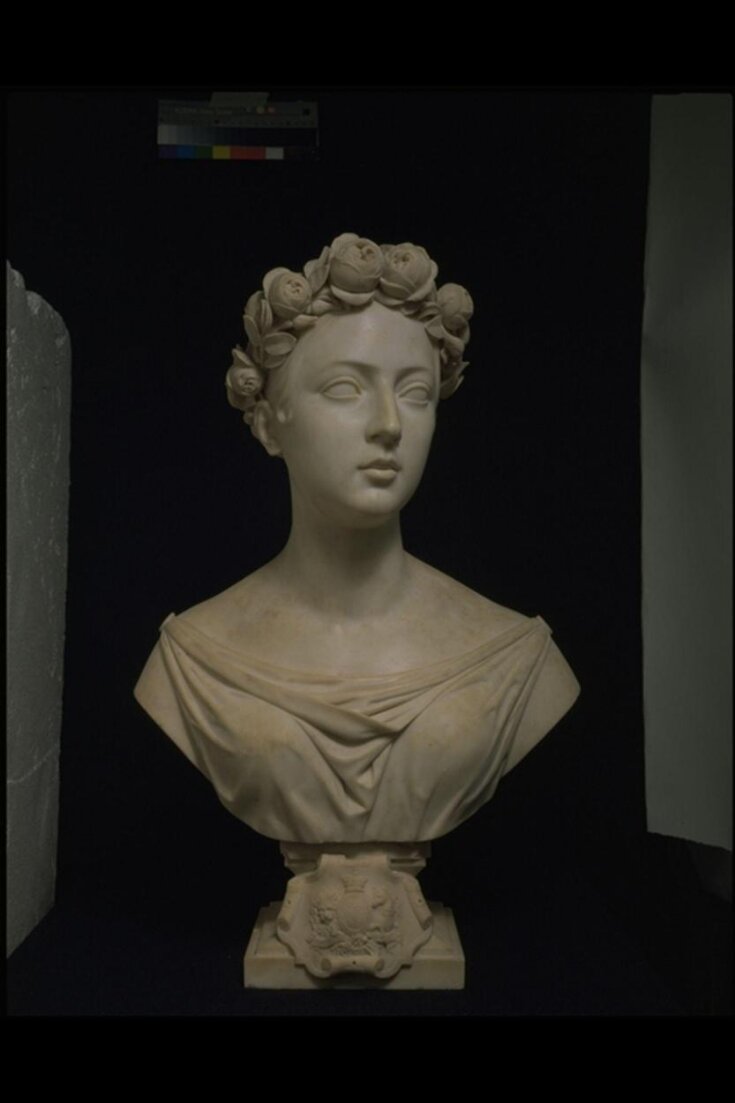
This marble bust of Queen Victoria (reigned 1837-1901) shows her dressed simply, although her royal status is indicated by the royal coat of arms on the front of the socle (base). The bust was made six years after her accession to the throne by a German sculptor possibly known to her husband, Prince Albert (1819-1861). The exact circumstances for the commission are unknown.
People
The sculptor of the bust, Johann Jacob Flatters (1786-1845), was born in the German city of Krefeld, but trained at the Ecole des Beaux-Arts (School of Fine Arts) in Paris, under the French artists Jean-Antoine Houdon (1741-1828) and Jacques-Louis David (1748-1825). He exhibited at the Salon in Paris from 1810 to 1839 and was created a member of the Legion of Honour. He settled in London in 1842 and exhibited at the Royal Academy there in that year. He was also known as a book illustrator.
Materials & Making
Marble busts were among the most popular and prestigious types of public portrait in Britain during the Victorian period. The marble, a relatively expensive material, was imported, usually from Italy via the Netherlands, since there are no marble quarries in Britain. Aspiring artists might also learn the skill of carving marble abroad, where they would probably gain their most important training assisting an established sculptor.
This marble bust of Queen Victoria (reigned 1837-1901) shows her dressed simply, although her royal status is indicated by the royal coat of arms on the front of the socle (base). The bust was made six years after her accession to the throne by a German sculptor possibly known to her husband, Prince Albert (1819-1861). The exact circumstances for the commission are unknown.
People
The sculptor of the bust, Johann Jacob Flatters (1786-1845), was born in the German city of Krefeld, but trained at the Ecole des Beaux-Arts (School of Fine Arts) in Paris, under the French artists Jean-Antoine Houdon (1741-1828) and Jacques-Louis David (1748-1825). He exhibited at the Salon in Paris from 1810 to 1839 and was created a member of the Legion of Honour. He settled in London in 1842 and exhibited at the Royal Academy there in that year. He was also known as a book illustrator.
Materials & Making
Marble busts were among the most popular and prestigious types of public portrait in Britain during the Victorian period. The marble, a relatively expensive material, was imported, usually from Italy via the Netherlands, since there are no marble quarries in Britain. Aspiring artists might also learn the skill of carving marble abroad, where they would probably gain their most important training assisting an established sculptor.
Object details
| Categories | |
| Object type | |
| Title | Queen Victoria (generic title) |
| Materials and techniques | Marble |
| Brief description | Bust, marble, Queen Victoria, by Johann Jakob Flatters, London, 1843 |
| Physical description | This youthful portrait of Queen Victoria shows the monarch garlanded with roses, rather than wearing a crown. Although dressed simply, her royalty is indicated by the coat of arms on the front of the socle. Signed. |
| Dimensions |
|
| Marks and inscriptions | 'Flatters/.1843' (on the sitter's left shoulder) |
| Gallery label | British Galleries:
The youthful Queen Victoria is shown here as an idealised figure, in contrast with other, more lifelike portraits of her. She is dressed in a version of classical robes and wears a wreath of roses in place of the laurel wreath of a Roman hero or emperor.(27/03/2003) |
| Object history | Purchased at an unrecorded sale early in 1952 by Dr W.L. Hildburgh F.S.A. Given by Dr. W. L. Hildburgh, F. S. A. to the Museum in 1952. |
| Subjects depicted | |
| Summary | Object Type This marble bust of Queen Victoria (reigned 1837-1901) shows her dressed simply, although her royal status is indicated by the royal coat of arms on the front of the socle (base). The bust was made six years after her accession to the throne by a German sculptor possibly known to her husband, Prince Albert (1819-1861). The exact circumstances for the commission are unknown. People The sculptor of the bust, Johann Jacob Flatters (1786-1845), was born in the German city of Krefeld, but trained at the Ecole des Beaux-Arts (School of Fine Arts) in Paris, under the French artists Jean-Antoine Houdon (1741-1828) and Jacques-Louis David (1748-1825). He exhibited at the Salon in Paris from 1810 to 1839 and was created a member of the Legion of Honour. He settled in London in 1842 and exhibited at the Royal Academy there in that year. He was also known as a book illustrator. Materials & Making Marble busts were among the most popular and prestigious types of public portrait in Britain during the Victorian period. The marble, a relatively expensive material, was imported, usually from Italy via the Netherlands, since there are no marble quarries in Britain. Aspiring artists might also learn the skill of carving marble abroad, where they would probably gain their most important training assisting an established sculptor. |
| Bibliographic references |
|
| Collection | |
| Accession number | A.36-1952 |
About this object record
Explore the Collections contains over a million catalogue records, and over half a million images. It is a working database that includes information compiled over the life of the museum. Some of our records may contain offensive and discriminatory language, or reflect outdated ideas, practice and analysis. We are committed to addressing these issues, and to review and update our records accordingly.
You can write to us to suggest improvements to the record.
Suggest feedback
You can write to us to suggest improvements to the record.
Suggest feedback
| Record created | December 15, 1999 |
| Record URL |
Download as: JSONIIIF Manifest
