
Valance
1570-1599 (made)
| Artist/Maker | |
| Place of origin |
Valances were the borders or bands that ran around the two sides and end of an Elizabethan bed, hiding the bed rail or the place from which the bed curtains were suspended. They formed a frieze that was particularly suitable for embroidery with figure subjects, often featuring a narrative to provide interest and entertainment. Sets of bed hangings also created a draught-free and private sleeping compartment.
The style and workmanship of this valance suggests that it was made in a professional workshop either in France itself or under strong French influence.
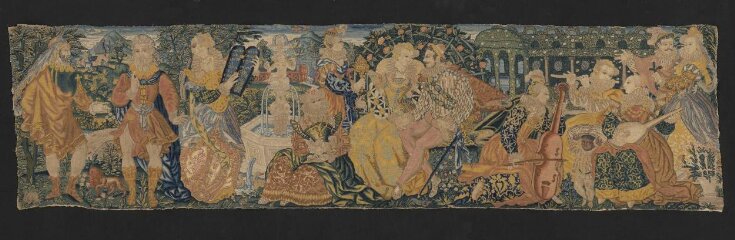
The setting is an ornamental garden with a mountainous skyline, a popular type of background for such scenes. and most of the figures wear rich contemporary court fashions. The main subject is a pair of seated lovers. They are attended by two women, one holding a mirror and possibly intended to represent Prudence, the other holding a small dog, possibly intended to represent Fidelity. One woman reads a partially legible French inscription, and a small black boy holds up a music score for the musicians on the right of the scene.
The style and workmanship of this valance suggests that it was made in a professional workshop either in France itself or under strong French influence.
The setting is an ornamental garden with a mountainous skyline, a popular type of background for such scenes. and most of the figures wear rich contemporary court fashions. The main subject is a pair of seated lovers. They are attended by two women, one holding a mirror and possibly intended to represent Prudence, the other holding a small dog, possibly intended to represent Fidelity. One woman reads a partially legible French inscription, and a small black boy holds up a music score for the musicians on the right of the scene.
Object details
| Categories | |
| Object type | |
| Materials and techniques | Embroidered in silks and wools on linen |
| Brief description | Embroidered valance in silks and wools on linen, possibly made in England or France, 1570-1599 |
| Physical description | Embroidered valance in silks and wools in tent stitch on linen, with details in stem stitch and couched work. In fine precision are well dressed figures in an outdoor setting. A little boy servant is holding music above his head for a trio of female musicians in fashionable French court dress who are playing a lute, flute and cello. Although a partial inscription on the valance is in French, as French was the courtly language of the time this does not necessarily indicate a French origin for the piece. |
| Dimensions |
|
| Gallery label | Treasures of the Royal Courts: Tudors, Stuarts and the Russian Tsars label text:
Bed valances
1580–1600
Sets of bed hangings created an enclosed, private space within the bedrooms of palaces and grand houses. They were a focal point for luxurious decoration. The horizontal form of valances suited narratives that continued around the bed. These four valances show scenes of courtly life and stories from classical literature.
England, Scotland or France
Linen canvas, embroidered with wool and silk
V&A T.135, 136-1991. Bequeathed by Maud Ochs
V&A 879&A-1904 |
| Credit line | Bequeathed by Miss Maud Lilian Ochs |
| Object history | Registered File number 1957/3032. May be a partner to T.137-1991. Formerly on loan to the museum, between 1957 and 1991. |
| Subjects depicted | |
| Summary | Valances were the borders or bands that ran around the two sides and end of an Elizabethan bed, hiding the bed rail or the place from which the bed curtains were suspended. They formed a frieze that was particularly suitable for embroidery with figure subjects, often featuring a narrative to provide interest and entertainment. Sets of bed hangings also created a draught-free and private sleeping compartment. The style and workmanship of this valance suggests that it was made in a professional workshop either in France itself or under strong French influence. The setting is an ornamental garden with a mountainous skyline, a popular type of background for such scenes. and most of the figures wear rich contemporary court fashions. The main subject is a pair of seated lovers. They are attended by two women, one holding a mirror and possibly intended to represent Prudence, the other holding a small dog, possibly intended to represent Fidelity. One woman reads a partially legible French inscription, and a small black boy holds up a music score for the musicians on the right of the scene. |
| Collection | |
| Accession number | T.136-1991 |
About this object record
Explore the Collections contains over a million catalogue records, and over half a million images. It is a working database that includes information compiled over the life of the museum. Some of our records may contain offensive and discriminatory language, or reflect outdated ideas, practice and analysis. We are committed to addressing these issues, and to review and update our records accordingly.
You can write to us to suggest improvements to the record.
Suggest feedback
You can write to us to suggest improvements to the record.
Suggest feedback
| Record created | December 15, 1999 |
| Record URL |
Download as: JSONIIIF Manifest
