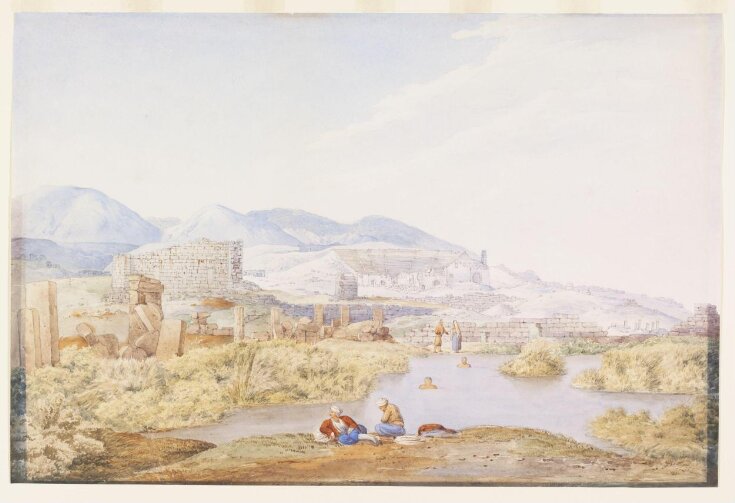

Hierapolis - Natural Hot Spring. Phrygia
Watercolour
1837 (painted)
1837 (painted)
| Artist/Maker | |
| Place of origin |
Antonio Schranz was part of a family of artists of German origin who had settled in Malta in 1818. Working in Valletta, Antonio was described as `paesista e pittore di marina', that is, a landscape and marine artist. He collaborated with his elder brother Giovanni (1794-1882) in the family lithographic establishment which published prints after their watercolours, usually lettered `Schranz Brothers.’ From 1823-47 Antonio made at least ten voyages to the eastern Mediterranean and Egypt, often finding employment as a draughtsman to wealthy British travellers, such as Robert Pashley in 1834 and Viscount Castlereagh in 1842. Later, he also took up photography and produced picturesque scenes of Cairo as early as 1851.
This image of Hierapolis [modern Pamukkale in western Turkey] was intended as a kind of souvenir for the unidentified patron and traveller who employed Antonio in 1836-1837. As a generalised view, it is a forerunner of the picture postcard. In ancient times Hierapolis in Phrygia was a kind of spa, famous for the healing properties of its hot springs, and the temples built to accommodate the influx of worshippers. Below the pool of warm water depicted here are the famous white cliffs, formed into fantastic shapes by the rapid deposition of calcium carbonate from the mineral rich waters, flowing down into a series of shallow pools and forming stalactites. The Turks called the site Pamukkale, `cotton castle’ and it is now a major tourist attraction. The uninhabited area amongst the ruins around the pool, as painted by Schranz, is now covered with modern buildings. The Sacred Pool itself is now the swimming pool located inside the Pamukkale Hotel.
This image of Hierapolis [modern Pamukkale in western Turkey] was intended as a kind of souvenir for the unidentified patron and traveller who employed Antonio in 1836-1837. As a generalised view, it is a forerunner of the picture postcard. In ancient times Hierapolis in Phrygia was a kind of spa, famous for the healing properties of its hot springs, and the temples built to accommodate the influx of worshippers. Below the pool of warm water depicted here are the famous white cliffs, formed into fantastic shapes by the rapid deposition of calcium carbonate from the mineral rich waters, flowing down into a series of shallow pools and forming stalactites. The Turks called the site Pamukkale, `cotton castle’ and it is now a major tourist attraction. The uninhabited area amongst the ruins around the pool, as painted by Schranz, is now covered with modern buildings. The Sacred Pool itself is now the swimming pool located inside the Pamukkale Hotel.
Object details
| Categories | |
| Object type | |
| Title | Hierapolis - Natural Hot Spring. Phrygia (assigned by artist) |
| Materials and techniques | Watercolour over pencil |
| Brief description | Watercolour, `Hierapolis - Natural Hot Spring. Phrygia', 1837, by Antonio (Anton Jr. or Antoine) Schranz. |
| Physical description | Watercolour drawing of a landscape with ruins; figures relaxing by a hot spring in the foreground. |
| Dimensions |
|
| Styles | |
| Marks and inscriptions | On the back numbered 40, signed with initials A. S., inscribed with title and dated Janry 8th 1837 |
| Credit line | Purchased with the assistance of the National Heritage Memorial Fund, Art Fund, Shell International and the Friends of the V&A |
| Object history | According to Rodney Searight: - `bt fr J.Mackinnon, April 1970 £45'. |
| Historical context | See B. Llewellyn, `Changing Views of the Middle East Watercolours from the Searight Collection', Antique Dealer & Collectors Guide, September 1983, p.51. SD.932-SD.946 are all dated between December 1836 and September 1837. Most are mounted on cards bearing inscriptions in the same hand. They probably result from a journey made by the artist with an unknown patron. Customs records (Palace Archives, Valletta) reveal that he left Malta for Turkey in April 1836 and returned in December 1839. See D. Cutajar, `The Lure of the Orient The Schranzes, the Brockdorffs, Preziosi and other artists', Hyphen A journal of Melitensia and the Humanities, No.3, Vol.V, 1987. Drawings from the same trip are in the Benaki Museum, Athens and in a private collection in Malta: see Cathedral Museum, Mdina, Malta, The Schranz Artists Landscape and Marine Painters in the Mediterranean (Active, XIX Century), 1987, pp.43, 59-63. |
| Subjects depicted | |
| Places depicted | |
| Summary | Antonio Schranz was part of a family of artists of German origin who had settled in Malta in 1818. Working in Valletta, Antonio was described as `paesista e pittore di marina', that is, a landscape and marine artist. He collaborated with his elder brother Giovanni (1794-1882) in the family lithographic establishment which published prints after their watercolours, usually lettered `Schranz Brothers.’ From 1823-47 Antonio made at least ten voyages to the eastern Mediterranean and Egypt, often finding employment as a draughtsman to wealthy British travellers, such as Robert Pashley in 1834 and Viscount Castlereagh in 1842. Later, he also took up photography and produced picturesque scenes of Cairo as early as 1851. This image of Hierapolis [modern Pamukkale in western Turkey] was intended as a kind of souvenir for the unidentified patron and traveller who employed Antonio in 1836-1837. As a generalised view, it is a forerunner of the picture postcard. In ancient times Hierapolis in Phrygia was a kind of spa, famous for the healing properties of its hot springs, and the temples built to accommodate the influx of worshippers. Below the pool of warm water depicted here are the famous white cliffs, formed into fantastic shapes by the rapid deposition of calcium carbonate from the mineral rich waters, flowing down into a series of shallow pools and forming stalactites. The Turks called the site Pamukkale, `cotton castle’ and it is now a major tourist attraction. The uninhabited area amongst the ruins around the pool, as painted by Schranz, is now covered with modern buildings. The Sacred Pool itself is now the swimming pool located inside the Pamukkale Hotel. |
| Bibliographic reference | Charles Newton `Images of the Ottoman Empire', 2007, illustrated on page 40 |
| Collection | |
| Accession number | SD.934 |
About this object record
Explore the Collections contains over a million catalogue records, and over half a million images. It is a working database that includes information compiled over the life of the museum. Some of our records may contain offensive and discriminatory language, or reflect outdated ideas, practice and analysis. We are committed to addressing these issues, and to review and update our records accordingly.
You can write to us to suggest improvements to the record.
Suggest feedback
You can write to us to suggest improvements to the record.
Suggest feedback
| Record created | April 2, 2008 |
| Record URL |
Download as: JSONIIIF Manifest
