Palpitation
Oil Painting
1844 (painted)
1844 (painted)
| Artist/Maker | |
| Place of origin |
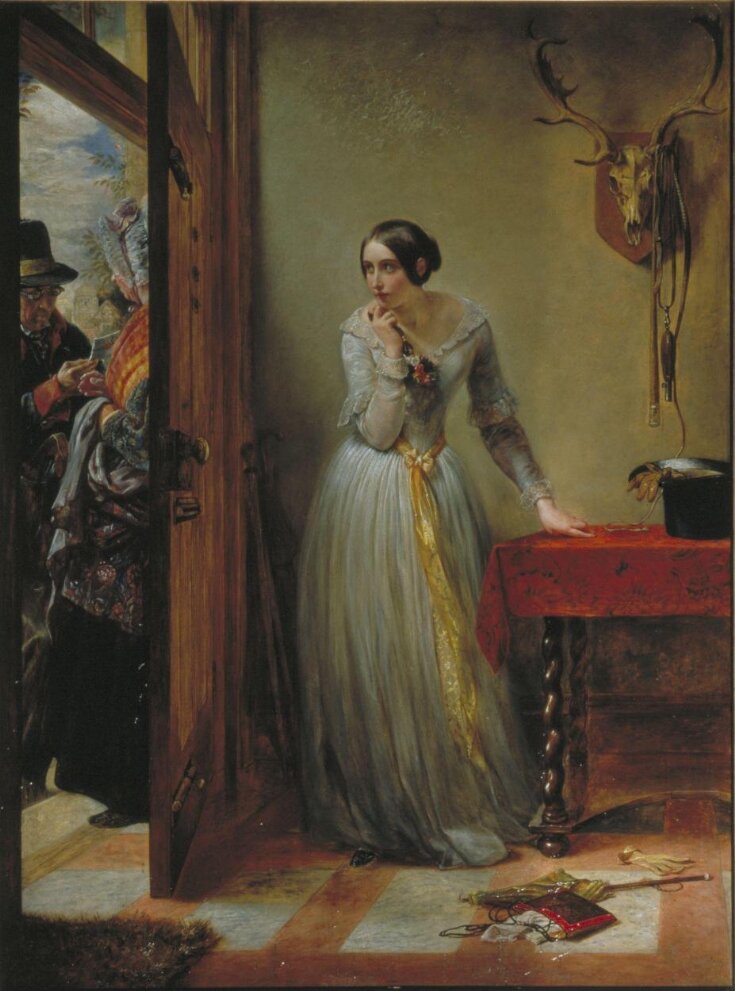
The artist described this scene as ‘a young lady waiting for her letter, while the postman and servant are gossiping on the doorstep’. It is unclear whether the palpitation of the title is caused by the lady’s anxiety to receive a letter from a suitor or to intercept a letter from an illicit lover.
Object details
| Categories | |
| Object type | |
| Title | Palpitation (assigned by artist) |
| Materials and techniques | oil on panel |
| Brief description | Oil painting entitled 'Palpitation' by Charles West Cope. Great Britain, 1844. |
| Physical description | This is an early example of a 'problem picture', in which the subject is rendered in a deliberately ambiguous way to provoke interest and argument among its audience. The arrival of a letter may be as exciting today as then, but the postal system in the 1840s was a novelty - the regular delivery of letters began in 1840 (see cat.no. 78) - and gives the subject of this painting a topical gloss. The lack of clarity in meaning concerns the reason for the 'palpitation' of the title. The woman may be awaiting a letter from an illicit lover, a letter she must intercept before others in the household are aware; the whip hanging on the stag's horns (themselves a traditional symbol of cuckoldry) and the hat on the table indicate a man's presence in the home. Or, the sender may be a legitimate suitor. The suspense is heightened by such details as the phial of smelling salts, the bag, umbrella and glove dropped on the floor, and the emphasis on the lock, chain casing and bolts on the door. Whether guilt, fear, or sheer delight has caused the palpitation, it is well conveyed in the woman's tremulous and febrile pose and facial expression. |
| Dimensions |
|
| Style | |
| Marks and inscriptions | 'C W Cope 1844' (Signed and dated by the artist, on the tablecloth) |
| Credit line | Given by John Sheepshanks, 1857 |
| Object history | Given by John Sheepshanks, 1857 |
| Subjects depicted | |
| Summary | The artist described this scene as ‘a young lady waiting for her letter, while the postman and servant are gossiping on the doorstep’. It is unclear whether the palpitation of the title is caused by the lady’s anxiety to receive a letter from a suitor or to intercept a letter from an illicit lover. |
| Bibliographic reference | Parkinson, R., Victoria and Albert Museum, Catalogue of British Oil Paintings 1820-1860, London: HMSO, 1990, pp. 45-46 |
| Collection | |
| Accession number | FA.52[O] |
About this object record
Explore the Collections contains over a million catalogue records, and over half a million images. It is a working database that includes information compiled over the life of the museum. Some of our records may contain offensive and discriminatory language, or reflect outdated ideas, practice and analysis. We are committed to addressing these issues, and to review and update our records accordingly.
You can write to us to suggest improvements to the record.
Suggest feedback
You can write to us to suggest improvements to the record.
Suggest feedback
| Record created | December 15, 1999 |
| Record URL |
Download as: JSONIIIF Manifest
