
Portrait of a lady seated in an armchair
Watercolour
1830 (painted), 1831 (exhibited)
1830 (painted), 1831 (exhibited)
| Artist/Maker | |
| Place of origin |
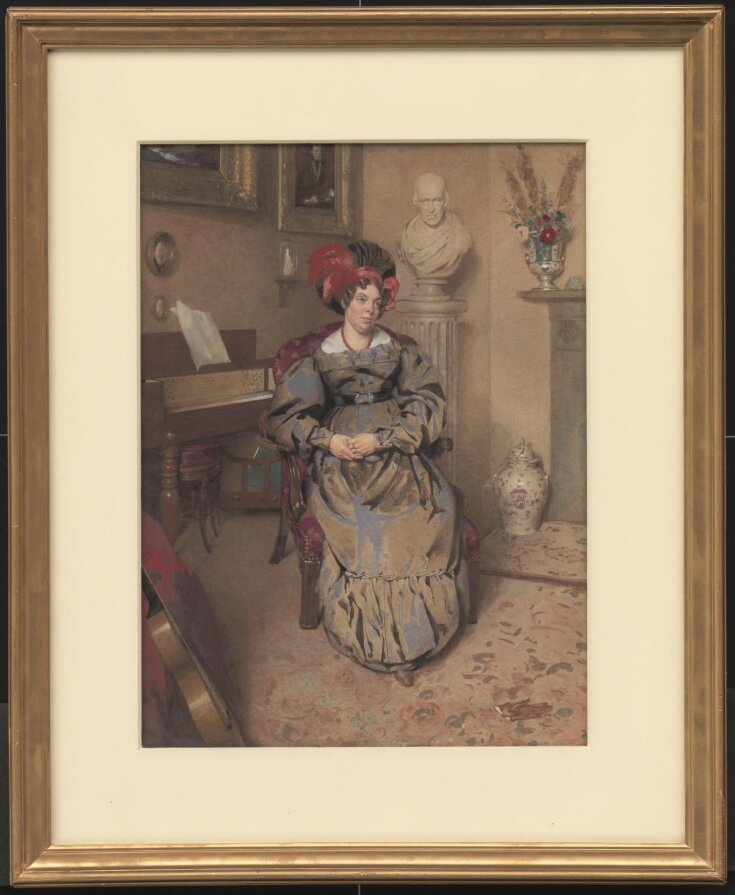
Cruickshank's anonymous subject is seated in a comfortable well-appointed drawing room. The room is furnished with a square piano and a guitar, and beneath the piano, a Canterbury--a rack designed to hold music. On the mantlepiece there is an ice pail doing duty as a vase for cut flowers. The woman has a distant melancholy air. Indeed the picture as a whole is ambiguous and puzzling. There is a pair of gloves on the floor in the foreground; this odd detail may in fact provide the clue to the mystery. Perhaps we are meant to see the woman as an abandoned wife or mistress, cast off like an old glove, as the saying has it. The sitter has not been identified but the bust on the pedestal behind her strongly resembles Sir Francis Chantrey's bust of James Watt (1736-1819), the engineer and inventor of the improved steam engine. Three versions of the bust were made, two for the Watt family, and one for a Colonel Campbell. Cruickshank exhibited a portrait of a Captain Campbell in 1829, so it is possible that this watercolour is a portrait of a member of Campbell's family.
Object details
| Categories | |
| Object type | |
| Title | Portrait of a lady seated in an armchair (popular title) |
| Materials and techniques | Watercolour and body-colour |
| Brief description | Watercolour portrait of a lady seated in an armchair, by F. Cruickshank. Great Britain, 1830. |
| Physical description | Cruickshank's anonymous subject has the individuality of a portrait. She is seated in a comfortable well-appointed drawing room. The room is furnished with a square piano and a guitar, and beneath the piano, a Canterbury, a rack designed to hold music. On the mantelpiece there is an ice pail doing duty as a vase for cut flowers. The woman has a distant melancholy air. Indeed the picture as a whole is ambiguous and heavy with mystery. There is a pair of gloves on the floor in the foreground; this odd detail may in fact provide the clue to the mystery. Perhaps we are meant to see the woman as an abandoned mistress, cast off like an old glove, as the saying has it. The sitter has not been identified but the bust on the pedestal behind her strongly resembles Sir Francis Chantrey's bust of James Watt (1736-1819), the engineer and inventor of the improved steam engine. Three versions of the bust were made, one for a Colonel Campbell. Cruickshank exhibited a portrait of a Captain Campbell in 1829, so it is possible that this watercolour is a portrait of a member of Campbell's family. |
| Dimensions |
|
| Marks and inscriptions | Signed and dated in pencil 'F. Cruickshank 1830'. |
| Subjects depicted | |
| Summary | Cruickshank's anonymous subject is seated in a comfortable well-appointed drawing room. The room is furnished with a square piano and a guitar, and beneath the piano, a Canterbury--a rack designed to hold music. On the mantlepiece there is an ice pail doing duty as a vase for cut flowers. The woman has a distant melancholy air. Indeed the picture as a whole is ambiguous and puzzling. There is a pair of gloves on the floor in the foreground; this odd detail may in fact provide the clue to the mystery. Perhaps we are meant to see the woman as an abandoned wife or mistress, cast off like an old glove, as the saying has it. The sitter has not been identified but the bust on the pedestal behind her strongly resembles Sir Francis Chantrey's bust of James Watt (1736-1819), the engineer and inventor of the improved steam engine. Three versions of the bust were made, two for the Watt family, and one for a Colonel Campbell. Cruickshank exhibited a portrait of a Captain Campbell in 1829, so it is possible that this watercolour is a portrait of a member of Campbell's family. |
| Bibliographic references |
|
| Collection | |
| Accession number | P.1-1946 |
About this object record
Explore the Collections contains over a million catalogue records, and over half a million images. It is a working database that includes information compiled over the life of the museum. Some of our records may contain offensive and discriminatory language, or reflect outdated ideas, practice and analysis. We are committed to addressing these issues, and to review and update our records accordingly.
You can write to us to suggest improvements to the record.
Suggest feedback
You can write to us to suggest improvements to the record.
Suggest feedback
| Record created | December 15, 1999 |
| Record URL |
Download as: JSONIIIF Manifest
