A Flemish Kitchen Garden: La Coupeuse de Choux
Oil Painting
ca. 1864 (painted)
ca. 1864 (painted)
| Artist/Maker | |
| Place of origin |
Henri de Braekeleer (1840-1888) was the son of the painter Ferdinand de Braekeleer and the nephew of the more famous artist Henri Leys with whom he would share several commissions. He trained with both his father and uncle and also studied at the Antwerp Academy. After his uncle's death in 1869, he began to find his own direction and the following years were the most productive of his career. He stopped painting due a mental illness between 1879 and 1881, turning afterwards into an almost Impressionist manner, particularly admired by Van Gogh. He died shortly after in misery.
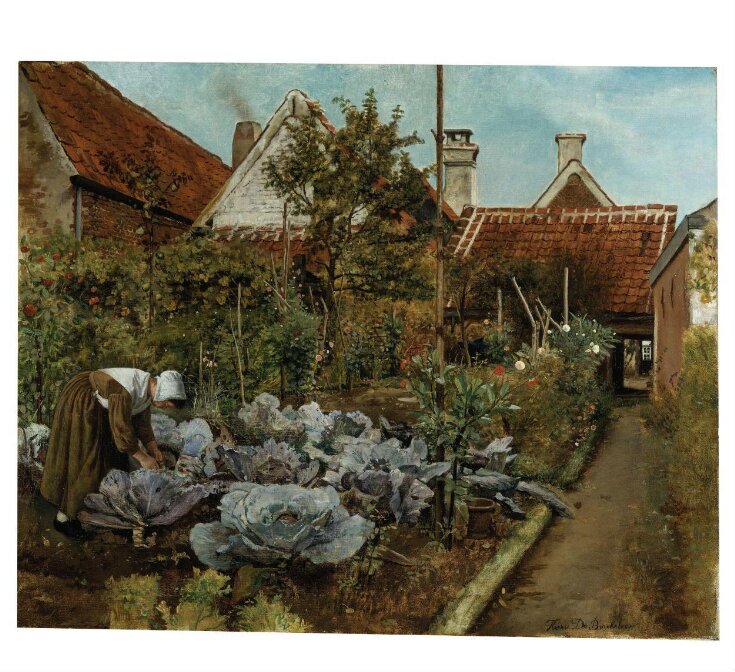
This painting is a typical example of Henri De Braekeleer's relatively large output of genre paintings. He favoured humble subjects matter such as the present one that he depicted with great realism in a restricted albeit bright palette. His paintings are part of the Belgian school that developed a new realism in genre paintings and landscapes, announcing somehow the new development of The Hague school.
This painting is a typical example of Henri De Braekeleer's relatively large output of genre paintings. He favoured humble subjects matter such as the present one that he depicted with great realism in a restricted albeit bright palette. His paintings are part of the Belgian school that developed a new realism in genre paintings and landscapes, announcing somehow the new development of The Hague school.
Object details
| Categories | |
| Object type | |
| Title | A Flemish Kitchen Garden: La Coupeuse de Choux (assigned by artist) |
| Materials and techniques | oil on canvas |
| Brief description | Oil painting, 'A Flemish Kitchen Garden: La Coupeuse de Choux', Henri de Braekeleer, Belgium, ca. 1864 |
| Physical description | In a garden with flowers and fruit trees, a young woman bends over a row of cabbages; in the background are houses with brick-red roofs. |
| Dimensions |
|
| Style | |
| Credit line | Bequeathed by Constantine Alexander Ionides |
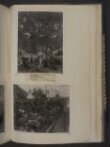
| Object history | Bequeathed by Constantine Alexander Ionides, 1900. Bought before 1881 by Constantine Alexander Ionides and valued by himself £150 at this date. An etching after the painting, La Coupeuse de Choux was also part of the Ionides bequest (CAI 566). Ref: Basil S. Long, Catalogue of the Constantine Alexander Ionides collection.Vol. 1, Paintings in oil, tempera and water-colour, together with certain of the drawings, London : Printed under the authority of the Board of Education, 1925. C. Monkhouse, ‘The Constantine Ionides Collection’ in Magazine of Art, vii, 1884, pp. 36-44, 208-214. The collection formed by Constantine Ionides includes works of a wide variety of schools, periods and artists. His collection includes Old Masters, 17th century works, contemporary British works and French 19th century works. Constantine formed friendships with artists of the day, especially Legros, who, having spent 17 years in Britain, became a naturalise British citizen. Constantine proved a stable and generous buyer of Legros work, while Legros, in turn, became an advisor in the matters of art to the attentive Constantine. Under the influence of Legros Constantine developed a keen interest in French 19th century paintings purchasing works by Delacroix, Degas, Millet and Rousseau. Constantine’s plans concerning his collection conformed to a more ‘public-welfare’ vein of thought than his father or brother. He decided to donate his collection to the Victoria & Albert Museum, instead of privately distributing it or disposing of it in a Sales room. His will states: 'All my pictures both in oil and water colors and crayon or colored chalks (but subject as to my family portraits to the interest herein before given to my said Wife) and all my etchings drawings and engravings to the South Kensington Museum for the benefit of the nation to be kept there as one separate collection to be called "The Constantine Alexander Ionides Collection" and not distributed over the Museum or lent for exhibition. And I desire that the said Etchings Drawings and Engravings shall be framed and glazed by and at the expense of the authorities of the Museum so that Students there can easily see them.' The collection bequeathed to the museum in 1901 comprises 1138 pictures, drawing and prints, to which a further 20 items were added on the death of his widow in 1920. The works are listed in the V&A catalogue of the Constantine Alexander Ionides collection. Historical significance: This painting is a typical example of Henri de Braekeleer's large output of realist pictures. He had a predilection for humble subject matters such as the present one. He depicted few landscapes, a certain number of interior scenes (La fileuse, Musée des Beaux-Arts, Anvers), domestic scenes in open air, all often peopled by a single figure, a few genre portraits (Le géographe, Musée des Beaux-Arts de Belgique, Brussels), and some still-lifes. A painting showing the same garden from a more distant point of view, dated 1864, is housed in the Koninklijk Museum voor Schone Kunsten, Antwerp (Inv. 1203). These two paintings, probably executed around the same time, were most likely inspired by the "Mechelsesteenweg" (now called "Mosselmanslei": Road to Malines) in Antwerp where the De Braekeleer family moved in 1852. There were in this neighbourhood many large gardens exploited by horticulturists and florists. The present painting shows a humbly dressed woman leaning towards a row of cabbages. Her garment echoes the brick-red of the roofs whereas the vegetables' light green reflects the clear sky's brightness. Essential characteristics of De Braekeleer's art is the restricted palette that focuses on earthy pigments, burnt Sienna, browns, ochre and black enlivened by a very bright light that goes back to Pieter de Hooch's (1629-1684 ) pictorial effects. Henri De Braekeleer belonged to the Belgian school of genre painters that focused on an immediate contact with their subjects and displayed a new realism that would precede and announce the school of The Hague. The artistic links between the northern and the southern parts of the Netherlands were indeed still very strong even after the independence of Belgium in 1830. |
| Historical context | The artistic relationship between the Northern and the Southern Netherlands, that is modern-day Holland and Belgium, were very strong during the 19th century especially after the proclamation of the Kingdom of Netherlands in 1815. The Prix de Rome was awarded equally to Antwerp and Amsterdam artists, even after the independence of Belgium in 1830. The majority of Belgian art of the first half of the 19th century, including history painting, genre scenes, landscape and portrait paintings, articulated a new national pride which nevertheless drew upon French academic taste. Such artists as Jean-Bernard Duvivier (1762-1837), Henry Leys (1815-1869) and Karel Verlat (1824-1890) made extensive use of these renewed genres in their oeuvre. Focusing on the achievement of a greater realism, Belgian artists travelled a great deal, not only for training purposes in the tradition of their artistic predecessors but for the sake of discovering new surroundings and making new acquaintances: Paris was the favourite destination. While Italy also remained a popular destination, the majority of these artists tended to move on to other areas of interest, such as Morocco, less for their artistic traditions, and more for their exotic aspects. |
| Subjects depicted | |
| Summary | Henri de Braekeleer (1840-1888) was the son of the painter Ferdinand de Braekeleer and the nephew of the more famous artist Henri Leys with whom he would share several commissions. He trained with both his father and uncle and also studied at the Antwerp Academy. After his uncle's death in 1869, he began to find his own direction and the following years were the most productive of his career. He stopped painting due a mental illness between 1879 and 1881, turning afterwards into an almost Impressionist manner, particularly admired by Van Gogh. He died shortly after in misery. This painting is a typical example of Henri De Braekeleer's relatively large output of genre paintings. He favoured humble subjects matter such as the present one that he depicted with great realism in a restricted albeit bright palette. His paintings are part of the Belgian school that developed a new realism in genre paintings and landscapes, announcing somehow the new development of The Hague school. |
| Associated object | CAI.566 (Reproduction) |
| Bibliographic references |
|
| Collection | |
| Accession number | CAI.88 |
About this object record
Explore the Collections contains over a million catalogue records, and over half a million images. It is a working database that includes information compiled over the life of the museum. Some of our records may contain offensive and discriminatory language, or reflect outdated ideas, practice and analysis. We are committed to addressing these issues, and to review and update our records accordingly.
You can write to us to suggest improvements to the record.
Suggest feedback
You can write to us to suggest improvements to the record.
Suggest feedback
| Record created | December 15, 1999 |
| Record URL |
Download as: JSONIIIF Manifest
