Dish
1690-1720 (made)
| Artist/Maker | |
| Place of origin |
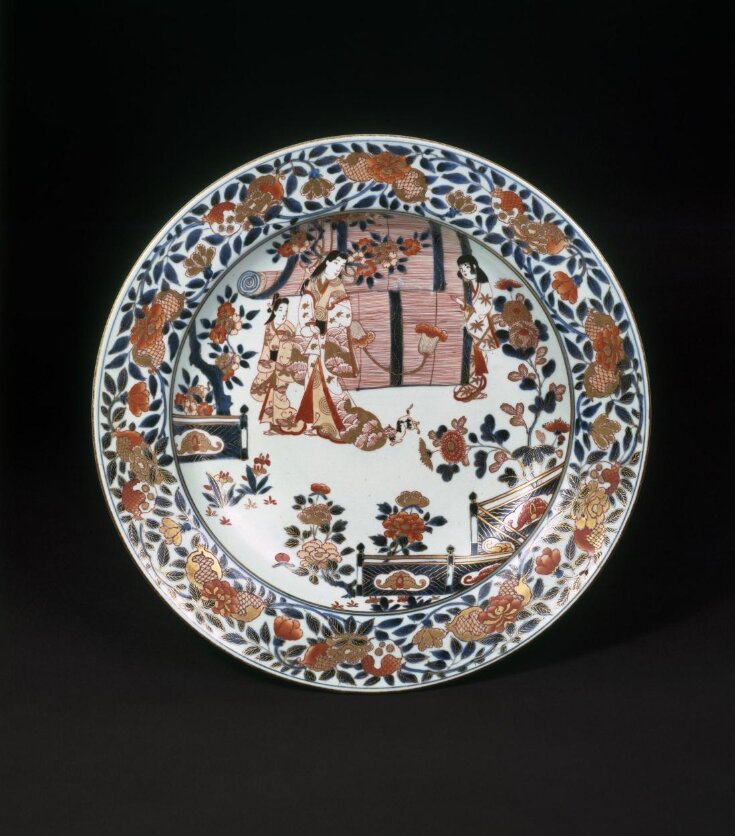
This large dish showing a woman and her two attendants is a fine example of the type of porcelain made in early 18th-century Japan for export to Europe. On its base there appears a Dresden inventory mark, indicating that the piece came from the collection of the Elector Frederick Augustus I of Saxony, ‘Augustus the Strong’, who died in 1733. The areas of dark blue were achieved by painting with cobalt oxide under a clear glaze and firing to a high temperature in a reducing atmosphere - one in which the kiln is starved of oxygen so that the burning fuel draws chemically bonded oxygen from the reactive parts of the ceramic material, leaving them in a reduced state and changing their colour. The gold, red and other enamel colours were applied and fused on in subsequent, low-temperature firings. The distinctive so-called Imari-style colour scheme was much copied by 18th-century European manufacturers. The term Imari comes from the name of the port in western Japan through which this and other products of the nearby Arita kilns were shipped. Porcelains for export were sent to Nagasaki and then shipped abroad by Chinese and Dutch merchants, the Dutch, who were based on the island of Dejima, being the only Europeans permitted to conduct trade in Japan at this time.
Object details
| Categories | |
| Object type | |
| Materials and techniques | Porcelain decorated in underglaze blue, overglaze enamels and gilt |
| Brief description | Dish, porcelain painted in underglaze blue, overglaze enamels and gilt, with a woman and her attendants in a garden; Japan, Arita kilns (Imari type), Edo period, 1690-1720 |
| Physical description | Dish of porcelain, painted in red, underglaze blue and black. In the middle, a woman and two attendants with a dog in a garden. Border of pomegranates and flowers. Under the rim the same design of pomegranates. Under the base twelve spur marks. |
| Dimensions |
|
| Styles | |
| Marks and inscriptions |
|
| Gallery label |
|
| Credit line | Salting Bequest |
| Object history | Bequeathed by Mr. George Salting, accessioned in 1910. This acquisition information reflects that found in the Asia Department registers, as part of a 2022 provenance research project. Formerly in the Royal Saxon Collection. |
| Subjects depicted | |
| Summary | This large dish showing a woman and her two attendants is a fine example of the type of porcelain made in early 18th-century Japan for export to Europe. On its base there appears a Dresden inventory mark, indicating that the piece came from the collection of the Elector Frederick Augustus I of Saxony, ‘Augustus the Strong’, who died in 1733. The areas of dark blue were achieved by painting with cobalt oxide under a clear glaze and firing to a high temperature in a reducing atmosphere - one in which the kiln is starved of oxygen so that the burning fuel draws chemically bonded oxygen from the reactive parts of the ceramic material, leaving them in a reduced state and changing their colour. The gold, red and other enamel colours were applied and fused on in subsequent, low-temperature firings. The distinctive so-called Imari-style colour scheme was much copied by 18th-century European manufacturers. The term Imari comes from the name of the port in western Japan through which this and other products of the nearby Arita kilns were shipped. Porcelains for export were sent to Nagasaki and then shipped abroad by Chinese and Dutch merchants, the Dutch, who were based on the island of Dejima, being the only Europeans permitted to conduct trade in Japan at this time. |
| Bibliographic reference | Earle, Joe, ed. Japanese art and design London: V&A Publishing, 2009, p. 84
|
| Other number | Loan no. 6 |
| Collection | |
| Accession number | C.1513-1910 |
About this object record
Explore the Collections contains over a million catalogue records, and over half a million images. It is a working database that includes information compiled over the life of the museum. Some of our records may contain offensive and discriminatory language, or reflect outdated ideas, practice and analysis. We are committed to addressing these issues, and to review and update our records accordingly.
You can write to us to suggest improvements to the record.
Suggest feedback
You can write to us to suggest improvements to the record.
Suggest feedback
| Record created | December 15, 1999 |
| Record URL |
Download as: JSONIIIF Manifest
