Sakyamuni Buddha
Figure of Sakyamuni Buddha
15th century (made)
15th century (made)
| Artist/Maker | |
| Place of origin |
Buddhism originated in India from the teachings of an Indian prince, Sakyamuni. He was probably born at the end of the 6th century BC in a small state in Nepal, but decided to renounce his royal position to embark upon a monastic life.
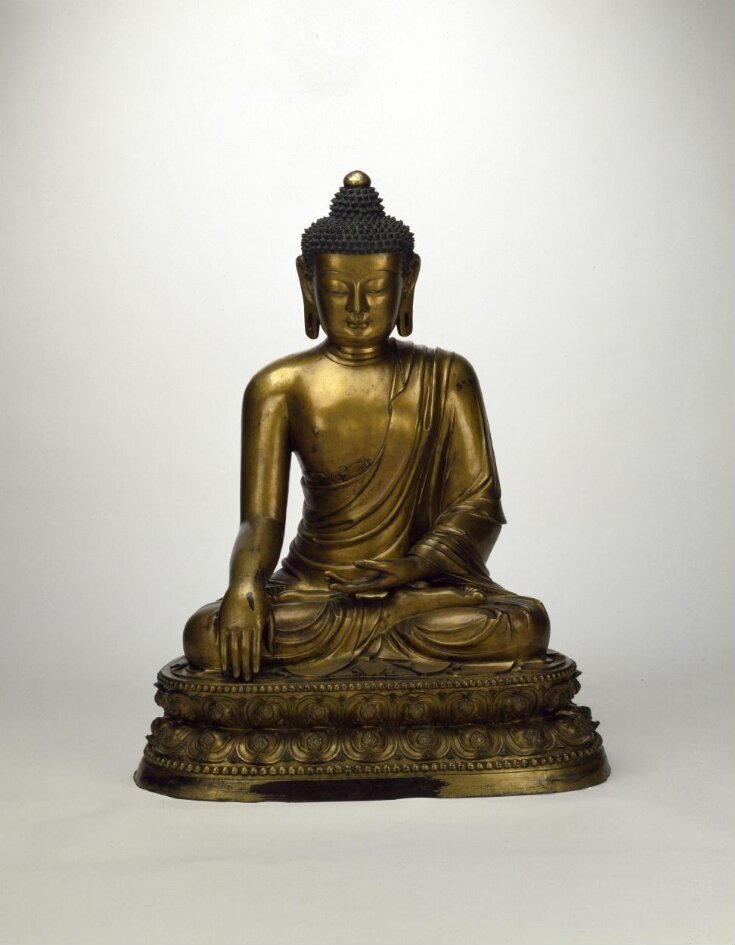
This gilt bronze figure represents a crucial event in Sakyamuni's life. After leaving his palace and and experiencing various spiritual revelations, he sat under a tree waiting for enlightenment, vowing not to move. After resisting the attacks of Mara, the goddess of evil, Sakyamuni summoned up the Earth goddess to bear witness to his achievement. The bronze figure shows Buddha in this precise moment: he is sitting in a meditative posture with his legs crossed, while his right hand extends downward to touch the soil in the symbolic gesture called 'Bhumisparsamudra' (Touching the Earth). The image is nearly entirely gilded, apart from the hair, and was probably once covered by a thin layer of transparent lacquer.
This gilt bronze figure represents a crucial event in Sakyamuni's life. After leaving his palace and and experiencing various spiritual revelations, he sat under a tree waiting for enlightenment, vowing not to move. After resisting the attacks of Mara, the goddess of evil, Sakyamuni summoned up the Earth goddess to bear witness to his achievement. The bronze figure shows Buddha in this precise moment: he is sitting in a meditative posture with his legs crossed, while his right hand extends downward to touch the soil in the symbolic gesture called 'Bhumisparsamudra' (Touching the Earth). The image is nearly entirely gilded, apart from the hair, and was probably once covered by a thin layer of transparent lacquer.
Object details
| Categories | |
| Object type | |
| Title | Sakyamuni Buddha (generic title) |
| Materials and techniques | Gilt bronze |
| Brief description | Figure of Sakyamuni Buddha, gilt bronze, China, 15th century |
| Physical description | Figure of Buddha with long earlobes and a protuberance on the top of the head, seated in the 'vajra posture' on a lotus throne; the right hand touches the soil with its second finger, the left hand is in his lap with palm upwards. The robes leave the right shoulder bare. The image is completely gilt apart from the hair, which is black. |
| Dimensions |
|
| Style | |
| Credit line | Charlotte Alison Shaw Gift |
| Subjects depicted | |
| Summary | Buddhism originated in India from the teachings of an Indian prince, Sakyamuni. He was probably born at the end of the 6th century BC in a small state in Nepal, but decided to renounce his royal position to embark upon a monastic life. This gilt bronze figure represents a crucial event in Sakyamuni's life. After leaving his palace and and experiencing various spiritual revelations, he sat under a tree waiting for enlightenment, vowing not to move. After resisting the attacks of Mara, the goddess of evil, Sakyamuni summoned up the Earth goddess to bear witness to his achievement. The bronze figure shows Buddha in this precise moment: he is sitting in a meditative posture with his legs crossed, while his right hand extends downward to touch the soil in the symbolic gesture called 'Bhumisparsamudra' (Touching the Earth). The image is nearly entirely gilded, apart from the hair, and was probably once covered by a thin layer of transparent lacquer. |
| Collection | |
| Accession number | FE.58-1977 |
About this object record
Explore the Collections contains over a million catalogue records, and over half a million images. It is a working database that includes information compiled over the life of the museum. Some of our records may contain offensive and discriminatory language, or reflect outdated ideas, practice and analysis. We are committed to addressing these issues, and to review and update our records accordingly.
You can write to us to suggest improvements to the record.
Suggest feedback
You can write to us to suggest improvements to the record.
Suggest feedback
| Record created | December 15, 1999 |
| Record URL |
Download as: JSONIIIF Manifest
