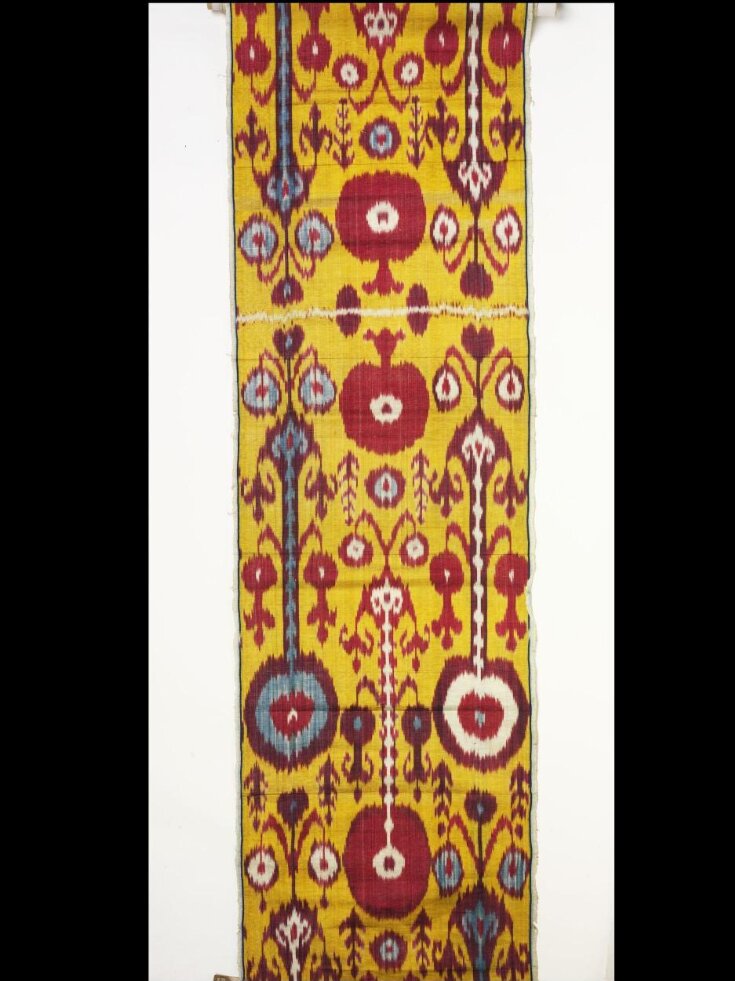

Ikat Length
before 1875 (made)
| Artist/Maker | |
| Place of origin |
Central Asian ikat fabrics were woven in long lengths like this example and were then used to make larger textiles of one of two types. They were either made into clothing or enlarged and used as hangings around the home. Ikats were high status items, often made under the patronage of the courts. The complex and highly skilled method of production – a process of resist dyeing the silk threads before weaving – meant that ikats were labour-intensive and expensive to produce. For this reason ikat clothing was often reserved for special occasions such as weddings and funerals, and was also given by members of the court as ‘robes of honour’ (khilat) to thank or honour high-ranking guests.
The earliest dated Central Asian ikats in the UK are from the Shaw collection at the Ashmolean Museum, which are known to date from before 1868. The V&A’s collection of lengths of ikat fabrics came into the collection in 1880 from the India Office. Documentation handed over with them record that they were purchased on two separate occasions, the first group in Kabul in 1870 and the second (including this piece) in Yarkand (modern-day Shache in China) in April 1875. We can therefore date these textiles to prior to these acquisition years.
The earliest dated Central Asian ikats in the UK are from the Shaw collection at the Ashmolean Museum, which are known to date from before 1868. The V&A’s collection of lengths of ikat fabrics came into the collection in 1880 from the India Office. Documentation handed over with them record that they were purchased on two separate occasions, the first group in Kabul in 1870 and the second (including this piece) in Yarkand (modern-day Shache in China) in April 1875. We can therefore date these textiles to prior to these acquisition years.
Object details
| Categories | |
| Object type | |
| Materials and techniques | Silk and cotton warp ikat |
| Brief description | Narrow length of ikat fabric with a repeating pattern of pomegranates in red, blue and white on a yellow background |
| Physical description | Narrow length of ikat fabric with a repeating pattern of pomegranates in red, blue and white on a yellow background. |
| Dimensions |
|
| Gallery label | Ikat length with pomegranate design on a yellow background
Acquired Yarkand, 1875
Silk and cotton
Museum no. 2113 (IS)(05/11/2007 to 30/03/2008) |
| Object history | The earliest dated Central Asian ikats in the UK are from the Shaw collection at the Ashmolean Museum, which are known to date from before 1868. The V&A’s collection of lengths of ikat fabrics came into the collection in 1880 from the India Office. Documentation handed over with them record that they were purchased on two separate occasions, the first group in Kabul in 1870 and the second (including this piece) in Yarkand (modern-day Shache in China) in April 1875. We can therefore date these textiles to prior to these acquisition years. |
| Historical context | The ‘golden age’ of nineteenth century Central Asian ikats is closely bound up with the economic and cultural dynamism of the cities which produced it – such as Samarkand and Bukhara, in modern-day Uzbekistan, and Kabul and Kunduz in Afghanistan. Large neighbourhoods existed to house the dyers, weavers, binders and designers whose collaborative activity went into the making of ikat fabrics. Central Asian ikat fabrics were woven in long lengths like this example and were then used to make larger textiles of one of two types. They were either made into clothing or enlarged and used as hangings around the home. Ikats were high status items, often made under the patronage of the courts. The complex and highly skilled method of production – a process of resist dyeing the silk threads before weaving – meant that ikats were labour-intensive and expensive to produce. For this reason ikat clothing was often reserved for special occasions such as weddings and funerals, and was also given by members of the court as ‘robes of honour’ (khilat) to thank or honour high-ranking guests. |
| Production | Acquired in Yarkand (modern-day Shache in China) in 1875 |
| Summary | Central Asian ikat fabrics were woven in long lengths like this example and were then used to make larger textiles of one of two types. They were either made into clothing or enlarged and used as hangings around the home. Ikats were high status items, often made under the patronage of the courts. The complex and highly skilled method of production – a process of resist dyeing the silk threads before weaving – meant that ikats were labour-intensive and expensive to produce. For this reason ikat clothing was often reserved for special occasions such as weddings and funerals, and was also given by members of the court as ‘robes of honour’ (khilat) to thank or honour high-ranking guests. The earliest dated Central Asian ikats in the UK are from the Shaw collection at the Ashmolean Museum, which are known to date from before 1868. The V&A’s collection of lengths of ikat fabrics came into the collection in 1880 from the India Office. Documentation handed over with them record that they were purchased on two separate occasions, the first group in Kabul in 1870 and the second (including this piece) in Yarkand (modern-day Shache in China) in April 1875. We can therefore date these textiles to prior to these acquisition years. |
| Bibliographic reference | Clark, Ruby Central Asian Ikats, V&A Publications, London, 2007. 96 p. : ill. (chiefly col.) ISBN: 9781851775255 (pbk.) 1851775250 (pbk.)
p. 91 |
| Other number | 13,015 - India Museum Slip Book |
| Collection | |
| Accession number | 2113(IS) |
About this object record
Explore the Collections contains over a million catalogue records, and over half a million images. It is a working database that includes information compiled over the life of the museum. Some of our records may contain offensive and discriminatory language, or reflect outdated ideas, practice and analysis. We are committed to addressing these issues, and to review and update our records accordingly.
You can write to us to suggest improvements to the record.
Suggest feedback
You can write to us to suggest improvements to the record.
Suggest feedback
| Record created | January 16, 2008 |
| Record URL |
Download as: JSONIIIF Manifest
