
Kalpasutra
Manuscript Page
late 15th century to early 16th century (made)
late 15th century to early 16th century (made)
| Artist/Maker | |
| Place of origin |
The Kalpasutra (Book of Rituals) is the most important canonical text in Jain literature for the Svetambaras (white-clad), one of the two sects of Jainism. Jainism is one of the oldest religions to have survived until the present time and its basic teaching is one of non-violence. The Kalpasutra is divided into three sections. The first section deals with the lives of the twenty-four Jinas or Tirthankaras, who were the Jain spiritual teachers or 'ford-makers'. The second part deals with the life of Mahavira, the twenty-fourth Tirthankara. The third part deals with rules for the ascetics and laws during the four months (chaturmas) of the rainy season, when ascetics temporarily abandon their wandering life and settle down amidst the laity. This is the time when the festival of Paryushan is celebrated and the Kalpasutra is traditionally recited.
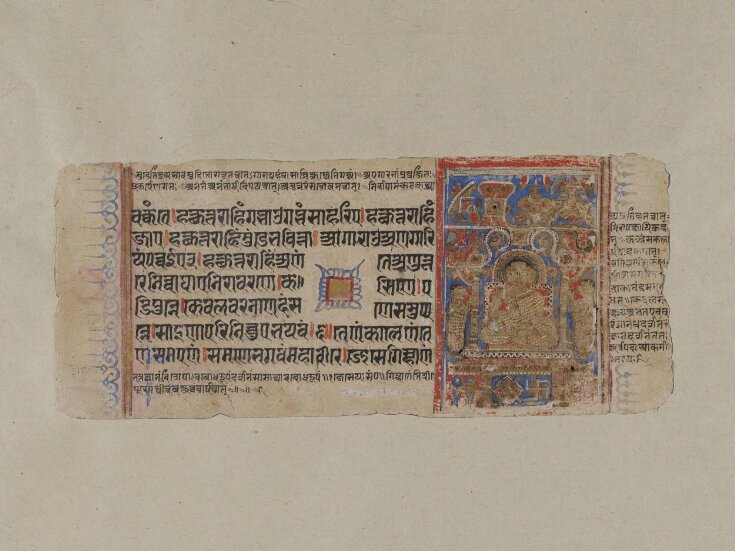
This folio shows Mahavira attended by demi-gods and demi-goddesses and the eight auspicious signs.
This folio shows Mahavira attended by demi-gods and demi-goddesses and the eight auspicious signs.
Object details
| Categories | |
| Object type | |
| Title | Kalpasutra (generic title) |
| Materials and techniques | Painted and written in ink, paint and gold on paper |
| Brief description | Jain manuscript page, Kalpasutra, a Jina with the eight auspicious emblems, ink, paint and gold on paper, Gujarat, late 15th and early 16th century |
| Physical description | Part of a manuscript of the Kalpasutra consisting of 91 folios, numbered 1-92, with folio 3 missing and containing 38 illustrations. The text is written in black ink in Prakrit, seven lines to the page between red and gold marginal rules and blue border decoration. The text of a Sanskrit commentary is inserted in small Nagari characters in the margins. Central and marginal string-holes are decorated but not pierced and on the obverse of each folio the central hole only is marked. Folio numbers are written in the lower right-hand corner of the reverse of each folio but are defective from folio 85 onwards due to insect damage. The colophon is written in red on f.92 verso (see Marks). This folio shows Mahavira attended by demi-gods and demi-goddesses and the eight auspicious signs. |
| Dimensions |
|
| Style | |
| Object history | Purchased in 1959 from Mr. A. Shah c/o. Mrs. G.Charlston, London S.W.16. for £48. |
| Production | Western India |
| Subjects depicted | |
| Summary | The Kalpasutra (Book of Rituals) is the most important canonical text in Jain literature for the Svetambaras (white-clad), one of the two sects of Jainism. Jainism is one of the oldest religions to have survived until the present time and its basic teaching is one of non-violence. The Kalpasutra is divided into three sections. The first section deals with the lives of the twenty-four Jinas or Tirthankaras, who were the Jain spiritual teachers or 'ford-makers'. The second part deals with the life of Mahavira, the twenty-fourth Tirthankara. The third part deals with rules for the ascetics and laws during the four months (chaturmas) of the rainy season, when ascetics temporarily abandon their wandering life and settle down amidst the laity. This is the time when the festival of Paryushan is celebrated and the Kalpasutra is traditionally recited. This folio shows Mahavira attended by demi-gods and demi-goddesses and the eight auspicious signs. |
| Bibliographic references |
|
| Collection | |
| Accession number | IS.46:2-1959 |
About this object record
Explore the Collections contains over a million catalogue records, and over half a million images. It is a working database that includes information compiled over the life of the museum. Some of our records may contain offensive and discriminatory language, or reflect outdated ideas, practice and analysis. We are committed to addressing these issues, and to review and update our records accordingly.
You can write to us to suggest improvements to the record.
Suggest feedback
You can write to us to suggest improvements to the record.
Suggest feedback
| Record created | December 20, 2007 |
| Record URL |
Download as: JSONIIIF Manifest
