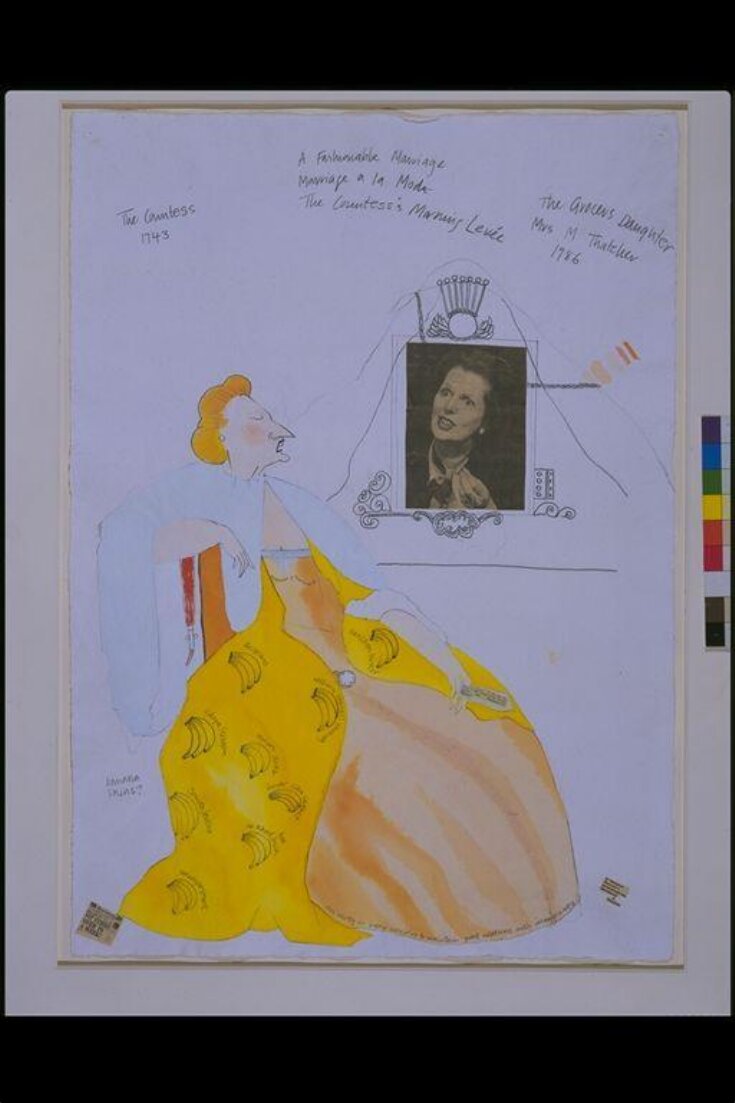

A Fashionable Marriage / Marriage à la Mode / The Countess's Morning Levée
Drawing
1986 (made)
1986 (made)
| Artist/Maker | |
| Place of origin |
In 1986 British artist Lubaina Himid was drawn to an image in a popular print series by William Hogarth. Marriage a la Mode of 1743 sought to expose the greed, fashionable excesses and exploitation which Hogarth saw at the heart of affluent 18th-century London life. Through six scenes, it describes the fall-out from an arranged marriage between the son of an impoverished Earl and the daughter of an avaricious tobacco merchant. Himid focused on scene four in which the countess is pictured at her toilette receiving the attention of her lover, the lawyer Silvertongue, surrounded by friends and admirers.
Himid’s response took the form of an installation entitled A Fashionable Marriage. Using larger-than-life plywood figures, she reused the characters and composition of the Hogarth original to deliver a scathing critique on contemporary art and politics. The countess and her lover became British Prime Minister Margaret Thatcher and US President Ronald Reagan, ‘an unwholesome liaison of capitalism and imperialism’ (Bernadette Fort, 2001). In this preparatory drawing Thatcher’s dress is sprinkled with bananas, a reference to her many ‘slips’ which are described beside each bunch: ‘Belgrano’, ‘miners’ strike’, ‘inner city neglect’, ‘unemployment’.
This and the related drawings (E.599-602-1996) were produced by the artist as 'aides memoires' for the 3D installation.
Himid’s response took the form of an installation entitled A Fashionable Marriage. Using larger-than-life plywood figures, she reused the characters and composition of the Hogarth original to deliver a scathing critique on contemporary art and politics. The countess and her lover became British Prime Minister Margaret Thatcher and US President Ronald Reagan, ‘an unwholesome liaison of capitalism and imperialism’ (Bernadette Fort, 2001). In this preparatory drawing Thatcher’s dress is sprinkled with bananas, a reference to her many ‘slips’ which are described beside each bunch: ‘Belgrano’, ‘miners’ strike’, ‘inner city neglect’, ‘unemployment’.
This and the related drawings (E.599-602-1996) were produced by the artist as 'aides memoires' for the 3D installation.
Object details
| Categories | |
| Object type | |
| Titles |
|
| Materials and techniques | Wash drawing with collage |
| Brief description | 'A Fashionable Marriage', wash drawing with collage, Lubaina Himid, Great Britain, 1986 |
| Physical description | A pencil and wash caricatured drawing of the former British prime minister Margaret Thatcher seated looking into a mirror which reflects (using a newspaper cutting) her face. The seated figure wears an orange and yellow gown with a white stole. Under her bodice is written 'supporter of apartheid' and her skirt is patterned with banana skins with text next to each reading 'Belgrano', 'sanction buster', 'selling council housing', 'miners' strike', 'Libya / Reagan', 'inner city neglect', 'no free school milk', 'unemployment'. On the hem is written 'My party is very anxious to maintain good relations with immigrants'. Further newspaper cuttings have been pasted onto the image. |
| Dimensions |
|
| Subjects depicted | |
| Summary | In 1986 British artist Lubaina Himid was drawn to an image in a popular print series by William Hogarth. Marriage a la Mode of 1743 sought to expose the greed, fashionable excesses and exploitation which Hogarth saw at the heart of affluent 18th-century London life. Through six scenes, it describes the fall-out from an arranged marriage between the son of an impoverished Earl and the daughter of an avaricious tobacco merchant. Himid focused on scene four in which the countess is pictured at her toilette receiving the attention of her lover, the lawyer Silvertongue, surrounded by friends and admirers. Himid’s response took the form of an installation entitled A Fashionable Marriage. Using larger-than-life plywood figures, she reused the characters and composition of the Hogarth original to deliver a scathing critique on contemporary art and politics. The countess and her lover became British Prime Minister Margaret Thatcher and US President Ronald Reagan, ‘an unwholesome liaison of capitalism and imperialism’ (Bernadette Fort, 2001). In this preparatory drawing Thatcher’s dress is sprinkled with bananas, a reference to her many ‘slips’ which are described beside each bunch: ‘Belgrano’, ‘miners’ strike’, ‘inner city neglect’, ‘unemployment’. This and the related drawings (E.599-602-1996) were produced by the artist as 'aides memoires' for the 3D installation. |
| Associated objects |
|
| Bibliographic references |
|
| Collection | |
| Accession number | E.599-1996 |
About this object record
Explore the Collections contains over a million catalogue records, and over half a million images. It is a working database that includes information compiled over the life of the museum. Some of our records may contain offensive and discriminatory language, or reflect outdated ideas, practice and analysis. We are committed to addressing these issues, and to review and update our records accordingly.
You can write to us to suggest improvements to the record.
Suggest feedback
You can write to us to suggest improvements to the record.
Suggest feedback
| Record created | December 6, 2007 |
| Record URL |
Download as: JSON
