Chalice and Paten
ca. 1200 (made)
| Artist/Maker | |
| Place of origin |
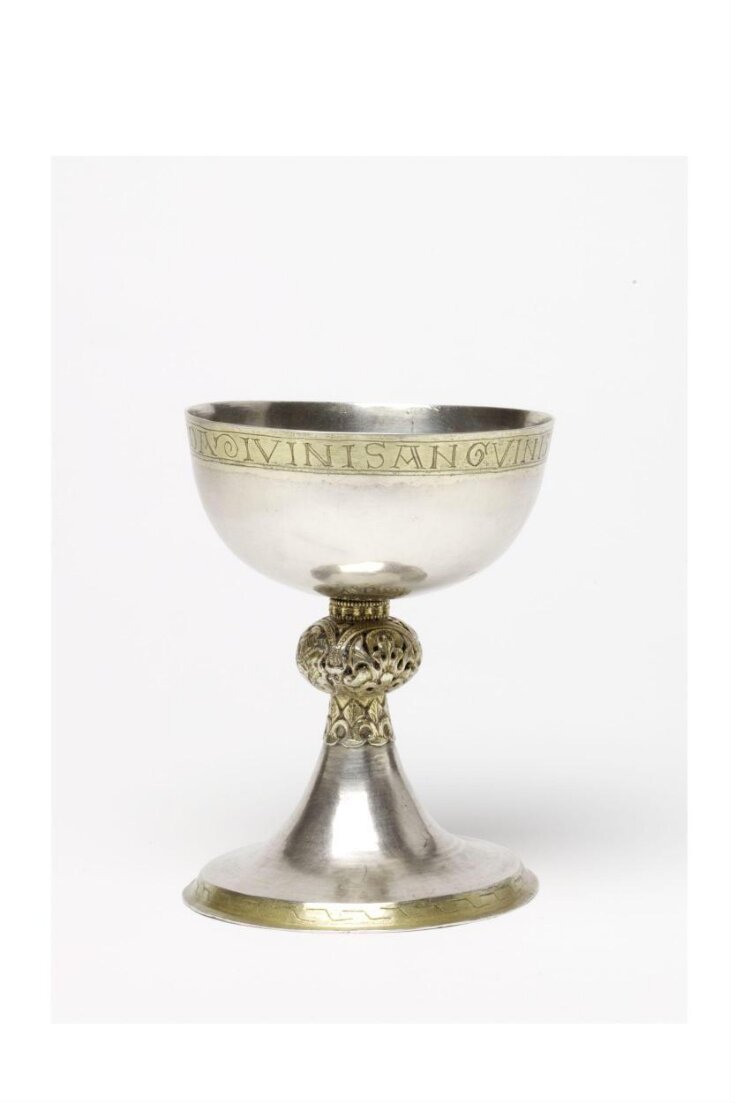
Chalices were usually made of the most precious materials, since they held the consecrated wine that was believed to be the blood of Christ. On this chalice, the Latin inscription around the bowl emphasizes this function. This silver chalice was made in the early 13th century, a time when Iceland had cultural, trade and diplomatic links with northern Europe, especially with Norway and England. In this period Icelandic culture flourished, notably through the work of writers like Snorri Sturluson (1178-1241), the great scholar, poet and historian. The decoration and style of this chalice, particularly the foliate decoration of the knop, reflects a knowledge of Romanesque sculptural forms.
Object details
| Categories | |
| Object type | |
| Parts | This object consists of 2 parts.
|
| Materials and techniques | Gilded silver |
| Brief description | Chalice and Paten, possibly Iceland,Norway or England, ca.1200 |
| Gallery label | CHALICE AND PATEN
Silver parcel-gilt
Round the lip is the inscription:- SVMMITVR (sumitur) HINC NVNDA (munda) DIVINI SANGVINIS VNDA.
Icelandic (?); 13th century
(The paten of later date)
From Grundt Church, Iceland |
| Object history | Purchased together for £70 from S. Verdier, Copenhagen, Denmark. RP number 81617/1902 Extract from letter received from MR Verdier dated 28th January, 1902 and registers under No. 3269-1902: "One very fine and rare Icelandic Chalice from the Middle ages, I have got it direct from Iceland it has belong to Grundt church by Arefiord. On the Chalice stand, SUMMITVR HINC NVNDA DIVINI SANGVINIS VNDA" British Library Sacred Exhibition RF.2006/484 |
| Historical context | The chalice and paten are said to have come from Grund, a farm in northern Iceland, only a few miles from the church of Holar, formerly the seat of the Cathedral for that region.The church still owns two fine and elaborate 13th century silver chalices, and it is possible that this chalice also once belonged to the cathedral. |
| Production | Also possible that the object was made in England or Norway and brought to Iceland |
| Summary | Chalices were usually made of the most precious materials, since they held the consecrated wine that was believed to be the blood of Christ. On this chalice, the Latin inscription around the bowl emphasizes this function. This silver chalice was made in the early 13th century, a time when Iceland had cultural, trade and diplomatic links with northern Europe, especially with Norway and England. In this period Icelandic culture flourished, notably through the work of writers like Snorri Sturluson (1178-1241), the great scholar, poet and historian. The decoration and style of this chalice, particularly the foliate decoration of the knop, reflects a knowledge of Romanesque sculptural forms. |
| Bibliographic reference | Campbell, Marian, 'The medieval chalices of Iceland and Norway', in Lilja Arnadottir and Ketil Kiran ed., Church and art: the medieval church in Norway and Iceland , Reykjavik 1997, pp. 102-4, pl. 1 |
| Collection | |
| Accession number | 639&A-1902 |
About this object record
Explore the Collections contains over a million catalogue records, and over half a million images. It is a working database that includes information compiled over the life of the museum. Some of our records may contain offensive and discriminatory language, or reflect outdated ideas, practice and analysis. We are committed to addressing these issues, and to review and update our records accordingly.
You can write to us to suggest improvements to the record.
Suggest feedback
You can write to us to suggest improvements to the record.
Suggest feedback
| Record created | November 5, 2007 |
| Record URL |
Download as: JSONIIIF Manifest
