
The Circus Collection
Pair of Gloves
1938 (made)
1938 (made)
| Artist/Maker | |
| Place of origin |
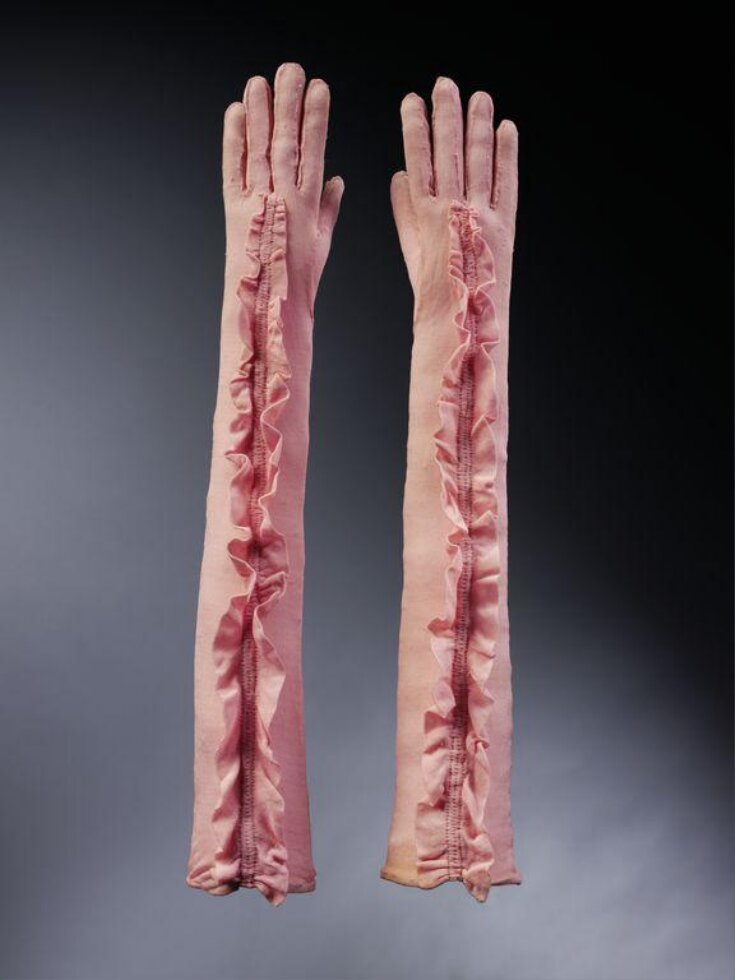
This pair of evening gloves was worn with Elsa Schiaparelli's 'Tears' dress. (see T.393&A-1974) Their strong pink colour would have complemented the pink and magenta print of the dress. Schiaparelli had a knack for taking everyday garments and using unusual details and trimmings to make them extraordinary. Here, instead of a traditional glove-leather, a pink crêpe fabric is used. Crêpe was more stretchy, precluding the need for buttons or fastenings. The dramatic shirred ruffles which run the entire length of each glove provide an additional unexpected touch.
Delve deeper
Discover more about this object

Object details
| Categories | |
| Object type | |
| Parts | This object consists of 2 parts.
|
| Title | The Circus Collection (named collection) |
| Materials and techniques | Crêpe |
| Brief description | Pair of crêpe evening gloves, 'The Circus Collection', designed by Elsa Schiaparelli, Paris, 1938. |
| Physical description | Pair of pink opera-length crêpe gloves with exaggerated ruffles down the back of the hand extending all the way up the forearm. |
| Style | |
| Production type | Haute couture |
| Credit line | Given by Miss Ruth Ford |
| Object history | Ref. Paris Centre de Documentation de Costume, Schiaparelli, Album no 19, 1938, p.124 Historical significance: Extremely important Schiaparelli design, representing her collaboration with Salvador Dali. Particularly significant in how it relates to world affairs. The savagely ripped print suggests the horrors of the Spanish Civil War and the upcoming turmoil of the Second World War. |
| Historical context | In 1936 Salvador Dali painted three pictures showing figures with flayed/torn skin where torn garment and torn flesh were indistinguishable. One of these, Necrophiliac Springtime was owned by Elsa Schiaparelli. The one most commonly associated with the "Tears Dress" is Three Young Surrealist Women Holding In Their Arms The Skins Of An Orchestra (both paintings can be seen in Blum, p.139) The Circus Collection for summer 1938 was presented at the beginning of February of that year, just after the Paris Surrealism exhibition opened on 17th January. Along with this dress, Dali collaborated with Schiaparelli on the Skeleton Dress in the same collection. (T.394-1974). Richard Martin says that to "tear the dress is to deny its customary decorum and utility, and to question the matter of concealment and revelation in the garment." He compares it to the Spanish Civil War, and the spread of Fascism through Europe. He suggests that the imagery of rent fabric held strong implications for both the politicial and visual worlds. To Martin, the dress is a memento mori - a reminder of one's own mortality - that was in a state of destruction even when it was new. (p.136-137) The real tears on the cape/veil and the fictive tears on the dress create a visual friction between what is real and what is not. Martin proposes that if the dress were to become mere decoration (like slashing in the 16th century), the cape would still negate this, and vice versa. The two styles support each other's plausibility. The mysticism of penetration without tearing asunder becomes more viable when accompanied by a physical manifestation of the dress without rupture. Dress is therefore used to represent and reference, just as furniture, architecture, and sculpture themselves do. (p.114) - Daniel Milford-Cottam, 2008 Bibilography Blum, Dilys E. Shocking! The Art and Fashion of Elsa Schiaparelli, Philadelphia Museum of Art, 2003 Martin, R. Fashion and Surrealism, London, 1988. |
| Subjects depicted | |
| Summary | This pair of evening gloves was worn with Elsa Schiaparelli's 'Tears' dress. (see T.393&A-1974) Their strong pink colour would have complemented the pink and magenta print of the dress. Schiaparelli had a knack for taking everyday garments and using unusual details and trimmings to make them extraordinary. Here, instead of a traditional glove-leather, a pink crêpe fabric is used. Crêpe was more stretchy, precluding the need for buttons or fastenings. The dramatic shirred ruffles which run the entire length of each glove provide an additional unexpected touch. |
| Associated object | T.393-1974 (Ensemble) |
| Bibliographic references |
|
| Collection | |
| Accession number | T.393B&C-1974 |
About this object record
Explore the Collections contains over a million catalogue records, and over half a million images. It is a working database that includes information compiled over the life of the museum. Some of our records may contain offensive and discriminatory language, or reflect outdated ideas, practice and analysis. We are committed to addressing these issues, and to review and update our records accordingly.
You can write to us to suggest improvements to the record.
Suggest feedback
You can write to us to suggest improvements to the record.
Suggest feedback
| Record created | October 29, 2007 |
| Record URL |
Download as: JSON
