Casket
1350-1370 (made)
| Artist/Maker | |
| Place of origin |
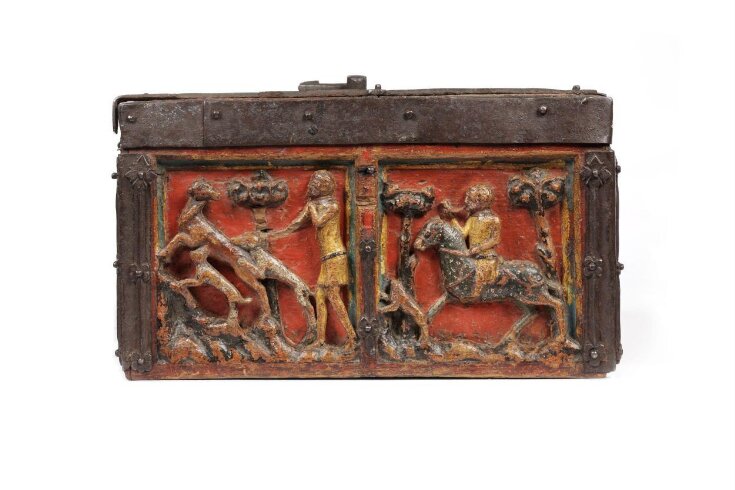
The lid of this casket shows a scene from the story of Tristan and Isolde, one of the most popular medieval romances. The adulterous lovers Tristan and Isolde meet secretly at a fountain, spied upon by Isolde's husband King Marke and a dwarf who hide in a tree. On the sides of the casket are scenes showing hunting, a lady and a Wild Man, and a couple playing chess.
What makes this casket particularly remarkable is that it retains much original paint. When it was bought by the Museum in 1855 the box had been overpainted in a dark colour and it was only during the next twenty years that this was removed to reveal the brighter colours underneath.
Decorated caskets were probably often given as gifts in the middle ages. The scenes associated with courtly love on this one suggests that it may have been a love gift, to mark a betrothal.
What makes this casket particularly remarkable is that it retains much original paint. When it was bought by the Museum in 1855 the box had been overpainted in a dark colour and it was only during the next twenty years that this was removed to reveal the brighter colours underneath.
Decorated caskets were probably often given as gifts in the middle ages. The scenes associated with courtly love on this one suggests that it may have been a love gift, to mark a betrothal.
Object details
| Categories | |
| Object type | |
| Materials and techniques | Oak, carved and painted, with metal mounts and textile/paper lining |
| Brief description | Casket with hinged lid, of oak, carved all over with images from the story of Tristan and Isolde and painted in polychrome. Northern Europe, 1350-75 |
| Physical description | Lidded oak box, carved with scenes from the story of Tristram and Isolde, with painted (mainly red) decoration, and iron mounts and lock. Construction The casket is a large box with hinged lid. The quartered oak boards are joined with a mitred joint (the front and back boards extending slightly over the side boards at the outside of the mitre). The internal joint is not visible, but it is presumed to be butted. The base board (a single oak panel) is held in rebates cut in the front, back and side panels, with supplementary hand-made nails. Seven nailed iron mounts originally extended under the base board, but all but one of these have broken. Plain iron bands are nailed around the front and sides of the lid. Passing over the lid and all four faces, and extending a short distance under the box are iron straps, with quatrefoil flower heads at intervals, through which nails are fixed. Where these straps pass over the lid, the quatrefoil flowers are flanked by small rectangular sections with a milled upper surface. Three of these straps incorporate hinges, the central one of which is now broken, and missing part. In the centre of the lid is a metal handle of M form, with a shaped, central knop. On the front is an external lock plate (apparently original). Below the lock plate is a fixing loop (presumably added), the hasp for which (now missing) was fixed to a band of iron nailed to the front top edge of the lid. Flanking the lockplate are two keyholes crudely cut through the front panel, which correspond to two internal locks and two barbed lock bolts fitted into the lid. Caskets of this type are usually fitted with a single lock. The interruption of the carved designs by the keyholes, and the internal evidence suggests that these were added, probably at an early date, and their fitting may have required the partial removal of the canvas lining behind the front board . On the underside of the base board at the corners are four holes cut into the mitre line, presumably for low, angled metal feet (which are missing). The keys are missing. The lid board is lined with linen of rather crude quality (probably dating to pre-1500), and the box itself is lined with blue paper over traces of what may be metal sheet and linen. Carved decoration The lid is carved with two standing figures, each beside a tree, representing Tristan (right) and Isolde (left) pointing at a pool, flanking a tree in which King Mark with a sword and the dwarf hide, above a pool. Where the handle is fixed to the lid two monstrous animal mask bosses (bat/lion) are carved. The front, back and ends are carved with conventional scenes of courtly love and hunting: the front with two central lions, back to back, with a seated wild man (right) facing a seated lady and male servant (left). The back is carved with a seated lady and man playing chess beneath two trees, this scene compartment flanked by compartments containing a man (right) and woman (left). The left side of the casket is carved with two compartments containing two trees and a huntsman on horseback, blowing a horn, with a hound alongside, and left, a tree with a huntsman on foot with two hounds bringing down a deer. The right side is carved with two compartments containing two trees and a woman on horseback, with a hound alongside, and left, a man who cups one hand to his eye and reaches the other into the jaws of a bear(?) sitting on its haunches while two hounds attack it. |
| Dimensions |
|
| Style | |
| Gallery label |
|
| Object history | This casket came from the Bernal Collection, auctioned in London in 1855. It was bought by the Museum of Ornamental Art (as the Victoria and Albert Museum was then called) for £15. 15s. The collection of ceramics, glass, metalwork and woodwork formed by Ralph Bernal MP 'was reckoned to be the only English Collection which could rival the 'private "cabinets" ' of France.' (Anthony Burton, 'Vision and Accident. The Story of the Victoria and Albert Museum' (London 1999), p.34) LONDON, Victoria and Albert Museum: 50 Masterpieces Series. Woodwork. (London, 1955) says that "Its colours were brought to light in the course of later [post acquisition] cleaning by the Museum craftsmen." |
| Historical context | Note on dress depicted: Tristan wears a shoulder cape with dagged edge and a belt worn on the hips over a supertunic, the length of which suggests a date c.1350-75 (tunics grew shorter towards 1400). Isolde wears a long-sleeved, tight-fitting gown (probably of wool) and her square-framed hair style suggest a similar date, as hairstyles became softer towards 1400. |
| Production | Northern Europe |
| Association | |
| Literary reference | Tristan and Isolde |
| Summary | The lid of this casket shows a scene from the story of Tristan and Isolde, one of the most popular medieval romances. The adulterous lovers Tristan and Isolde meet secretly at a fountain, spied upon by Isolde's husband King Marke and a dwarf who hide in a tree. On the sides of the casket are scenes showing hunting, a lady and a Wild Man, and a couple playing chess. What makes this casket particularly remarkable is that it retains much original paint. When it was bought by the Museum in 1855 the box had been overpainted in a dark colour and it was only during the next twenty years that this was removed to reveal the brighter colours underneath. Decorated caskets were probably often given as gifts in the middle ages. The scenes associated with courtly love on this one suggests that it may have been a love gift, to mark a betrothal. |
| Bibliographic references |
|
| Collection | |
| Accession number | 2173-1855 |
About this object record
Explore the Collections contains over a million catalogue records, and over half a million images. It is a working database that includes information compiled over the life of the museum. Some of our records may contain offensive and discriminatory language, or reflect outdated ideas, practice and analysis. We are committed to addressing these issues, and to review and update our records accordingly.
You can write to us to suggest improvements to the record.
Suggest feedback
You can write to us to suggest improvements to the record.
Suggest feedback
| Record created | September 14, 2007 |
| Record URL |
Download as: JSONIIIF Manifest
