
Doublet and Breeches
1630-1639 (made)
| Artist/Maker | |
| Place of origin |
Object Type
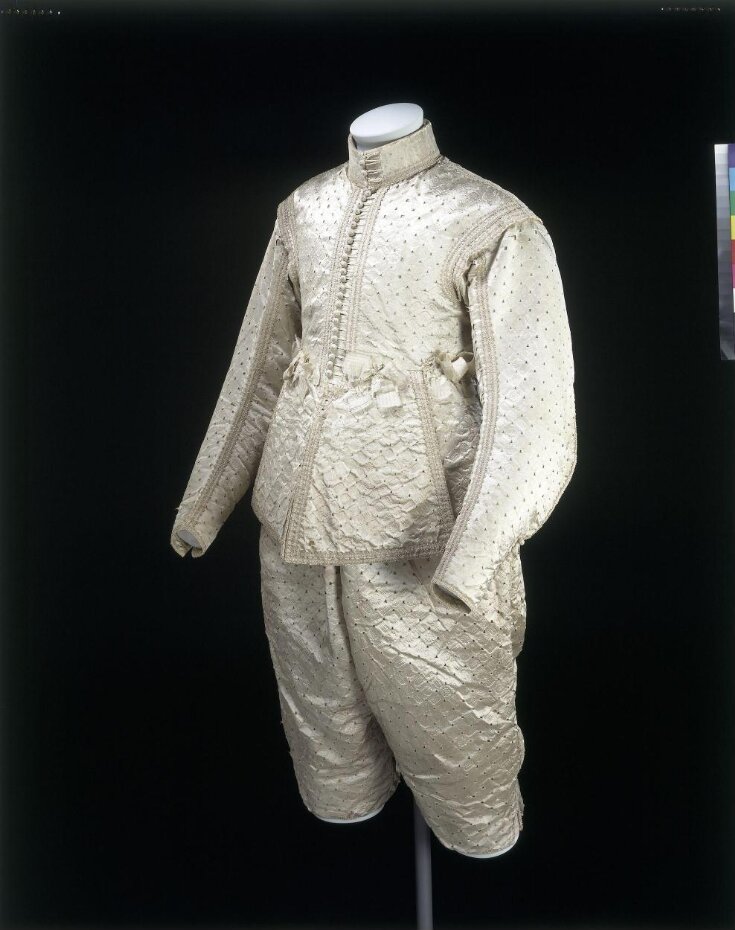
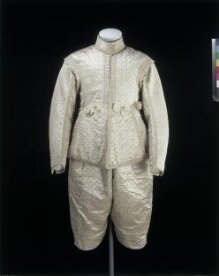
This ensemble of doublet and breeches is typical of a wealthy man's clothing. It would have been worn with a matching or contrasting cloak. A fine lace or linen collar and cuffs would have completed the outfit, along with silk stockings and heeled leather shoes.
Time
The style of this outfit is characteristic of the 1630s. The breeches are longer and less voluminous than they were in the early 17th century. They are attached with long heavy hooks which run through eyelets at the waistband on the inside of the doublet. The silk ribbons at the waistband once had the function of holding doublet and breeches together, but are now purely decorative. On the doublet the waist tabs are now much larger and longer than they had been 20 years previously.
Materials & Making
The lustrous white satin was a suitable fabric for stamping and pinking. The fabric was probably dampened first and the stamping tools heated to make the impression indelible. In between the stamped motifs, a pinking tool similar to an awl created the tiny decorative holes. Once the satin was decorated, it was cut and hand-sewn. The doublet and breeches are interlined with wool and lined with silk.
This ensemble of doublet and breeches is typical of a wealthy man's clothing. It would have been worn with a matching or contrasting cloak. A fine lace or linen collar and cuffs would have completed the outfit, along with silk stockings and heeled leather shoes.
Time
The style of this outfit is characteristic of the 1630s. The breeches are longer and less voluminous than they were in the early 17th century. They are attached with long heavy hooks which run through eyelets at the waistband on the inside of the doublet. The silk ribbons at the waistband once had the function of holding doublet and breeches together, but are now purely decorative. On the doublet the waist tabs are now much larger and longer than they had been 20 years previously.
Materials & Making
The lustrous white satin was a suitable fabric for stamping and pinking. The fabric was probably dampened first and the stamping tools heated to make the impression indelible. In between the stamped motifs, a pinking tool similar to an awl created the tiny decorative holes. Once the satin was decorated, it was cut and hand-sewn. The doublet and breeches are interlined with wool and lined with silk.
Object details
| Categories | |
| Object type | |
| Parts | This object consists of 2 parts.
|
| Materials and techniques | Silk, linen, wool, baleen, steelst; hand-woven, hand-sewn, stamped and pinked |
| Brief description | Man's doublet and breeches, 1630s, English; ivory silk satin with stamped and pinked decoration |
| Physical description | Man’s doublet and breeches of ivory silk satin, decorated with stamping and pinking. The doublet is interlined with linen and coarsely woven wool and lined with ivory silk satin. It has a 2¼-inch (5.5 cm) standing collar, ⅞-inch (2.2 cm) deep shoulder wings, curving 2-piece sleeves and 6 large, deep laps below the waist. The belly pieces are probably made of baleen stitched into layers of linen and covered with ivory satin. A ⅜-inch (8 mm) wide woven lace of ivory silk cord and silk floss, applied in 2 parallel rows, covers the seams, edges the shoulder wings, laps and collar and circles the armhole. There are 8 worked buttonholes on each sleeve and 26 on the left front with 4 button loops of braided ivory silk on the left side of the collar. The buttons have a domed wooden core, covered with ivory silk thread; 36 remain. A band of linen covered with ivory satin, sewn into the waist seam on the inside bears 16 metal eyes. The breeches are made of the same fabric as the doubletand interlined with blue wool and linen. A separate liner of bleached fustian is sewn to the waistband. The legs are full, gathered into the waistband and eased at the knee. The woven silk lace is applied in double rows along the outside leg and in a single line around the knee opening. There is a pocket lined with ivory silk taffeta in each side seam. The breeches open at the front with a buttonhole stand on the left with 10 buttonholes. Three buttons, the same as on the doublet sleeves, remain. There are 2 worked eyelets on each side of the front waistband and 14 metal hooks are sewn around the waistband. |
| Dimensions |
|
| Gallery label | British Galleries:
This doublet and breeches illustrate the processes of stamping and pinking fabric that could be done much more quickly than embroidery. Five decorative motifs have been stamped into the satin in a process similar to leather bookbinding. The satin has been 'pinked' or perforated with tiny decorative holes.(27/03/2003) |
| Object history | Made in England |
| Summary | Object Type This ensemble of doublet and breeches is typical of a wealthy man's clothing. It would have been worn with a matching or contrasting cloak. A fine lace or linen collar and cuffs would have completed the outfit, along with silk stockings and heeled leather shoes. Time The style of this outfit is characteristic of the 1630s. The breeches are longer and less voluminous than they were in the early 17th century. They are attached with long heavy hooks which run through eyelets at the waistband on the inside of the doublet. The silk ribbons at the waistband once had the function of holding doublet and breeches together, but are now purely decorative. On the doublet the waist tabs are now much larger and longer than they had been 20 years previously. Materials & Making The lustrous white satin was a suitable fabric for stamping and pinking. The fabric was probably dampened first and the stamping tools heated to make the impression indelible. In between the stamped motifs, a pinking tool similar to an awl created the tiny decorative holes. Once the satin was decorated, it was cut and hand-sewn. The doublet and breeches are interlined with wool and lined with silk. |
| Bibliographic reference | Miller, Lesley Ellis, and Ana Cabrera Lafuente, with Claire Allen-Johnstone, eds. Silk: Fibre, Fabric and Fashion. London: Thames & Hudson Ltd in association with the Victoria and Albert Museum, 2021. ISBN 978-0-500-48065-6.
This object features in the publication Silk: Fibre, Fabric and Fashion (2021) |
| Collection | |
| Accession number | 348&A-1905 |
About this object record
Explore the Collections contains over a million catalogue records, and over half a million images. It is a working database that includes information compiled over the life of the museum. Some of our records may contain offensive and discriminatory language, or reflect outdated ideas, practice and analysis. We are committed to addressing these issues, and to review and update our records accordingly.
You can write to us to suggest improvements to the record.
Suggest feedback
You can write to us to suggest improvements to the record.
Suggest feedback
| Record created | December 15, 1999 |
| Record URL |
Download as: JSONIIIF Manifest
