
Stays
1780-1789 (made)
| Artist/Maker | |
| Place of origin |
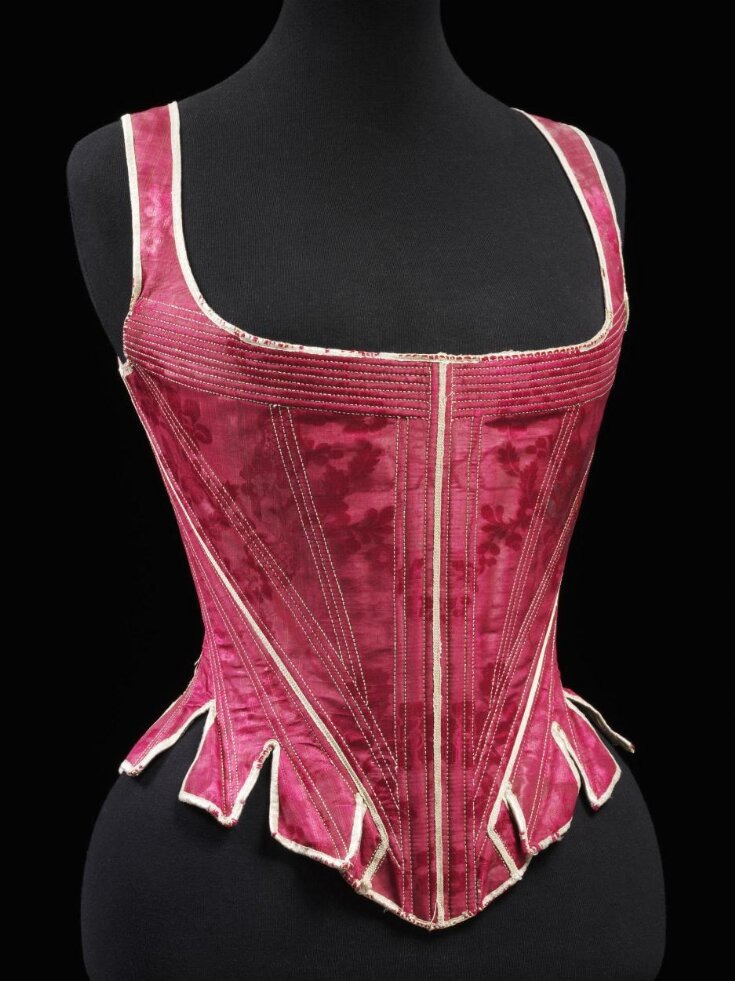
In the 18th century, women’s stays served to mould the torso to the fashionable shape and provide a rigid form on which the gown could be arranged and fastened. Because they were underwear and therefore never seen, stays were usually made of plain linen, but this example provides a colourful and luxurious alternative.
Object details
| Categories | |
| Object type | |
| Materials and techniques | Silk, linen, baleen; hand-woven damask weave, hand-sewn |
| Brief description | Woman's stays 1780s, British; Crimson silk damask, partially boned, back lacing |
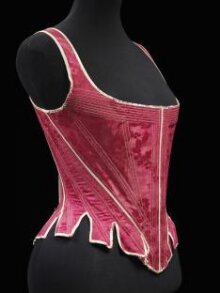
| Physical description | Woman’s stays of crimson silk damask, lined and interlined with linen and reinforced with baleen. They are back-lacing with a high narrow back, a wide, decolletage and a point in front, about 4 inches (10 cm) below the natural waist. The stays are cut in 8 pieces and partially boned in stitched channels about 3/16-inch (4 mm) wide, the baleen extending into the skirts below the waist. There are 7 horizontal boned channels at the neckline and a ⅜-inch (5 mm) wide, boned channel on each side of the centre front. A 3/16-inch (4 mm) wide white silk twill ribbon covers the seams. The neckline, armholes and edges of the skirts are bound with white silk grosgrain ribbon. The stays are laced through 12 eyelets on each side at centre back arranged asymmetrically. The shoulder straps, each with an eyelet, extend from the front and fasten to a pair of eyelets at each back shoulder. |
| Dimensions |
|
| Gallery label |
|
| Credit line | Given by Messrs Harrods Ltd. |
| Summary | In the 18th century, women’s stays served to mould the torso to the fashionable shape and provide a rigid form on which the gown could be arranged and fastened. Because they were underwear and therefore never seen, stays were usually made of plain linen, but this example provides a colourful and luxurious alternative. |
| Collection | |
| Accession number | T.909-1913 |
About this object record
Explore the Collections contains over a million catalogue records, and over half a million images. It is a working database that includes information compiled over the life of the museum. Some of our records may contain offensive and discriminatory language, or reflect outdated ideas, practice and analysis. We are committed to addressing these issues, and to review and update our records accordingly.
You can write to us to suggest improvements to the record.
Suggest feedback
You can write to us to suggest improvements to the record.
Suggest feedback
| Record created | December 15, 1999 |
| Record URL |
Download as: JSONIIIF Manifest
