
Side Hoop
1780 - 1789 (made)
| Artist/Maker | |
| Place of origin |
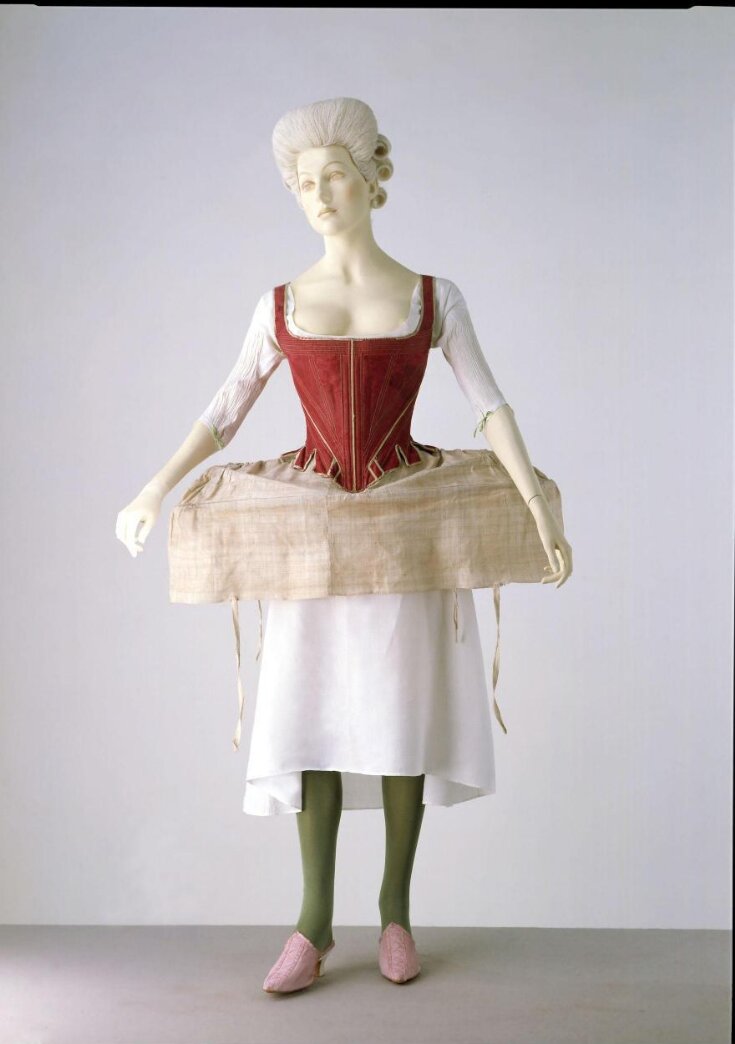
Women's underwear served two purposes in the 18th century. The first function, carried out by the shift or smock, was to protect the clothing from the body, in an age when daily bathing was not customary. Made of very fine linen, the shift was the first garment put on when dressing. Over the shift went the linen stays, heavily reinforced with strips of whalebone. Their purpose was to mould the torso to the fashionable shape and provide a rigid form on which the gown could be arranged and fastened. The hoops were also made of linen and stiffened with whalebone or cane. They shaped the petticoat of the gown to the appropriate silhouette. At various times during the 18th century, this profile varied from round, to square and flat, to fan-shaped.
Object details
| Categories | |
| Object type | |
| Materials and techniques | Linen, silk and baleen (‘whalebone’) |
| Brief description | Side hoop petticoat covered in linen, retailed by A. Schabner, England, 1780s |
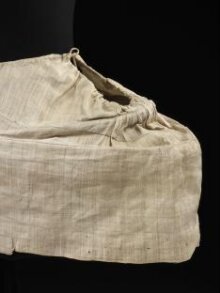
| Physical description | Side hoop petticoat covered in pink striped linen. Reinforced with baleen, and kept in shape with tapes inside. Hand-sewn. |
| Dimensions |
|
| Gallery label | A fashionable woman's underwear
Women's underwear had two functions in the 18th century: hygienic and structural.
The shift formed a hygienic barrier between body and clothing. Few women wore drawers.
Stays and hoops were structural garments, designed to create the fashionable silhouette. Stays, the antecedent of the corset, formed a rigid foundation for the gown. The hoop supported the volume of the petticoat, as the skirt was known in the 18th century.
A Miss Davis ordered this hoop, with a gown and petticoat, from a London robe maker.
Reconstruction of a mid 18th century shift
Hand-sewn linen
Made by Susan North
Stays
Britain, 1780s
Wool, linen or canvas interlining, whalebone (baleen), glazed linen lining
V&A: T.192-1929
Given by the family of the late Mrs Jane Robinson
Hooped petticoat
Andrew Schabner
Britain, London, 1778
Linen and cane
V&A: T.120-1969
From the family of Mrs Deborah Carter, given by Mr and Mrs R.C. Carter
(16/04/2016-12/03/2017) |
| Credit line | Given by Mr and Mrs R. C. Carter |
| Object history | RF number is 1964/1383. Displayed in "Undressed: A Brief History of Underwear", 16 April 2016 to 12 March 2017. According to the original bill it was purchased on 16 February 1778 from A. Schabner Riding Habit and Robe Maker at his Warehouse in Tavistock Street Covent Garden by Miss Davis as a Pink Holland Hoop for 10s 6d. Given to the V&A in 1969, along with T.120A-1969, T.121-1969 and T.122-1969, the gift of Bobby and Deborah Carter [64/1383]. These items were initially lent in 1964, but later were given to the Museum. The family from which they originated were the Hodges of Slowwe House, Arlingham, Gloucestershire. |
| Summary | Women's underwear served two purposes in the 18th century. The first function, carried out by the shift or smock, was to protect the clothing from the body, in an age when daily bathing was not customary. Made of very fine linen, the shift was the first garment put on when dressing. Over the shift went the linen stays, heavily reinforced with strips of whalebone. Their purpose was to mould the torso to the fashionable shape and provide a rigid form on which the gown could be arranged and fastened. The hoops were also made of linen and stiffened with whalebone or cane. They shaped the petticoat of the gown to the appropriate silhouette. At various times during the 18th century, this profile varied from round, to square and flat, to fan-shaped. |
| Associated object | |
| Collection | |
| Accession number | T.120-1969 |
About this object record
Explore the Collections contains over a million catalogue records, and over half a million images. It is a working database that includes information compiled over the life of the museum. Some of our records may contain offensive and discriminatory language, or reflect outdated ideas, practice and analysis. We are committed to addressing these issues, and to review and update our records accordingly.
You can write to us to suggest improvements to the record.
Suggest feedback
You can write to us to suggest improvements to the record.
Suggest feedback
| Record created | December 15, 1999 |
| Record URL |
Download as: JSONIIIF Manifest
