
Dress
ca. 1862 (made)
| Artist/Maker | |
| Place of origin |
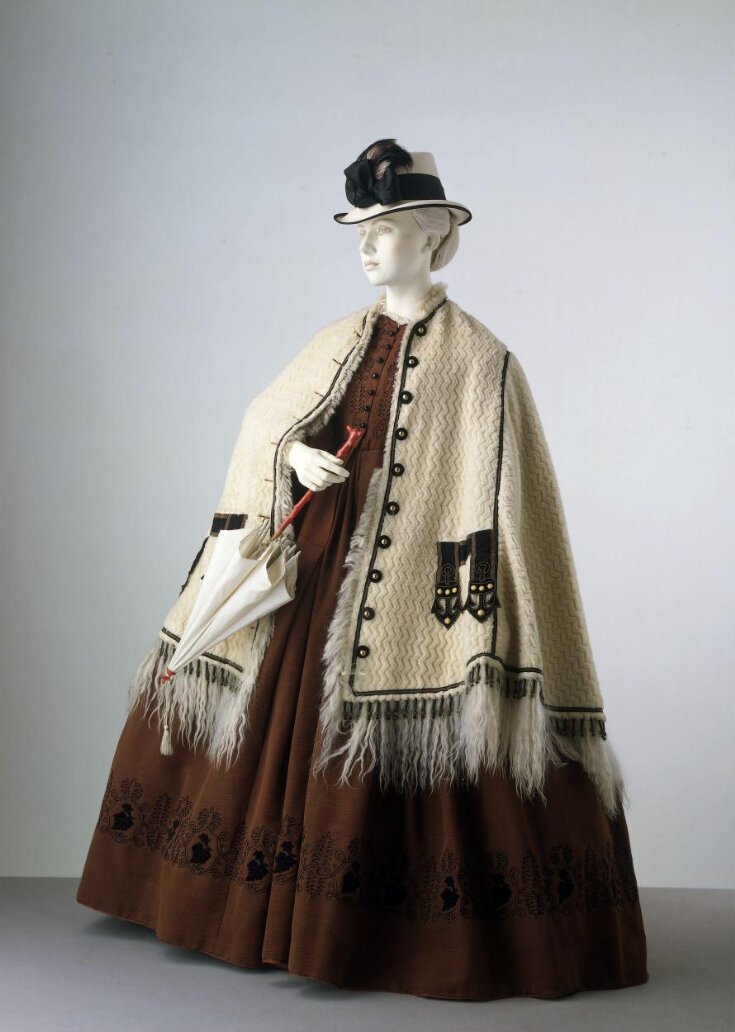
This dress is machine-embroidered, but hand sewn. The first machine for embroidery was invented in France. Examples were first brought to Britain in the 1820s. Machine embroidery developed for men’s waistcoats and women’s dresses throughout the 1840s and 1850s. Various inventions of machines for sewing seams occurred in the 1840s, but they did not become commercially available until the late 1850s. It was several decades before the sewing machine was widely used in homes and by professional dressmakers.
Object details
| Categories | |
| Object type | |
| Materials and techniques | Corded silk trimmed with machine embroidered, lined with glazed cotton, faced with tarleton, reinforced with boning, hand-sewn |
| Brief description | Embroidered corded silk dress, Great Britain, ca. 1862. |
| Physical description | Dress of brown corded silk trimmed with black machine embroidery. It consists of a close-fitting, short-waisted bodice and a full skirt. The bodice has medium-wide long sleeves and a waistband, to which the skirt is attached in deep, double box-pleats. It fastens with black glass stud buttons. It is boned, lined with glazed cotton and faced with tarleton. The epaulettes, cuffs, bodice and skirt border are trimmed with machine embroidery in an interlinked design of leaves and flowers. It is carried out in black chain stitch and velvet appliqué. |
| Credit line | Given by Dr N. Goodman |
| Summary | This dress is machine-embroidered, but hand sewn. The first machine for embroidery was invented in France. Examples were first brought to Britain in the 1820s. Machine embroidery developed for men’s waistcoats and women’s dresses throughout the 1840s and 1850s. Various inventions of machines for sewing seams occurred in the 1840s, but they did not become commercially available until the late 1850s. It was several decades before the sewing machine was widely used in homes and by professional dressmakers. |
| Collection | |
| Accession number | T.22-1973 |
About this object record
Explore the Collections contains over a million catalogue records, and over half a million images. It is a working database that includes information compiled over the life of the museum. Some of our records may contain offensive and discriminatory language, or reflect outdated ideas, practice and analysis. We are committed to addressing these issues, and to review and update our records accordingly.
You can write to us to suggest improvements to the record.
Suggest feedback
You can write to us to suggest improvements to the record.
Suggest feedback
| Record created | December 15, 1999 |
| Record URL |
Download as: JSONIIIF Manifest
