
Evening Dress
ca. 1818 (made)
| Artist/Maker | |
| Place of origin |
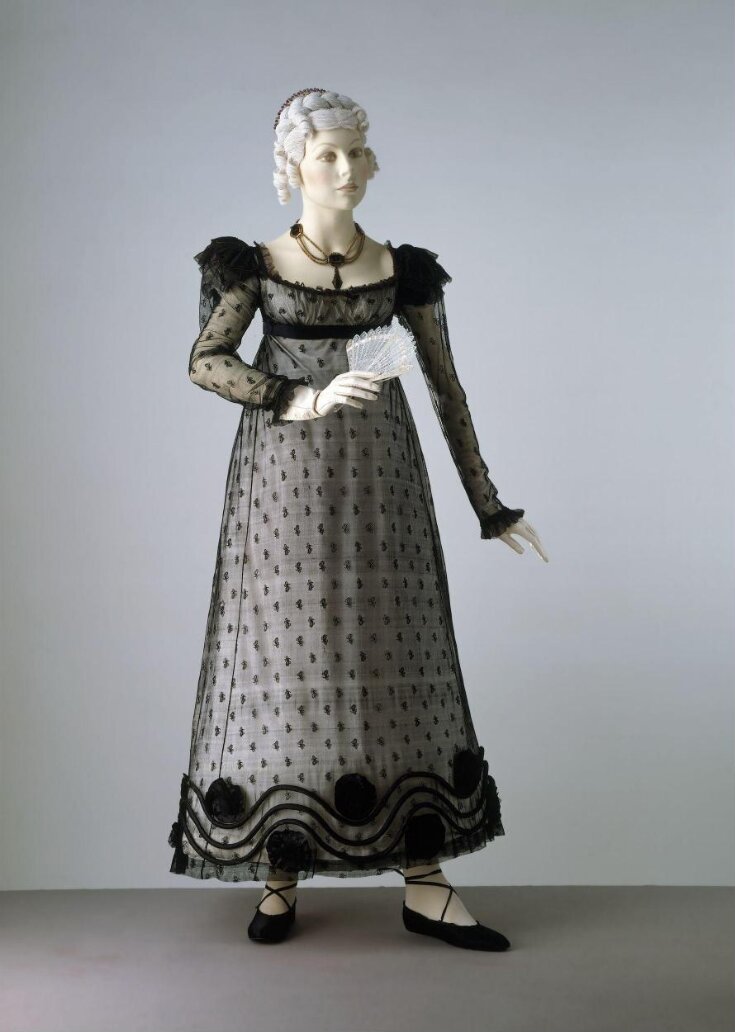
Machine-made net was developed from the late 1760s. It became a popular ground for embroidery and machine-made laces. Its light weight and airy texture suited the simple style of early 19th century women’s dress. This example in black allows for a dramatic contrast when worn over a white under-dress. The applied satin rolls and rosettes at the hem and shoulders were a new decorative trend in women’s dress, which was moving away from the very plain styles of earlier Neo-classical dress. Between 1815 and 1820 the waist was very high, reducing the bodice to narrow strips of fabric at the front and back.
Object details
| Categories | |
| Object type | |
| Materials and techniques | Machine made silk net, embroidered with silk, trimmed with satin decoration, wired epaulettes, hand-sewn |
| Brief description | Evening dress, ca. 1818, English; Embroidered black net with applied decoration |
| Physical description | The dress is trimmed at the hem with padded black satin rouleaux and rosettes. The bodice has a low, square neck and fastens at the back with tapes. It is very short-waisted with slight fullness eased in at the front. The gored skirt is attached smoothly except for a wide panel of tight gathering at the back. The epaulettes are wired and, like the cuffs on the long sleeves, made from satin with an applied cord decoration. |
| Dimensions |
|
| Credit line | Given by Misses H. and M. Hague |
| Summary | Machine-made net was developed from the late 1760s. It became a popular ground for embroidery and machine-made laces. Its light weight and airy texture suited the simple style of early 19th century women’s dress. This example in black allows for a dramatic contrast when worn over a white under-dress. The applied satin rolls and rosettes at the hem and shoulders were a new decorative trend in women’s dress, which was moving away from the very plain styles of earlier Neo-classical dress. Between 1815 and 1820 the waist was very high, reducing the bodice to narrow strips of fabric at the front and back. |
| Collection | |
| Accession number | T.175-1922 |
About this object record
Explore the Collections contains over a million catalogue records, and over half a million images. It is a working database that includes information compiled over the life of the museum. Some of our records may contain offensive and discriminatory language, or reflect outdated ideas, practice and analysis. We are committed to addressing these issues, and to review and update our records accordingly.
You can write to us to suggest improvements to the record.
Suggest feedback
You can write to us to suggest improvements to the record.
Suggest feedback
| Record created | December 15, 1999 |
| Record URL |
Download as: JSONIIIF Manifest
