
Gown
1780-1785 (sewing), 1870 - 1910 (altered)
| Artist/Maker | |
| Place of origin |
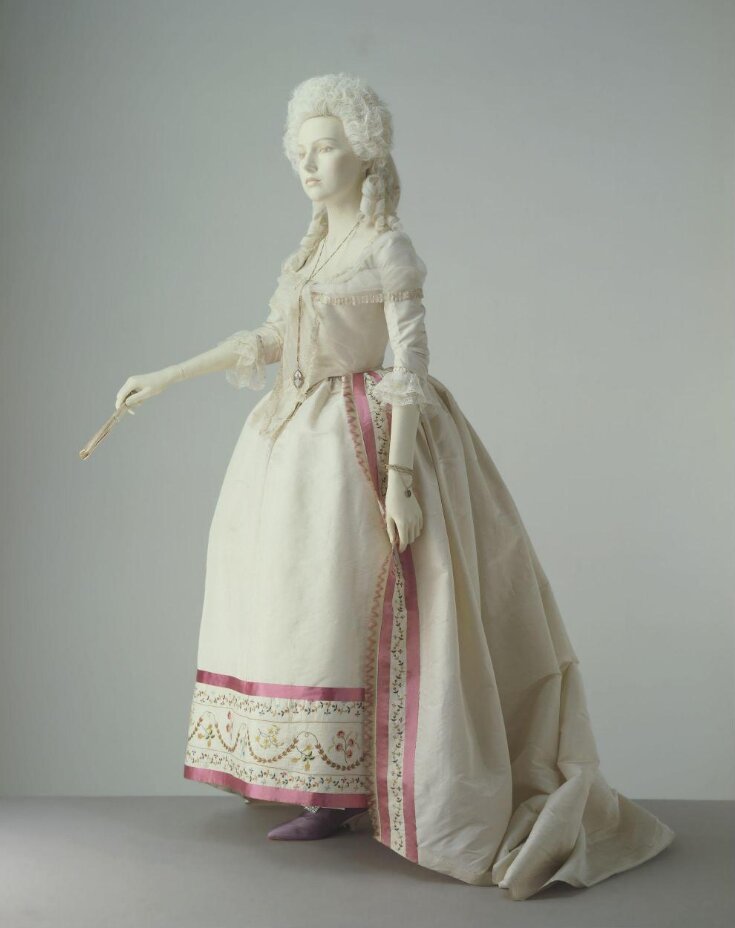
This gown demonstrates the fashionable styles in women’s formal dress of the 1780s. The hoop has changed from the square shape of earlier decades to a round profile. A stomacher is no longer needed, because the gown now meets in the front. The cream silk is adorned only at the edges with an embroidered band, ribbon and a stencilled fringe. This restraint in decoration illustrates the growing influence of the Neo-classical style in textile design.
Object details
| Categories | |
| Object type | |
| Parts | This object consists of 2 parts.
|
| Materials and techniques | Silk, linen, cotton, silk thread, linen thread, whalebone; hand-woven, hand-embroidered, hand-sewn |
| Brief description | A woman's gown and petticoat, 1780s, British; Cream Chinese silk, mauve satin ribbon, applied embroidery on cotton, fringe; altered 1870-1910 |
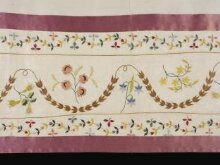
| Physical description | A woman's gown of cream silk, open at the front, with shaped, tucked elbow-length sleeves. The bodice and skirt are cut separately and seamed at the waist. The bodice meets at centre front. The back is made of 2 shaped pieces, tapering to a point at centre back below the waist. The neck is rounded at the back and without a facing band. The bodice fronts and backs are lined with bleached linen, then stitched together. There are boning channels with bones, stitched either side of the centre back seam. Stitching along the neckline of the bodice fronts makes casings for narrow linen tape drawstrings. The skirt is made of 3 widths of silk, with a partial panel on either side of the front. The skirts are finely pleated into the waist seam and held in place with stitching 2 cm below the seam. There are no pocket openings. On the inside of the back fo the skirt are stitched two white silk ribbon loops through which is threaded vertically from the bottom a mauve silk ribbon, for looping up the skirt. The front edges of the skirts are edged with a silk fringe with a plum coloured stencilled zigzag pattern. Running down the fronts of the skirt is a band of glazed white cotton embroidered with a floral trail in coloured silks, bordered on either side with mauve silk ribbon. The petticoat is made of four widths of silk, with pocket openings in the side seams. The petticoat is trimmed all around above the hem, with a broad band of cotton, embroidered with narrow bands of floral embroidery as on the gown, and a wider pattern of floral sprays of poppies, roses and butter cups, and an undulating band formed of brown trefoil leaf shapes. The embroidery is bordered on either side with a broad band of mauve silk ribbon. In the late 19th century, the petticoat was altered for fancy dress. The waist binding was unpicked and a casing sewn into the silk for a drawstring front and back. |
| Dimensions |
|
| Production type | Unique |
| Credit line | Bequeathed by A. M. R. Kenny |
| Summary | This gown demonstrates the fashionable styles in women’s formal dress of the 1780s. The hoop has changed from the square shape of earlier decades to a round profile. A stomacher is no longer needed, because the gown now meets in the front. The cream silk is adorned only at the edges with an embroidered band, ribbon and a stencilled fringe. This restraint in decoration illustrates the growing influence of the Neo-classical style in textile design. |
| Bibliographic reference | Natalie Rothstein (ed.), Four Hundred Years of Fashion (V&A publications, 1984), p. 126
|
| Collection | |
| Accession number | T.98&A-1966 |
About this object record
Explore the Collections contains over a million catalogue records, and over half a million images. It is a working database that includes information compiled over the life of the museum. Some of our records may contain offensive and discriminatory language, or reflect outdated ideas, practice and analysis. We are committed to addressing these issues, and to review and update our records accordingly.
You can write to us to suggest improvements to the record.
Suggest feedback
You can write to us to suggest improvements to the record.
Suggest feedback
| Record created | December 15, 1999 |
| Record URL |
Download as: JSONIIIF Manifest
