Dish
ca. 1450 (made)
| Artist/Maker | |
| Place of origin |
Large basins have been depicted in Italian paintings and manuscripts in scenes of dining and cleansing. Washing hands prior to dining and during the meal itself was a standard custom in 15th century Italy. This dish, or basin, may have been used for washing and then kept on display on a sideboard to show off its fine decoration.
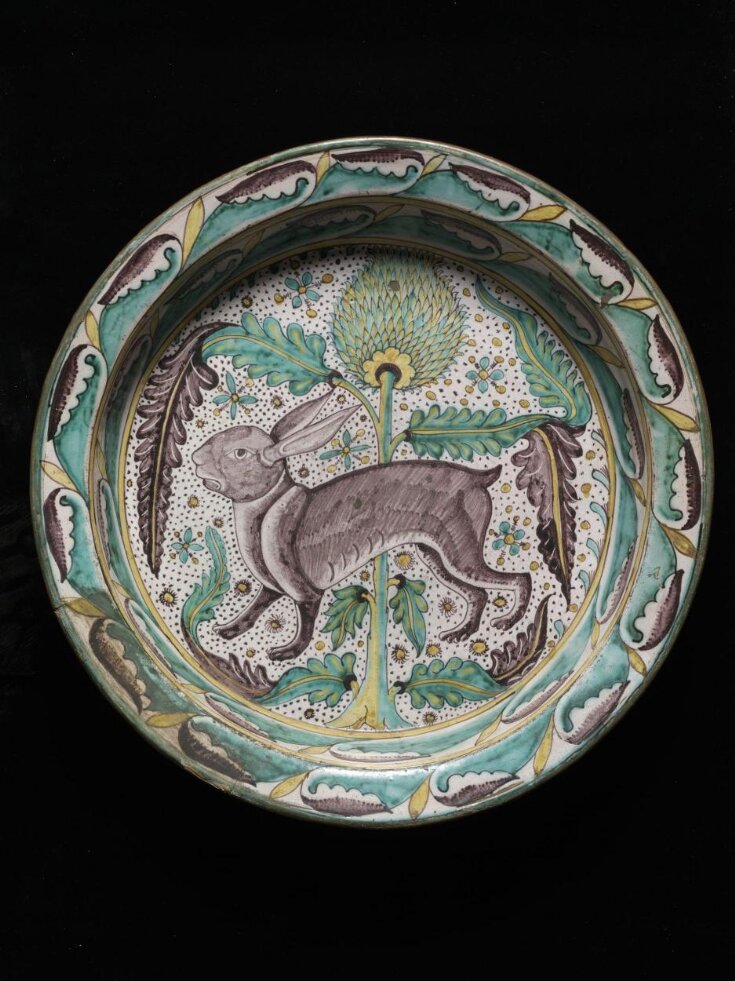
The basin is covered with a tin-opacified glaze which gives a bright white covering on which the design is painted. This type of decorative glazing is known as 'maiolica' in Italy. The image on the basin is a hare standing in front of what apears to be an artichoke. Artichokes may have been cultivated in Italy as early as the 9th century.
This basin was made in the latter part of the 15th century in the Florentine region. Another dish in the Victoria & Albert Museum's collection (Museum no. 2593-1856) is a similar shape and size and has the same decoration on the wide rim as our basin here. It is believed that both dishes were made in the same pottery in Montelupo, just outside Florence.
The basin is covered with a tin-opacified glaze which gives a bright white covering on which the design is painted. This type of decorative glazing is known as 'maiolica' in Italy. The image on the basin is a hare standing in front of what apears to be an artichoke. Artichokes may have been cultivated in Italy as early as the 9th century.
This basin was made in the latter part of the 15th century in the Florentine region. Another dish in the Victoria & Albert Museum's collection (Museum no. 2593-1856) is a similar shape and size and has the same decoration on the wide rim as our basin here. It is believed that both dishes were made in the same pottery in Montelupo, just outside Florence.
Object details
| Category | |
| Object type | |
| Materials and techniques | Tin-glazed earthenware painted in copper, manganese and either antimony or iron |
| Brief description | Dish of tin-glazed earthenware (maiolica) with an image of a rabbit or hare in front of an artichoke thistle. Italian (Florentine region), about 1450 |
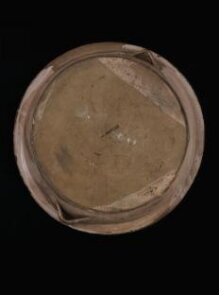
| Physical description | Large deep dish with a broad rim. The earthenware body is covered with a tin glaze. The centre of the dish is painted with an artichoke thistle and leaves which stands vertically and occupies the length of the centre. The background is composed of dots and small flowers. Placed in front of the thistle is the figure of a hare or a rabbit. The rim and the inner rim of the dish is painted with a scroll of stylised leaves. The whole is painted in green, brown and yellow. On the back, a winged cupid holding a branch is painted in manganese on to the unglazed body. |
| Dimensions |
|
| Gallery label |
|
| Production | Probably made in Montelupo, just outside Florence. |
| Subjects depicted | |
| Summary | Large basins have been depicted in Italian paintings and manuscripts in scenes of dining and cleansing. Washing hands prior to dining and during the meal itself was a standard custom in 15th century Italy. This dish, or basin, may have been used for washing and then kept on display on a sideboard to show off its fine decoration. The basin is covered with a tin-opacified glaze which gives a bright white covering on which the design is painted. This type of decorative glazing is known as 'maiolica' in Italy. The image on the basin is a hare standing in front of what apears to be an artichoke. Artichokes may have been cultivated in Italy as early as the 9th century. This basin was made in the latter part of the 15th century in the Florentine region. Another dish in the Victoria & Albert Museum's collection (Museum no. 2593-1856) is a similar shape and size and has the same decoration on the wide rim as our basin here. It is believed that both dishes were made in the same pottery in Montelupo, just outside Florence. |
| Associated objects | |
| Bibliographic references |
|
| Other number | 74 - Rackham (1940) |
| Collection | |
| Accession number | 4901-1858 |
About this object record
Explore the Collections contains over a million catalogue records, and over half a million images. It is a working database that includes information compiled over the life of the museum. Some of our records may contain offensive and discriminatory language, or reflect outdated ideas, practice and analysis. We are committed to addressing these issues, and to review and update our records accordingly.
You can write to us to suggest improvements to the record.
Suggest feedback
You can write to us to suggest improvements to the record.
Suggest feedback
| Record created | July 30, 2007 |
| Record URL |
Download as: JSONIIIF Manifest
