
Supportasse
1595-1615 (made)
| Artist/Maker | |
| Place of origin |
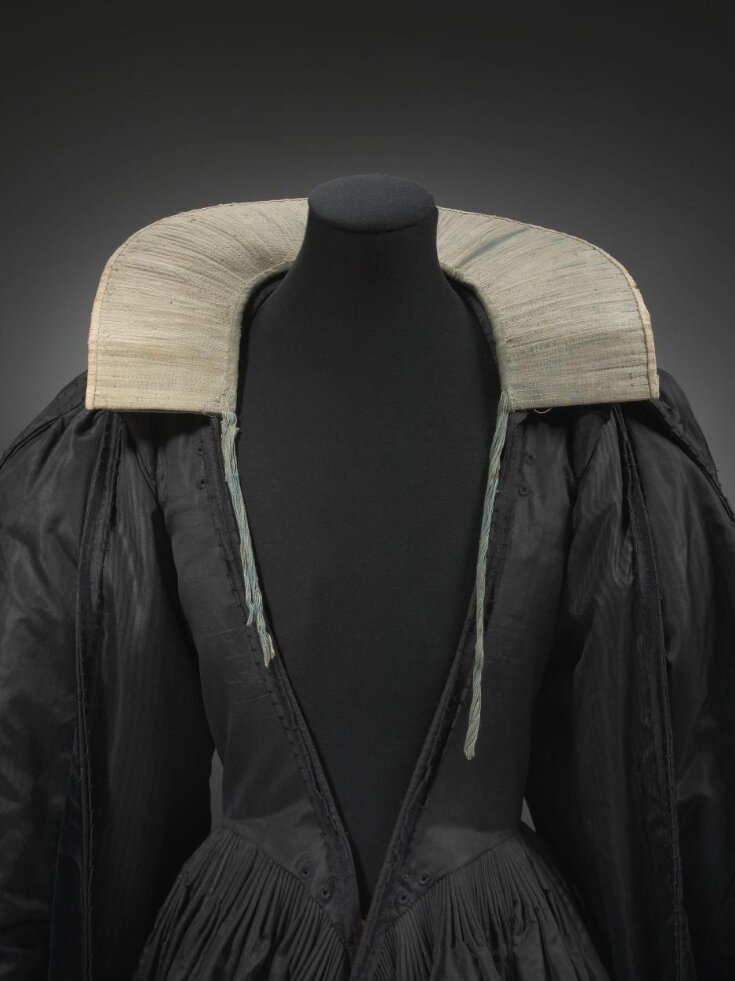
During the early 17th century, formal neckwear such as ruffs and starched collars needed support. Flat collars and the wide circles of gathered linen that made up ruffs had to be held up at the back of the neck in order to frame the face properly. Such supports were called by a range of different names: ‘supportasse’ (a French term), underpropper, pickadil or rebato (an Italian name). A variety of materials were used to make such supports; this example is made of linen reinforced with whalebone, card and wire. A close analysis of this supporter determined that it was once stuffed with straw to create a slightly curved surface. This would have made a linen band worn on top fall gracefully from the neck of the wearer. The supporter is open in front, probably intended for a woman’s low-necked gown or bodice.
Object details
| Categories | |
| Object type | |
| Materials and techniques | Linen, silk, whalebone, card, wire, and linen thread, hand-sewn |
| Brief description | Woman's supporter, 1595-1615, English; blue linen with whalebone and wire |
| Physical description | An open supporter made in two layers. Top layer is two pieces of blue linen stitched and reinforced with baleen radiating from neck to outer edge, which is bound with pale yellow silk grosgrain ribbon. Bottom layer of blue linen is reinforced with card and wire along the outer edge. Both layers attached and bound at neck with a strip of blue linen, with extends at front edges to form ties. |
| Dimensions |
|
| Production type | Unique |
| Object history | Purchased as part of a collection of mainly early 17th century men's garments, from H Fetherstonhaugh Frampton, Esq. for £150 in 1910. According to the registered files, he said they came from a farmhouse at Whaddon Dorsetshire and had been given to his grandmother. |
| Historical context | One of a variety of different types of support for starched ruffs and bands in the late sixteenth and early seventeenth centuries. These were tied or secured to gowns at the neck and the linen neckwear sat on top. |
| Summary | During the early 17th century, formal neckwear such as ruffs and starched collars needed support. Flat collars and the wide circles of gathered linen that made up ruffs had to be held up at the back of the neck in order to frame the face properly. Such supports were called by a range of different names: ‘supportasse’ (a French term), underpropper, pickadil or rebato (an Italian name). A variety of materials were used to make such supports; this example is made of linen reinforced with whalebone, card and wire. A close analysis of this supporter determined that it was once stuffed with straw to create a slightly curved surface. This would have made a linen band worn on top fall gracefully from the neck of the wearer. The supporter is open in front, probably intended for a woman’s low-necked gown or bodice. |
| Bibliographic reference | Costigliolo, Luca, 'Linen Supporter', in North, Susan and Jenny Tiramani, eds, Seventeenth-Century Women’s Dress Patterns, vol.2, London: V&A Publishing, 2012, pp.100-107
|
| Collection | |
| Accession number | T.62-1910 |
About this object record
Explore the Collections contains over a million catalogue records, and over half a million images. It is a working database that includes information compiled over the life of the museum. Some of our records may contain offensive and discriminatory language, or reflect outdated ideas, practice and analysis. We are committed to addressing these issues, and to review and update our records accordingly.
You can write to us to suggest improvements to the record.
Suggest feedback
You can write to us to suggest improvements to the record.
Suggest feedback
| Record created | July 24, 2007 |
| Record URL |
Download as: JSONIIIF Manifest
