
Waistcoat
1730-1739 (made), 1875-1899 (altered)
| Artist/Maker | |
| Place of origin |
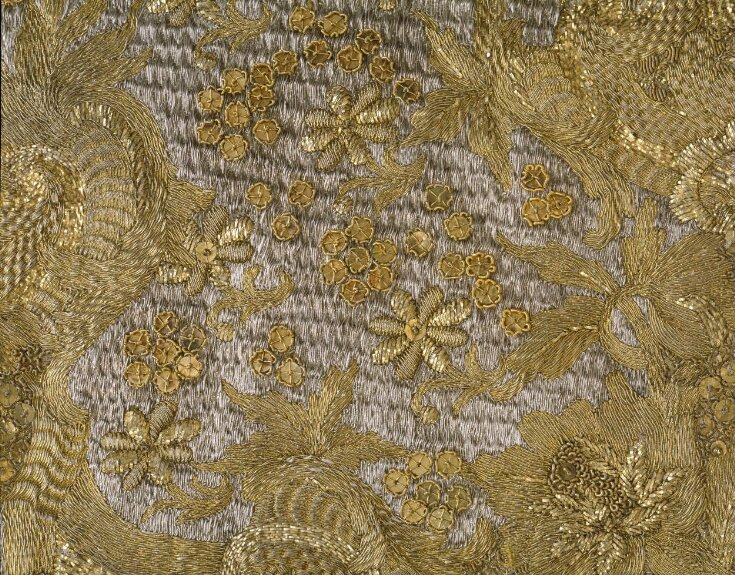
The metal threads of this dazzling waistcoat have been embroidered so densely that not a speck of the white satin fabric underneath can be seen. A pattern of leaves and flowers has been worked in silver-gilt spangles (sequins) and threads in a variety of textures. The ground in between has been embroidered in silver thread. Most of the metal threads are lying on the surface of the waistcoat, held in place by silk threads, in a technique known as couching. By using very fine silks for couching, white for the silver threads and yellow for the silver-gilt, the tiny stitches holding the metal thread in place are cleverly concealed.
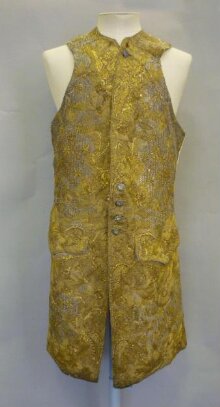
The waistcoat has been cut away at the armholes, probably for fancy dress in the late 19th century.
The waistcoat has been cut away at the armholes, probably for fancy dress in the late 19th century.
Object details
| Categories | |
| Object type | |
| Materials and techniques | Linen, silk, silver and silver-gilt; hand-woven, hand-embroidered, hand-sewn |
| Brief description | Man's linen waistcoat, 1730s, French; linen embroidered all over with silver and silver-gilt threads and spangles, armholes altered 1875-1899 |
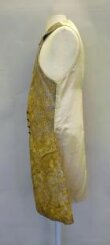
| Physical description | Man’s waistcoat with a round neck, curving fronts, skirts reaching between the knee and middle of the thigh. Each front had a pocket opening and pointed pocket flap. The waistcoat fronts and pocket flaps are made of coarse linen completely covered with embroidery in silver and silver-gilt thread, frisé, strip, purl and spangles in a pattern of large flowers and leaves. The fronts are lined with ivory silk satin, the back with fustian. There are 5 worked buttonholes along the left front, 1 at the neck and 4 at the waist. The waistcoat was extensively altered in the late 19th century, probably for fancy dress. The armholes were cut larger, the back replaced, the sides below the waist stitched closed and the buttons replaced. |
| Dimensions |
|
| Summary | The metal threads of this dazzling waistcoat have been embroidered so densely that not a speck of the white satin fabric underneath can be seen. A pattern of leaves and flowers has been worked in silver-gilt spangles (sequins) and threads in a variety of textures. The ground in between has been embroidered in silver thread. Most of the metal threads are lying on the surface of the waistcoat, held in place by silk threads, in a technique known as couching. By using very fine silks for couching, white for the silver threads and yellow for the silver-gilt, the tiny stitches holding the metal thread in place are cleverly concealed. The waistcoat has been cut away at the armholes, probably for fancy dress in the late 19th century. |
| Bibliographic reference | Avril Hart and Susan North, Historical Fashion in Detail: the 17th and 18th centuries, London: V&A, 1998, p. 158
|
| Collection | |
| Accession number | 408-1882 |
About this object record
Explore the Collections contains over a million catalogue records, and over half a million images. It is a working database that includes information compiled over the life of the museum. Some of our records may contain offensive and discriminatory language, or reflect outdated ideas, practice and analysis. We are committed to addressing these issues, and to review and update our records accordingly.
You can write to us to suggest improvements to the record.
Suggest feedback
You can write to us to suggest improvements to the record.
Suggest feedback
| Record created | July 20, 2007 |
| Record URL |
Download as: JSONIIIF Manifest
